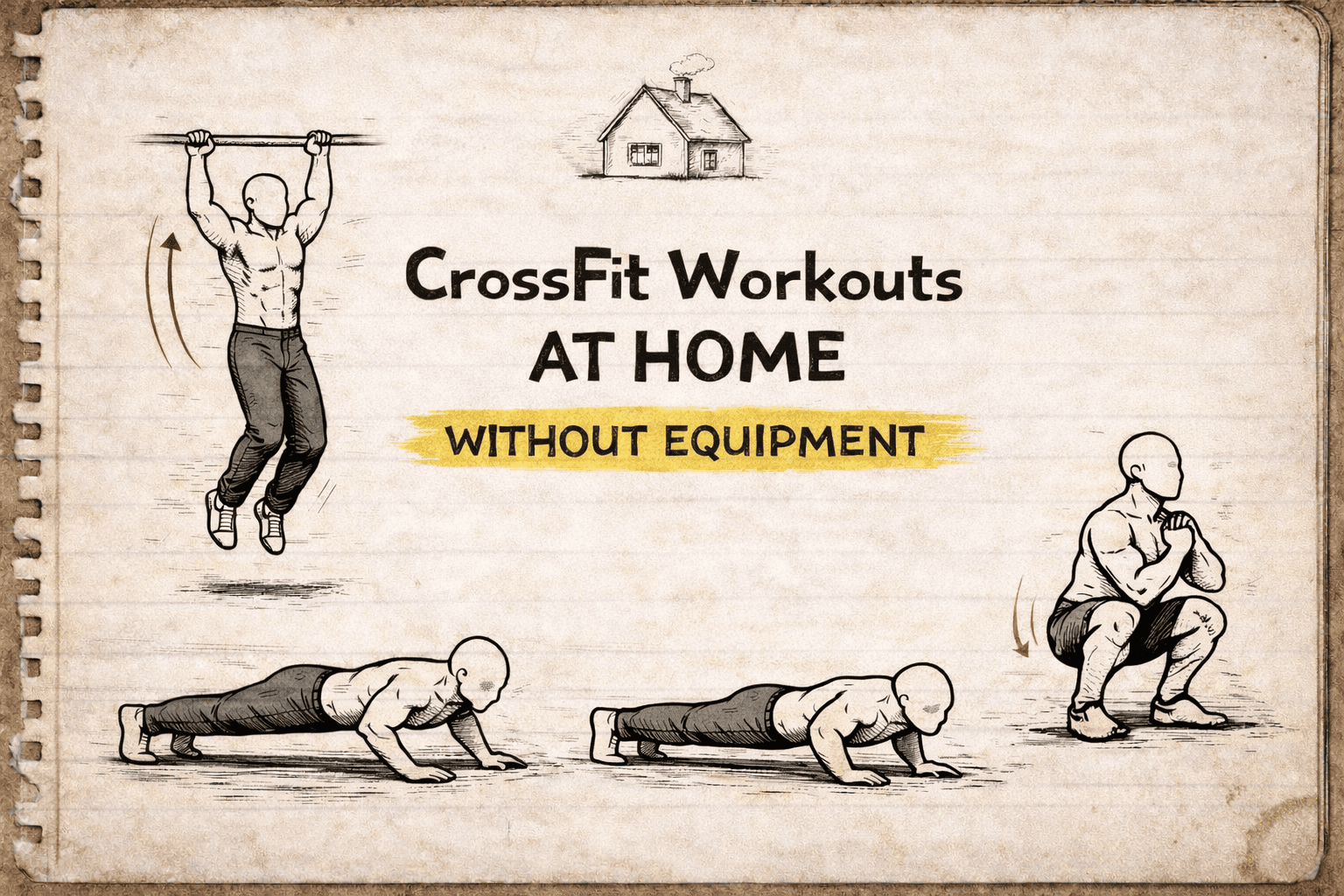
You don’t need a gym membership or a garage full of equipment to train like a CrossFit athlete.
The entire foundation of functional fitness rests on movements your body was designed to perform. Push-ups, squats, burpees, and running built elite conditioning long before branded workouts and specialty barbells existed. The equipment-free approach strips away the noise and forces you to master the fundamentals that actually transfer to real life. You get stronger, more mobile, and significantly harder to break.
CrossFit workouts at home without equipment aren’t a watered-down version of the real thing. They’re a return to the core principles that made CrossFit effective in the first place: constantly varied, high-intensity functional movements. You’re training for work capacity across broad time and modal domains using nothing but your bodyweight, creativity, and willingness to suffer a little.
This guide delivers complete workouts, scaling options, and the tactical knowledge you need to build durable fitness in your living room, backyard, or hotel room.
What Makes a CrossFit Workout Actually CrossFit
CrossFit isn’t just random hard exercises. It’s a specific training methodology built on three pillars: constant variation, functional movements, and high intensity. Strip away the barbells and rowers, and these principles still hold. A true CrossFit workout without equipment should still challenge multiple energy systems, demand full-body coordination, and push you into uncomfortable metabolic zones.
Functional movements are the non-negotiables. These are multi-joint actions that mimic real-world patterns: squatting, jumping, pushing, pulling, running, and carrying. They recruit large muscle groups, generate force from core to extremity, and improve your ability to handle physical demands outside the gym. Air squats build the same movement pattern as a 300-pound back squat. Burpees train the same get-up-off-the-ground explosiveness you’d need in a fight, a fall, or a scramble over rough terrain.
High intensity separates a CrossFit session from a casual workout. You’re moving with purpose, chasing specific time domains, and embracing discomfort. Intensity is relative to your current capacity, but the goal is always the same: maximize power output. That could mean completing a workout as fast as possible, accumulating maximum reps in a fixed time, or maintaining a brutal pace that most people would quit.
Constant variation keeps your body adapting. You’re not running the same 5K every Tuesday or doing the same push-up routine every week. You’re rotating through different rep schemes, time domains, movement combinations, and intensity levels. This prevents plateaus, reduces overuse injuries, and builds a more complete, resilient athlete.
Without equipment, you lean harder into gymnastics, monostructural cardio, and creative combinations. The workouts become cleaner, more scalable, and brutally effective when programmed correctly.
The Core Movements You’ll Use Most
Every no-equipment CrossFit workout pulls from a toolbox of proven bodyweight movements. Master these, and you can build an infinite number of challenging sessions. **
- Air Squats: The foundation of lower-body strength and conditioning. Full range of motion, hips below parallel, weight in the heels. Used in high-rep AMRAPs, EMOMs, and strength progressions like pistol squat work.
- Push-Ups: Upper-body pushing power and core stability. Strict form with chest-to-deck and full lockout at the top. Scale to knees or elevate hands. Progress to deficit push-ups, pseudo planche push-ups, or handstand push-ups against a wall.
- Burpees: Full-body cardio punishment. Chest and thighs hit the ground, jump with full hip extension at the top. The ultimate test of work capacity and mental toughness.
- Sit-Ups: Core conditioning, not bodybuilding. Abmat or towel under the lower back, shoulders touch the ground, hands touch the floor overhead at the bottom. Speed and volume matter here.
- Lunges: Single-leg strength and balance. Forward, reverse, or walking variations. Back knee kisses the ground, front knee tracks over the toes. Great for building unilateral strength and exposing imbalances.
- Jumping: Explosive power. Broad jumps, box jumps (onto a sturdy surface), and tuck jumps all train the same fast-twitch fibers you’d hit with Olympic lifts.
- Running: Pure monostructural cardio. Sprints, middle-distance efforts, and long slow runs all have a place. Running pairs brutally well with bodyweight movements in couplets and triplets.
- Plank Holds and Hollow Holds: Midline stability under tension. These aren’t flashy, but they build the core strength that powers every other movement.
- Mountain Climbers: Cardio, core, and hip flexor endurance rolled into one. Fast and controlled, alternating knees to chest from a plank position.
These movements combine in thousands of ways. A simple couplet of air squats and push-ups becomes a lung-burning grind when you program it correctly. Add running or burpees, and you’ve got a workout that rivals anything you’d find in a fully equipped gym.
Programming Structure: AMRAPs, EMOMs, Chippers, and For Time
How you structure a workout determines what adaptation you’re chasing.
CrossFit uses specific formats to target different energy systems, movement patterns, and mental challenges. Understanding these structures lets you design your own sessions or modify existing workouts to fit your goals.
AMRAP (As Many Rounds as Possible)
Set a timer for a fixed duration, usually 10 to 30 minutes. Complete a prescribed sequence of movements as many times as possible before time expires. AMRAPs reward pacing, consistency, and the ability to keep moving when you’re deep in the hurt. They’re self-scaling: fitter athletes complete more rounds, beginners complete fewer, but everyone works at their own max capacity.
Example: 20-minute AMRAP of 5 pull-ups (or jumping pull-ups), 10 push-ups, 15 air squats. Classic Crossfit benchmark called “Cindy,” perfectly suited for home training when you have a pull-up bar or tree branch.
EMOM (Every Minute on the Minute)
At the start of each minute, complete a set amount of work. Rest for whatever time remains in that minute. Repeat for a predetermined number of rounds. EMOMs force you to maintain output under fatigue and teach efficient movement. They’re also great for skill work, strength progressions, and conditioning in short, repeatable bursts.
Example: 12-minute EMOM alternating between 15 air squats (minute 1, 3, 5, etc.) and 10 burpees (minute 2, 4, 6, etc.). If the work takes 35 seconds, you get 25 seconds of rest. If it takes 50 seconds, you get 10. The workout adjusts to your pace.
For Time
Complete a fixed amount of work as fast as possible. This is pure sprint effort, often used in benchmark workouts. For Time sessions teach you to push through discomfort, manage transitions, and find another gear when your body begs to quit.
Example: 100 burpees for time. Simple, brutal, and scalable. Elite athletes finish in under 6 minutes. Mortals take 12 to 20. Everyone suffers equally relative to their capacity.
Chipper
A long list of movements, each performed once for high reps, completed in order as fast as possible. Chippers test endurance, pacing, and the ability to keep moving through accumulating fatigue. They’re called chippers because you chip away at the work one movement at a time.
Example: For time: 50 air squats, 40 sit-ups, 30 push-ups, 20 lunges (total), 10 burpees. No repeating movements, just one long grind from start to finish.
Each format creates a different stimulus. Rotate through them to build well-rounded fitness, prevent adaptation, and keep workouts mentally fresh.
Ten Proven No-Equipment CrossFit Workouts
These workouts require zero gear and deliver maximum results. Scale reps, rounds, or movements to match your current fitness level. Push hard, move with intention, and track your scores to measure progress over time.
Workout 1: Death by Burpees
Minute 1: 1 burpee. Minute 2: 2 burpees. Minute 3: 3 burpees. Continue adding one burpee per minute until you can no longer complete the required reps within the minute. This workout ends when you fail, and it’s one of the simplest tests of conditioning and mental toughness you’ll find.
Workout 2: The Bodyweight Cindy
20-minute AMRAP: 10 push-ups, 15 air squats, 20 mountain climbers (total). Track total rounds plus any partial rounds. This is a grinding, high-volume session that punishes your shoulders, legs, and lungs in equal measure.
Workout 3: Tabata Something Else
Complete 4 minutes (8 rounds of 20 seconds work / 10 seconds rest) of each movement. Rest 1 minute between movements. Movements: air squats, push-ups, sit-ups, burpees. Score is the total of your lowest rep count from each movement. Tabata intervals are brutal because the rest is too short to recover and the work intervals are long enough to flood your muscles with lactate.
Workout 4: The Dirty Thirty
For time: 30 burpees, 30 sit-ups, 30 air squats, 30 push-ups, 30 lunges (total), 30 jumping jacks. Break up reps however you need, but finish all 30 of each movement before moving to the next. A classic chipper that tests your ability to sustain output across multiple movement patterns.
Workout 5: Seven-Minute Burpee Hell
7-minute AMRAP: 7 burpees, 7 air squats. Simple, short, and soul-crushing. The goal is maximum rounds. If you hit 10 or more rounds, you’re moving with serious efficiency and power.
Workout 6: Running Cindy
5 rounds for time: 400-meter run, 10 push-ups, 15 air squats. This mixes monostructural cardio with bodyweight conditioning. Your legs will be smoked from the runs, making the squats progressively harder. Transitions matter here.
Workout 7: The Burpee Box
For time: 10-9-8-7-6-5-4-3-2-1 burpees and air squats. Start with 10 burpees and 10 air squats, then 9 and 9, dropping by one each round until you finish with 1 and 1. Total reps: 55 of each movement. Fast athletes finish under 8 minutes. Mere mortals take 12 to 15.
Workout 8: EMOM Grind
16-minute EMOM alternating: Minute 1: 20 air squats. Minute 2: 15 push-ups. Minute 3: 20 sit-ups. Minute 4: 10 burpees. Repeat for 4 total rounds. The goal is to maintain consistent rest intervals. If your rest drops below 10 seconds, scale the reps.
Workout 9: The Hotel Room Horror
21-15-9 reps for time: burpees, sit-ups, air squats. Total reps: 45 of each movement across three descending rounds. This is a classic CrossFit structure that works in any space. Faster athletes finish in under 7 minutes. Most people land between 9 and 12.
Workout 10: Long Slow Grind
40-minute AMRAP: 5 burpees, 10 push-ups, 15 air squats, 20 sit-ups. This is an aerobic capacity builder. Pace matters more than speed. The goal is steady, sustainable output for the full 40 minutes. Track total rounds and use this as a benchmark every 8 to 12 weeks.
Scaling Options for All Fitness Levels
Scaling isn’t weakness. It’s intelligent training. The goal is to preserve the intended stimulus of the workout while matching the movements and volume to your current capacity. A beginner doing scaled burpees at high intensity gets more benefit than an advanced athlete doing full burpees at 60 percent effort.
Burpee Scaling
- Step back instead of jump back: Reduces impact and allows better control.
- Elevate hands on a bench or box: Decreases range of motion and makes the push-up easier.
- Remove the push-up entirely: Just step or jump back to plank, then step or jump feet forward and stand.
- Remove the jump at the top: Stand to full extension instead of jumping. Still counts, still effective.
Push-Up Scaling
- Hands elevated on a box, bench, or wall: The higher the hands, the easier the movement.
- Knees on the ground: Maintain a straight line from knees to shoulders. Still lower chest to the floor.
- Reduce range of motion: Use a yoga block or stack of books as a target for your chest. Touch the target, then press back up.
Air Squat Scaling
- Reduce depth: Squat to a box or bench. Sit down fully, then stand. Progressively lower the target height over time.
- Hold onto a post or doorframe: Assisted squats let you work on depth and balance without worrying about falling backward.
- Slow the tempo: 3 seconds down, 1 second up. Builds strength and reinforces good movement patterns.
Volume Scaling
Cut reps by one-third or one-half. If the workout calls for 100 burpees, do 50 or 65. The intensity should still feel challenging. If you finish a scaled workout feeling like you could do another round, you didn’t scale correctly. You undershot.
Time Domain Scaling
Reduce the clock. A 20-minute AMRAP becomes 12 or 15 minutes. A 40-minute session becomes 25. The shorter time keeps intensity high and prevents form breakdown that comes with excessive fatigue.
Every athlete, regardless of experience, should scale at least occasionally. It’s how you stay healthy, learn new skills, and build the engine that supports long-term progress.
Common Mistakes That Kill Progress
Most people fail at home CrossFit workouts not because the programming is bad, but because they ignore fundamentals. Equipment-free training exposes weaknesses quickly. Without the external load of a barbell or the distraction of machines, every flaw in movement quality, pacing, and effort becomes obvious.
Going Too Hard, Too Often
High-intensity work is the point, but intensity every single day leads to burnout, overtraining, and injury. Your central nervous system needs recovery. Your joints need time to adapt. Program 3 to 5 hard sessions per week, and fill the gaps with low-intensity movement like walking, easy running, or mobility work. If you’re constantly sore, irritable, or your performance is dropping week to week, you’re overdoing it.
Ignoring Movement Quality for Speed
Chasing faster times with garbage reps builds bad patterns and sets you up for injury. A half-depth air squat doesn’t count. A push-up where your hips sag and your chest doesn’t touch the ground doesn’t count. If you can’t maintain solid mechanics under fatigue, slow down or scale the movement. Speed is the byproduct of efficiency, not the goal itself.
Skipping Warm-Ups
Jumping straight into a 15-minute AMRAP from a cold start is a great way to tweak a shoulder, pull a hamstring, or just perform like garbage. Spend 5 to 10 minutes raising your heart rate, mobilizing stiff joints, and rehearsing the movements you’re about to load with volume and intensity. A proper warm-up improves performance and reduces injury risk.
No Progression or Tracking
If you’re not recording your workouts, you’re just exercising randomly. Write down your times, rounds, and reps. Track how movements feel. Note when you scale and when you go RX (as prescribed). Progress happens when you have data to compare. Repeat benchmark workouts every 4 to 8 weeks and measure improvement.
Forgetting About Recovery
You don’t get stronger during workouts. You get stronger during recovery. Sleep 7 to 9 hours. Eat enough protein and carbohydrates to support training. Manage stress. Hydrate. Take rest days seriously. The minimalist athlete isn’t the one who trains the most, it’s the one who trains smart and recovers hard.
How to Program Your Week
A solid training week balances intensity, volume, recovery, and skill work. You’re not randomly smashing hard workouts every day. You’re following a structure that builds fitness while keeping you healthy and hungry to train.
Sample 4-Day Training Week
- Monday: High-Intensity Short AMRAP – 12-minute AMRAP of bodyweight movements. Focus on speed and power output. Example: 10 burpees, 15 air squats, 20 mountain climbers.
- Tuesday: Skill and EMOM – Work on a specific skill like handstand holds, pistol squat progressions, or hollow body holds. Follow with a 16-minute EMOM alternating between two movements. Lower intensity, higher technical demand.
- Wednesday: Active Recovery – 30 to 60 minutes of easy movement. Walk, light jog, swim, or mobility flow. No intensity, just movement to promote blood flow and recovery.
- Thursday: Long Grind or Chipper – 25 to 40 minutes of sustained effort. Either a long AMRAP or a chipper-style For Time workout. Aerobic base building mixed with muscular endurance.
- Friday: Rest or Easy Mobility – Full rest or 20 to 30 minutes of stretching, yoga, or foam rolling.
- Saturday: Benchmark Workout – Repeat a workout you’ve done before and track your score. Push hard, measure progress.
- Sunday: Rest or Long Low-Intensity Cardio – Either full rest or a 45 to 90 minute easy effort. Think long hike, easy run, or bike ride. Build aerobic capacity without taxing recovery.
This structure hits all energy systems, allows for skill development, and includes enough recovery to support adaptation. Adjust volume and intensity based on your experience level, but keep the framework intact.
Mobility Work You Can’t Skip
Mobility isn’t a luxury. It’s a requirement for long-term durability and performance. Without equipment, your range of motion directly determines how much force you can generate and how safely you can move under fatigue. Tight hips, stiff shoulders, and limited ankle dorsiflexion turn simple movements into injury risks.
Daily Mobility Minimums
Spend 10 to 15 minutes every day on targeted mobility work. This isn’t static stretching before a workout. It’s intentional, loaded stretching and movement prep designed to improve joint function and tissue quality.
Key Areas to Hit
- Hips: 90/90 stretches, deep squat holds, pigeon pose, and Cossack squats. These open up hip flexors, glutes, and adductors, which directly improve squat depth and running mechanics.
- Shoulders: Wall slides, band pull-aparts (or towel pull-aparts), and doorway pec stretches. Healthy shoulders are non-negotiable for push-ups, handstands, and overhead work.
- Ankles: Ankle rocks against a wall, deep squat holds with heels down, and banded ankle mobilizations. Poor ankle mobility kills squat depth and increases knee injury risk.
- Thoracic Spine: Cat-cow stretches, thread-the-needle, and thoracic extensions over a foam roller or couch cushion. A stiff mid-back forces compensation in the lower back and shoulders.
Mobility work pairs perfectly with rest days or as part of your warm-up. It’s low-intensity, high-value work that pays long-term dividends. Skip it, and you’ll eventually pay in injuries, limited movement capacity, or chronic pain.
Nutrition for Equipment-Free CrossFit Training
You can’t out-train a bad diet. Bodyweight CrossFit workouts create serious metabolic demand, which means your body needs fuel to perform, recover, and adapt. The minimalist approach to training doesn’t mean a minimalist approach to eating.
Protein Is Non-Negotiable
Aim for 0.8 to 1 gram of protein per pound of bodyweight daily. Protein supports muscle repair, immune function, and recovery. Prioritize whole food sources: eggs, chicken, fish, beef, Greek yogurt, cottage cheese, and legumes if you eat plant-based. Spread intake across 3 to 4 meals for optimal muscle protein synthesis.
Carbohydrates Fuel High-Intensity Work
CrossFit-style training runs on glycogen, which comes from carbohydrates. If you’re doing 3 to 5 high-intensity sessions per week, you need carbs to perform and recover. Focus on whole food sources: rice, potatoes, oats, fruit, and vegetables. Time your largest carb meals around training for maximum benefit.
Fats Support Hormones and Recovery
Healthy fats from nuts, seeds, avocados, olive oil, and fatty fish support hormone production, reduce inflammation, and keep you satiated. Don’t fear fat, but don’t overdo it either. Around 20 to 30 percent of total calories is a solid target for most people.
Hydration Matters More Than You Think
Dehydration kills power output, cognitive function, and recovery. Drink water consistently throughout the day, not just during workouts. A simple guideline: half your bodyweight in ounces daily, more if you’re training hard or in hot conditions. Add electrolytes if you’re sweating heavily or training for longer than 60 minutes.
Nutrition doesn’t need to be complicated. Eat real food, prioritize protein and carbs around training, stay hydrated, and don’t under-eat. Consistency beats perfection.
What Success Actually Looks Like
Progress in equipment-free CrossFit isn’t just about faster times. It’s about becoming a more capable, resilient human who can handle physical and mental stress without breaking down.
You’ll Notice Performance Gains
Workouts that destroyed you in month one become manageable by month three. Movements that felt awkward smooth out. You recover faster between rounds. Your breathing stays controlled longer. These are the tangible signs that your engine is growing.
You’ll Move Better in Real Life
Picking up heavy objects, sprinting to catch a bus, playing with your kids, hiking steep terrain, all of it gets easier. The strength, power, and conditioning you build in workouts transfer directly to real-world movement quality.
You’ll Build Mental Toughness
The ability to push through discomfort, manage suffering, and keep moving when your brain screams to quit is a skill. CrossFit workouts teach you to embrace the suck, control your breathing, and stay present under stress. That mental resilience shows up everywhere: work, relationships, and life challenges.
You’ll Stay Healthy Longer
Functional fitness builds durability. You’re training movements that reinforce joint health, balance, coordination, and tissue resilience. You’re less likely to get injured doing normal human activities. You age slower because you’re actively fighting the decline that comes from sedentary living.
Success is measured in decades, not weeks. The goal is to be strong, capable, and pain-free at 50, 60, and beyond. Equipment-free CrossFit training, done correctly, builds exactly that.
You don’t need a gym to build elite fitness. You need a plan, consistency, and the willingness to work hard with nothing but your body and the ground beneath you. The workouts in this guide are battle-tested, scalable, and brutally effective. Program them intelligently, move with intention, and track your progress.
The barbell will always be there if you want it later. But right now, in this moment, you have everything you need to build strength, conditioning, and durability that lasts. Get after it.


ABOUT THE AUTHOR
Carlos Grider is a former U.S. Marine, CrossFit Level 1 trainer, certified personal trainer, and the creator of Forge the Flow. After nearly a decade supporting combat operations and special operations in austere environments — and another decade traveling across 65+ countries as a nomad and adventure athlete — Carlos distilled everything he learned about staying strong, capable, and resilient without a gym into the Forge the Flow training system. He has trekked solo to Everest Base Camp, surfed Bali through the pandemic, trained Muay Thai in Thailand, and run self-guided marathons across four continents — all maintained on minimalist training built for real life. He writes about the fitness methods that actually travel.
Click here to learn more about Carlos's story.