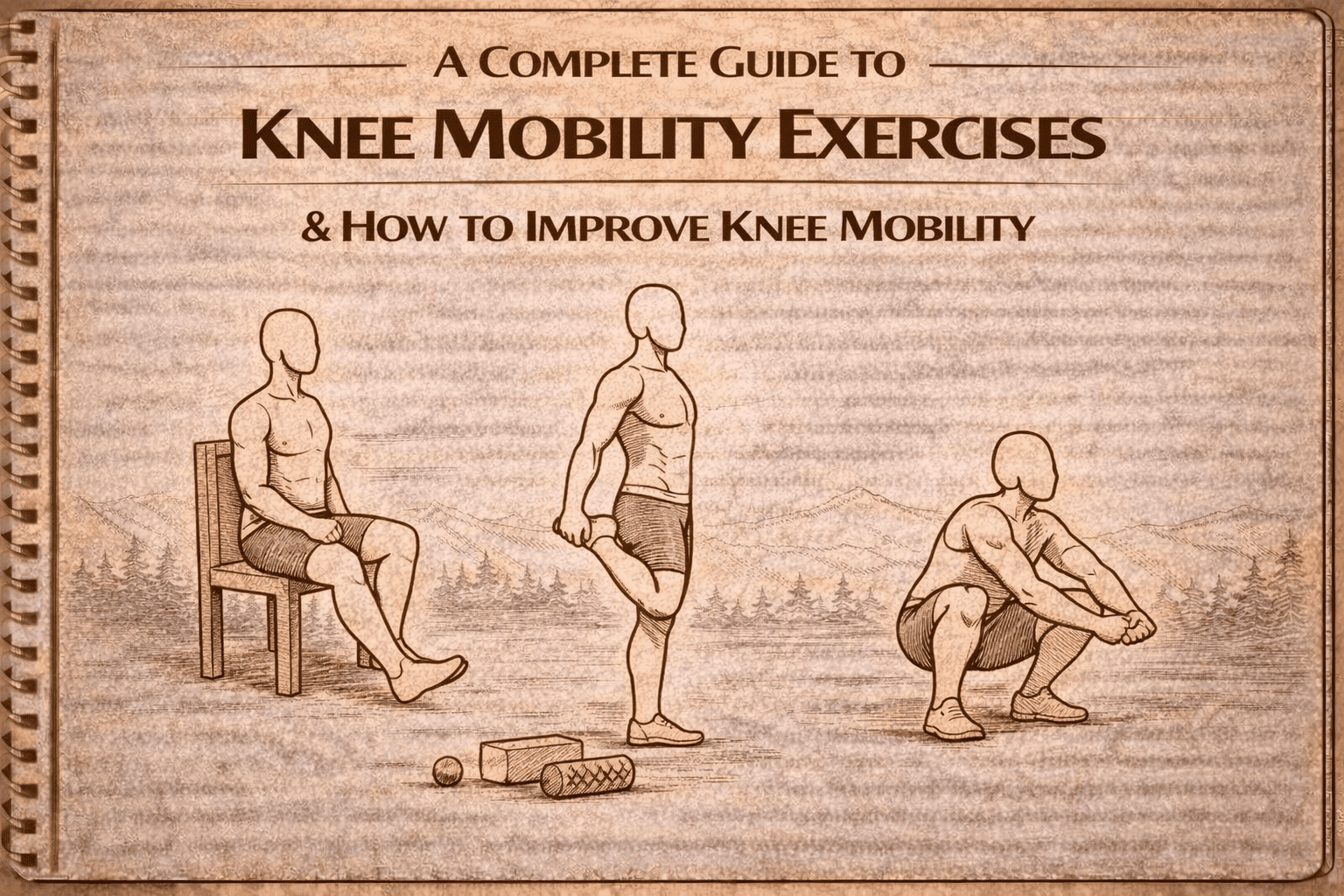
Your knees click when you squat, ache after rucking, and feel stiff every morning you swing your legs out of bed.
You assume it is age, or wear and tear, or just something you have to live with. But the truth is simpler and more fixable than that. Your knees are not the problem. They are the victim. The knee is a slave joint, a hinge that does what the hip above and the ankle below tell it to do. When those two joints lose mobility, your knee compensates, twists, and eventually breaks down. The pain you feel in your patella, the grinding you hear in deep flexion, the lateral ache after a long ruck are all downstream consequences of restrictions you have ignored for years.
This guide will show you how to systematically restore knee mobility by releasing tight muscles, stretching restricted tissues, and building strength through full range of motion. You will learn the exact foam rolling techniques, stretches, and loaded drills that address the true root causes of knee dysfunction. No fluff, no generic advice, just the tested methods used by physiotherapists, strength coaches, and high-level athletes to keep their knees healthy for decades.
If you want knees that move freely, load safely, and last a lifetime, this is where you start.
Table of Contents
Start Here If You Have Knee Pain or a History of Injury
If your knee hurts, clicks with pain, swells after training, or has a history of acute injury like an ACL tear, meniscus damage, or patellar tendinopathy, you need clearance before you start aggressive mobility work. This is not legal coverage or overcaution. It is smart training. Some knee pain is mechanical and responds beautifully to the drills in this guide. Other knee pain is structural, requiring imaging, diagnosis, and sometimes surgical intervention. You cannot foam roll your way out of a torn meniscus, and trying to stretch through a ligament injury can make things significantly worse.
Talk to a physician or physiotherapist first. Get assessed. Rule out structural damage. Once you have clearance, you can confidently apply the protocols here knowing you are working with a knee that can handle load and adaptation, not one that needs medical management.
If you have no pain and no injury history, you are clear to proceed. But if you are reading this because something feels off, take the extra step. Your long-term joint health is worth the appointment.
Understanding the Knee as a Slave Joint
The knee does not have much intrinsic mobility. It is primarily a hinge joint designed to flex and extend in a single plane. It does not rotate well, does not side-bend, and does not like being twisted. Its health is almost entirely dictated by the quality of movement at the hip and the ankle. If your hip lacks internal rotation, your femur compensates by rotating inward at the knee. If your ankle lacks dorsiflexion, your heel lifts early in the squat and your knee dives forward to make up the difference. Both patterns load the knee badly and create the grinding, clicking, and pain that most people assume is just joint wear.
This is the most important concept in the entire guide. Trying to fix knee pain by only working on the knee is like trying to fix a jammed door by oiling the hinges when the real problem is a crooked frame. You can get temporary relief, but the dysfunction returns because the root cause is still upstream.
The protocols in this guide address the knee, the hip, and the ankle as a complete system. You will release the quads, hamstrings, and calves. You will stretch the hip flexors, IT band, and deep hip rotators. You will strengthen the VMO, train knee tracking, and build controlled range through your full squat depth. This is not a knee mobility program. It is a lower body mobility and control program that happens to make your knees feel and move like they did when you were 20.
Release the Muscles Around the Knee With Tissue Work
Before you stretch, before you load, you need to restore sliding quality in the tissues surrounding the knee. Muscles that are tight, adhered, or full of trigger points do not respond well to stretching. They fight back. You pull them into length, they cramp or stay restricted, and you walk away frustrated wondering why nothing changes. Soft tissue work using foam rollers, barbells, lacrosse balls, and compression bands fixes this. It loosens the fascia, breaks up adhesions, and restores the deep tissue glide that makes stretching and strengthening actually effective.
Spend a minimum of two minutes per area. This is not a quick warm-up pass. You are hunting for tight spots, tender zones, and areas that feel stuck. When you find them, stay on them. Apply pressure, breathe through it, and work the tissue the same way a deep tissue massage therapist would, slowly, with intent, aiming for a release.
Quad Smash
Lie face-down with a foam roller under your quads or place a barbell across your thighs while sitting on a bench. Slowly roll from just above the knee to the top of the hip. The vastus lateralis, the outer quad muscle, is especially important for patellar tracking. If your kneecap does not glide smoothly in its groove, this muscle is often the culprit. Spend extra time on the outer quad, apply your body weight, and move slowly. You should feel a deep ache, not sharp pain. If you hit a spot that makes you want to tap out, that is the spot that needs the most work.
IT Band and Lateral Quad Smash
Lie on your side with a foam roller under the lateral thigh, from the hip down to just above the knee. The IT band itself is a tough piece of connective tissue that does not stretch well, but the muscles around it, especially the tensor fasciae latae (TFL) near the hip, do respond to pressure. Use a lacrosse ball on the TFL at the hip bone for pinpoint work. The IT band is one of the top causes of lateral knee pain, and this smash directly addresses it. Roll slowly, pause on tender spots, and do not rush.
Hamstring Smash
Sit on a foam roller or lacrosse ball and work the length of the hamstring from the sit bone to the back of the knee. A barbell across the back of a bench also works well if you want more pressure. Tight hamstrings pull the tibia backward, alter knee mechanics, and contribute to posterior knee pain. The hamstrings cross both the hip and the knee, so releasing them affects both joints. Spend at least two minutes per leg.
Calf and Gastrocnemius Smash
Place a foam roller under your calf or use a barbell across your calves while seated on the floor. Tight calves are one of the most overlooked contributors to knee pain. When the calf is restricted, ankle dorsiflexion is limited, which forces the knee to compensate by diving forward or rotating inward during squats, lunges, and running. Work both the upper calf (gastrocnemius) and the lower calf (soleus). Point and flex your foot while rolling to hit different angles.
Popliteal Fossa Mobilization
The back of the knee, the popliteal fossa, is a sensitive area full of nerves, blood vessels, and soft tissue. Use a lacrosse ball gently, not forcefully, into the back of the knee while seated. Flex and extend the knee slowly while the ball is in place. This helps with posterior capsule tightness and can reduce the sensation of stiffness or pressure behind the knee. Do not force this. Light pressure, slow movement, and controlled breathing are the rules here.
Voodoo Flossing for the Knee
This is one of the most effective tools for knee mobility and deserves its own focus. Voodoo flossing uses a compression band (a thick rubber band) wrapped tightly around the knee joint to compress the tissues, then you move the joint through flexion and extension while wrapped. The compression pushes out excess fluid, increases joint capsule mobility, and restores glide between the layers of tissue that surround the knee. Wrap the band starting just below the knee, overlap it up and around the joint, ending just above the knee. The wrap should be tight, about 50 to 70 percent tension, enough that you feel pressure but not so tight that your foot goes numb.
Once wrapped, perform 15 to 20 knee flexion and extension reps, then hold a deep squat position for 30 seconds. Unwrap the band and move the knee immediately. You will feel a dramatic increase in range and a reduction in stiffness. The blood flow that rushes back in after decompression also helps reduce inflammation. Use this before training or after sitting for long periods. It is one of the fastest ways to restore acute knee mobility.
Tibialis Anterior Smash
The shin muscle, the tibialis anterior, is neglected in most mobility routines. Tightness here limits ankle dorsiflexion and contributes to anterior knee pain by changing how the tibia sits relative to the femur. Use a foam roller or a barbell on the front of your shin while kneeling. Roll from just below the knee down to the ankle. It will be uncomfortable, but that discomfort is a sign you need this work. Tight shins show up as restricted squats, toe walking, and knee pain during running and jumping.
Do this tissue work two to three times per week, or daily if you are coming back from injury or dealing with chronic stiffness. It is not glamorous, but it works.
Stretch the Muscles Around the Knee to Improve Passive Range
After releasing the tissues with foam rolling and soft tissue work, you are ready to stretch. Stretching lengthens the muscles that cross the knee joint, the quads, hamstrings, calves, hip flexors, and deep hip rotators. Healthy knees need healthy range in all of these areas. If your hamstrings are tight, your knee cannot fully extend without compensation. If your quads are short, deep knee flexion becomes impossible. If your calves are restricted, your ankle cannot dorsiflex, and your knee pays the price.
The stretches below target every major muscle group that affects knee health. Hold each stretch for 45 to 60 seconds, breathe deeply, and do not bounce. Stretching is not about forcing range. It is about convincing the nervous system that the new length is safe.
Locked Knee Hamstring Stretch
Extend one leg straight in front of you with the knee locked and the foot blocked at 90 degrees or less (toes pulled back toward your shin). Hinge at the hips, keep your back straight, and lean forward until you feel a deep stretch along the back of the thigh and knee. This stretch hits the hamstrings and the posterior knee capsule. The locked knee position is critical. If you let the knee bend, you lose tension in the hamstring and the stretch becomes ineffective.
Supine Hamstring Stretch With Band
Lie on your back, loop a resistance band or stretching strap over one foot, and pull your knee toward your chest. Once the knee is close to your chest, straighten the leg toward the ceiling while keeping tension on the band. The combination of hip flexion and knee extension creates a deep hamstring stretch without compensatory movement elsewhere. This is one of the safest and most effective hamstring stretches because your lower back stays neutral and supported.
Wall Calf Stretch
Stand a few inches from a wall with your shoes on. Place your heel on the ground and your forefoot flat against the wall. Straighten your posterior chain, stand tall with a straight leg, and lean your hips toward the wall. You will feel a deep stretch in the calf, the Achilles tendon, and the back of the knee. This stretch is critical for ankle dorsiflexion, which directly affects knee mechanics in every squat, lunge, and step. For a variation, bend the knee slightly and lean in again to target the soleus and lower calf.
Standing Quad Stretch
Stand on one leg, grab your opposite foot behind you, and pull your heel toward your glute. Keep your knees together and your pelvis neutral. Do not let your lower back arch. The stretch should be felt along the front of the thigh. If you feel it in your knee joint, ease off. A tight quad pulls on the patellar tendon and increases pressure under the kneecap. Releasing this tension is one of the fastest ways to reduce anterior knee pain.
Hurdler Stretch
Sit on the ground with one leg extended straight and the other bent with the foot tucked near your hip. Lean forward over the extended leg, keeping your back straight. This stretch combines hamstring and hip flexor work. It is old school but effective, especially for athletes who sit a lot or spend long hours in a car or at a desk.
Seiza Position and Vajrasana
Sit back on your ankles in the traditional Japanese seiza position. This stretches the quads, the ankles, and the top of the foot. It is uncomfortable at first, especially if you have tight quads or restricted ankle plantar flexion. Start with 30 seconds and build up over time. For a deeper stretch, lean back while in seiza, placing your hands behind you and lifting your knees slightly off the ground. This is Vajrasana, also called Diamond Pose or Thunderbolt Pose in yoga. It creates an intense quad and hip flexor stretch and is one of the best ways to restore knee flexion range.
Kneeling Hip Flexor Stretch (Couch Stretch)
Kneel with one knee on the ground and the other foot forward in a lunge position. Drive your hips forward until you feel a stretch in the front of the hip. The hip flexors, especially the rectus femoris, cross the knee joint. When they are tight, they increase anterior pelvic tilt and pull on the quad tendon, which loads the kneecap. For an advanced version, elevate your rear foot against a wall or couch while kneeling. This is the couch stretch, one of the most important knee-adjacent stretches you can do. It is brutal, but it works.
IT Band and TFL Stretch
Stand and cross one leg behind the other, then lean your hips to the side away from the rear leg. You can also perform this lying on your side with the top leg crossed over the bottom leg and pressed down toward the floor. IT band tightness is one of the top causes of lateral knee pain. The IT band itself does not stretch well, but the TFL at the hip and the lateral quad do respond. Target those areas with sustained pressure and controlled breathing.
90/90 Stretch
Sit on the ground with one leg in front of you bent at 90 degrees (hip externally rotated) and the other leg behind you also bent at 90 degrees (hip internally rotated). Sit tall and lean forward over the front leg to deepen the stretch. This stretch addresses both internal and external hip rotation, which directly controls how the knee tracks during movement. Poor hip rotation causes the knee to cave inward (valgus collapse) under load, one of the primary injury mechanisms for ACL tears and patellar tracking issues. This is one of the best drills for knee health, even though it does not touch the knee directly.
Pigeon Pose
From a plank position, bring one knee forward and place it on the ground with your shin angled across your body. Extend the opposite leg straight behind you and lower your hips toward the ground. This targets the piriformis and deep external hip rotators. Tight external rotators force compensatory rotation at the knee, especially during single-leg movements like running, jumping, and lunging. Pigeon pose is uncomfortable, but it opens the hips in a way that protects the knee.
Figure-Four Stretch
Lie on your back and cross one ankle over the opposite knee, forming a figure-four shape. Pull the uncrossed leg toward your chest and hold. This stretches the piriformis and glutes, which influence hip stability and knee tracking. Weakness or tightness in the glutes causes the hip to drop and the knee to collapse inward during single-leg loading, a pattern that leads to IT band syndrome, patellar pain, and ACL injuries.
Ankle Dorsiflexion Stretch (Half-Kneeling Wall Stretch)
Kneel on one knee with the opposite foot forward and flat on the ground. Place your forward foot a few inches from a wall, then drive your knee forward trying to touch the wall with your kneecap while keeping your heel down. This is one of the most important stretches for knee health. Limited ankle dorsiflexion forces compensatory movement at the knee, causing the heel to lift early or the knee to collapse medially during squats and walking. If you cannot touch your knee to the wall with your heel down, your ankle is restricting your knee. Fix this and watch your squat depth and knee pain improve almost immediately.
Perform these stretches three to five times per week. If you are rehabbing an injury or dealing with chronic tightness, daily stretching is appropriate. Combine stretching with tissue work for maximum results.
Build Strength and Control Through Full Knee Range
Tissue work releases restrictions. Stretching improves passive range. But mobility without strength is just flexibility, and flexibility without control is a recipe for injury. To build durable, pain-free knees, you need to load the joint through its full range of motion with exercises that strengthen the muscles, train proper tracking, and build proprioception. The drills below do exactly that.
Perform two to three sets of 12 to 15 reps for each exercise. Choose two to four exercises per session, balancing quad-dominant movements with hamstring-dominant movements. The goal is not to annihilate your legs. It is to build controlled, pain-free range that transfers to squats, rucks, running, and life.
Terminal Knee Extension With Band
Anchor a resistance band in front of you at knee height and loop it around the back of your knee. Stand with a slight bend in the knee, then drive the knee back to full extension against the band. This exercise targets the VMO, the vastus medialis oblique, the teardrop-shaped muscle on the inner lower quad. The VMO controls patellar tracking, and weakness here is the number one cause of kneecap pain. Perform two to three sets of 15 to 20 reps with slow, controlled movement. Focus on squeezing the quad at full extension and holding for a one-second pause.
Heel Slides
Lie on your back and slide one heel along the ground toward your glute, bending the knee through its full pain-free range. Then slide it back to full extension. This drill restores basic knee flexion and extension without load. It is often used in early-stage rehab, but it is also valuable for anyone coming back from a layoff or dealing with stiffness. You can progress this by adding a resistance band looped around your ankle, creating resistance as you pull the heel toward your glute.
Eccentric Step-Downs
Stand on a step or box with one foot and let the opposite heel slowly lower toward the ground, controlling the descent with the standing leg. This is the gold-standard eccentric drill for patellar tendon health and VMO control. The eccentric (lowering) phase builds tendon strength and teaches the knee to handle load under control. Perform three sets of 10 to 15 slow reps per leg. If you feel pain under the kneecap, reduce the height of the step and slow down the tempo.
Quadruped Knee Circles (CARs for the Knee)
Get on your hands and knees, lift one knee slightly off the ground, and draw slow, controlled circles with the knee, maximizing range in every direction. This is the knee version of Controlled Articular Rotations (CARs), a joint health drill that builds active range and lubricates the joint capsule. Move slowly and with intention. This is not a cardio drill. It is a nervous system drill that teaches your brain to control every degree of available knee motion.
Deep Squat Hold
Stand with your feet shoulder-width apart, toes slightly out, and lower into the bottom of a squat. Hold this position with a flat back and heels down for 30 to 60 seconds. This is the single most important position for restoring full knee and hip flexion. It is also a diagnostic tool. If you cannot hold a deep squat without your heels lifting, your knees caving in, or your lower back rounding, you have identified your restrictions. Use a post, doorframe, or TRX strap for assistance initially, then work toward a free-standing hold.
Cossack Squat
Stand with a wide stance, shift your weight to one leg, and lower into a lateral squat while keeping the opposite leg straight. Your hips should drop low and your torso should stay upright. This develops knee flexion and extension through a lateral plane and builds hip adductor mobility simultaneously. It is excellent for athletic knee durability and for training the knee to handle multi-directional load. Perform 8 to 12 reps per side with bodyweight, then add a light kettlebell when ready.
Sissy Squat (Carefully Progressed)
Stand with your feet hip-width apart, rise onto your toes, and lean your torso back while bending your knees forward. Your body forms a straight line from your knees to your shoulders as you lower. This forward-leaning knee flexion drill loads the quad through an extremely long range and is one of the most effective exercises for patellar tendon strength. It is also one of the most challenging. Even bodyweight sissy squats are difficult. Start with partial range and progress slowly. If you have a history of patellar tendinopathy, get clearance before adding this exercise.
Single-Leg Balance Progressions
Start with basic single-leg balance for 30 to 60 seconds per leg. Progress by closing your eyes, standing on an unstable surface like a foam pad, or adding movement like a single-leg Romanian deadlift. Knee proprioception, the ability of the joint to sense its position in space, is often lost after injury or with age. Rebuilding proprioception is critical for injury prevention. These drills retrain the nervous system to stabilize the knee automatically, without conscious thought.
Wall Sit
Lean your back against a wall and lower into a squat position with your thighs parallel to the ground. Hold this position for 30 to 90 seconds. This isometric drill builds quad strength in mid-range without movement, making it useful for building pain-free strength when other exercises are too aggravating. Progress by lowering the angle of your squat (deeper position) or adding weight across your thighs.
Banded Knee Tracking Drill
Loop a resistance band around your knees, stand in a quarter squat position, and push your knees out against the band. This trains the hip abductors and external rotators to keep the knees tracking properly. It directly counteracts knee valgus (inward collapse), one of the most common movement faults and a major contributor to knee injuries. Perform two sets of 20 to 30 reps before squatting or lunging.
Perform these exercises two to four times per week. Focus on quality over volume. Every rep should look clean, controlled, and pain-free. If an exercise hurts, reduce the range, reduce the load, or skip it and revisit it in two weeks.
What Different Types of Knee Pain Actually Mean
Not all knee pain is the same. Where you feel pain, when it shows up, and what makes it better or worse are all clues to what is actually going wrong. Understanding the difference helps you choose the right corrective strategy and know when to seek professional help.
Lateral knee pain (pain on the outside of the knee) is almost always IT band syndrome. The IT band rubs against the lateral femoral condyle during repetitive knee flexion and extension, causing inflammation and pain. This shows up during running, rucking, and cycling. The fix is releasing the TFL and lateral quad, stretching the IT band, and strengthening the hip abductors to reduce compensatory tension.
Pain below the kneecap (inferior patellar pain) is usually patellar tendinopathy, also called jumper’s knee. This is a load management issue where the tendon is overloaded relative to its capacity. It shows up during jumping, squatting, and running, especially after high-volume training. The fix is eccentric loading (step-downs, reverse Nordics), reducing training volume temporarily, and improving quad and hip strength.
Pain behind the knee (posterior knee pain) is typically related to the hamstring, popliteal muscle, or posterior capsule tightness. It can also be a Baker’s cyst, a fluid-filled sac that develops in response to joint inflammation. The fix is hamstring smashing and stretching, popliteal fossa mobilization, and addressing underlying joint inflammation. If there is visible swelling, see a doctor.
Pain under the kneecap (retropatellar pain or patellofemoral syndrome) is a tracking issue. The kneecap does not glide smoothly in its groove, causing pain during squatting, stairs, and prolonged sitting. This is the most common type of knee pain and is almost always caused by VMO weakness and hip dysfunction. The fix is terminal knee extensions, step-downs, hip strengthening, and improving ankle dorsiflexion.
If your pain does not fit one of these patterns, or if it is accompanied by swelling, locking, giving way, or sharp catching sensations, you need imaging and a professional diagnosis. Not all knee pain is mechanical, and some issues require more than mobility work.
Clicking, Cracking, and Crepitus in the Knee
Your knee clicks every time you squat. It cracks when you stand up. It grinds when you do lunges. This freaks you out, and you assume something is broken.
Here is the reality. Clicking, cracking, and crepitus (the grinding or popping sensation in a joint) without pain is generally not dangerous. It is often the sound of gas bubbles releasing in the synovial fluid, tendons snapping over bony prominences, or slight roughness in the cartilage surface. These sounds are extremely common and do not predict injury or joint damage.
Pain with clicking is the red flag. If your knee clicks and hurts at the same time, or if the clicking is accompanied by swelling, locking, or instability, that is a sign of structural damage such as a meniscus tear, loose cartilage, or ligament laxity. In that case, see a professional.
If your knee clicks but does not hurt, the best approach is to continue training, improve your mobility with the drills in this guide, and monitor for changes. In many cases, restoring proper movement patterns and joint mechanics reduces or eliminates the clicking over time. Your knee is not broken. It is just noisy.
The Role of the Foot and Ankle in Knee Health
Your knee does not exist in isolation. It sits between the hip and the ankle, and dysfunction in either joint forces the knee to compensate. The ankle, in particular, is massively underrated when it comes to knee pain.
Overpronation, the inward collapse of the foot and ankle during walking and running, causes the tibia to rotate inward. This internal tibial rotation loads the knee badly, increasing stress on the patellar tendon, the IT band, and the medial knee structures. If your feet collapse inward when you walk or squat, your knees are paying the price.
Strengthening the arch and improving foot mechanics is part of the solution. Toe yoga, short foot exercises, and single-leg balance drills all help. Footwear also matters. Minimalist shoes with a wide toe box and zero drop encourage natural foot mechanics. Cushioned, narrow, elevated shoes do the opposite.
Ankle dorsiflexion, the ability to bring your shin forward over your toes while keeping your heel down, is one of the most important mobility markers for knee health. If your ankle cannot dorsiflex, your knee has to dive forward or rotate inward to compensate during squats and lunges. This loads the patellar tendon and increases valgus stress. The half-kneeling wall stretch and calf smashing drills are non-negotiable if you have restricted ankles.
Fix your feet and ankles, and your knees will thank you.
Warm Up Before You Stretch or Load
Stretching a cold muscle is like trying to stretch a rubber band that has been sitting in the freezer. It does not respond well. The muscle fibers are stiff, the fascia is tight, and the synovial fluid in the joint has not reached optimal viscosity. You pull, you feel resistance, and you walk away with minimal improvement and sometimes a strain.
Joint fluid, synovial fluid, needs five to 10 minutes of gentle movement to become adequately lubricating. Walking, cycling, leg swings, and bodyweight squats all work. The goal is to raise tissue temperature, increase blood flow, and signal to the nervous system that movement is coming.
Before you foam roll, before you stretch, and especially before you load the knee with strength exercises, spend five to 10 minutes warming up. This is not optional. It is part of the protocol. Your knees will move better, feel better, and adapt faster when you respect this step.
Using Elevation and Compression for Acute Knee Swelling
If your knee is swollen, puffy, or feels tight after training, elevation and compression are your first tools. Swelling is excess fluid in the joint or surrounding tissues, and it restricts movement, increases pain, and slows recovery.
Elevate your leg above heart level for 15 to 20 minutes. Gravity helps drain the excess fluid back into the circulatory system. Combine this with voodoo flossing, the compression band technique described earlier. Wrap the knee, perform gentle flexion and extension for 10 to 15 reps, then elevate the leg while still wrapped for two to three minutes. Unwrap and move the joint immediately. The compression pushes fluid out, and the movement prevents it from pooling again.
Use this protocol after long rucks, high-volume training days, or any time your knee feels thick and stiff. It is one of the fastest ways to restore acute mobility and reduce inflammation without drugs or ice.
The Three Deep Squat Morning Habit
Here is a simple daily practice that takes 60 seconds and maintains knee health for life. Every morning when you wake up, before coffee, before your phone, do three slow, controlled bodyweight deep squats. Lower to full depth, pause for two seconds, stand up, and repeat.
This habit does three things. It lubricates the knee joint by circulating synovial fluid. It trains the deep squat pattern daily, keeping the movement ingrained in your nervous system. And it gives you immediate feedback on how your body is feeling. If your knees feel stiff, you know you need extra mobility work that day. If they feel smooth, you are good to train hard.
Three deep squats every morning. No equipment, no excuses, just 60 seconds of movement that pays dividends for decades.
Common Mistakes That Sabotage Knee Mobility Progress
You can do all the right drills and still make no progress if you are making these mistakes. Avoid them and your knees will improve faster.
Skipping Tissue Work and Jumping Straight to Stretching
Stretching tight, adhered tissue does not work. You have to release the muscle first with foam rolling or massage. If you skip this step, you are stretching against a locked system and nothing changes.
Stretching for 10 Seconds and Expecting Results
Stretching for 10 or 15 seconds is a warm-up, not a mobility session. You need 45 to 60 seconds per stretch to create actual length changes in the muscle. Anything less is a waste of time.
Only Training the Knee and Ignoring the Hip and Ankle
The knee is a slave joint. If you only work on the knee, you miss the root cause. Always address hip rotation, ankle dorsiflexion, and foot mechanics as part of your knee mobility program.
Loading Pain
Pain is a signal, not a challenge to push through. If an exercise hurts, reduce the range, reduce the load, or skip it. Training through pain does not build toughness. It builds chronic injuries.
Doing Mobility Work Once a Week and Expecting Change
Mobility is a skill and a physical adaptation. It requires consistent practice. Two to four sessions per week is the minimum for progress. Once a week is maintenance at best.
Ignoring Strength Work
Stretching without strengthening creates loose, unstable joints. You need both. Stretch to improve range, then strengthen in that range to make it usable and durable.
How to Program Knee Mobility Into Your Training Week
You do not need a separate knee mobility day. You need a smart integration strategy that fits into your existing training without adding hours to your week.
Option 1: Pre-Training Mobility Primer (10 to 15 Minutes)
Before strength training or hard conditioning, spend 10 to 15 minutes on tissue work and dynamic stretching. Foam roll the quads, IT band, hamstrings, and calves. Perform leg swings, Cossack squats, and deep squat holds. This primes your knees to move well during the session and reduces injury risk.
Option 2: Post-Training Mobility Cooldown (10 to 15 Minutes)
After training, when your muscles are warm and pliable, spend 10 to 15 minutes on static stretching and joint mobility. This is the ideal time to work on hip flexor stretches, hamstring stretches, and ankle mobility. Your body is warm, your nervous system is relaxed, and you will get deeper, longer-lasting changes.
Option 3: Standalone Mobility Sessions (20 to 30 Minutes, Two to Three Times Per Week)
If you have specific knee issues or mobility restrictions, dedicate two to three standalone sessions per week to the full protocol. Tissue work, stretching, and strength in range. Treat it like a training session, not an afterthought.
Option 4: Daily Minimum Effective Dose (Five to 10 Minutes)
Every morning, do three deep squats, two minutes of foam rolling, and two to three stretches. This keeps your knees moving well even on days when you do not have time for a full session.
Choose the option that fits your schedule and stick with it. Consistency beats perfection.
What Success Looks Like
You will know your knee mobility is improving when you can hit a full-depth squat with your heels flat, knees tracking over your toes, and no pain or clicking. You will feel it when you get up from a chair without stiffness, when you can kneel and stand without wincing, and when your knees feel strong and stable during rucks, runs, and heavy lifts.
Success is not just about range of motion. It is about control, strength, and confidence in your knees under load. It is about waking up without stiffness, training without pain, and knowing that your joints are durable enough to last for decades.
You are not chasing flexibility for the sake of flexibility. You are building knees that move well, load safely, and support the active life you want to live.
Your knees are not the problem. They are the victim of restrictions and weaknesses upstream. Fix the hip, fix the ankle, release the tight muscles, build strength through full range, and your knees will move like they did 10 years ago. The protocols in this guide work. Apply them consistently, stay patient, and trust the process.
Healthy knees are not built in a week. They are built in the small, unglamorous sessions you show up for when no one is watching. Roll, stretch, strengthen, and repeat. That is the program.

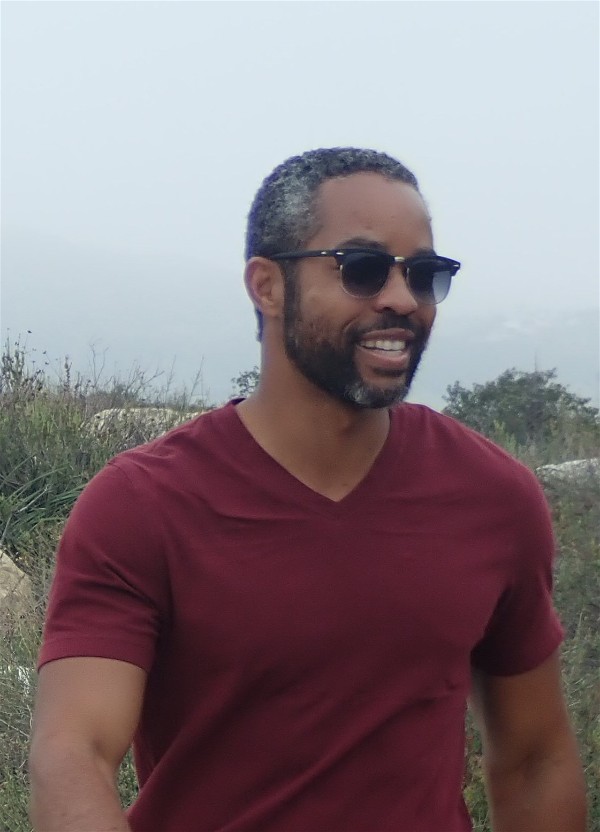
ABOUT THE AUTHOR
Carlos Grider is a former U.S. Marine, CrossFit Level 1 trainer, certified personal trainer, and the creator of Forge the Flow. After nearly a decade supporting combat operations and special operations in austere environments — and another decade traveling across 65+ countries as a nomad and adventure athlete — Carlos distilled everything he learned about staying strong, capable, and resilient without a gym into the Forge the Flow training system. He has trekked solo to Everest Base Camp, surfed Bali through the pandemic, trained Muay Thai in Thailand, and run self-guided marathons across four continents — all maintained on minimalist training built for real life. He writes about the fitness methods that actually travel.
Click here to learn more about Carlos's story.