
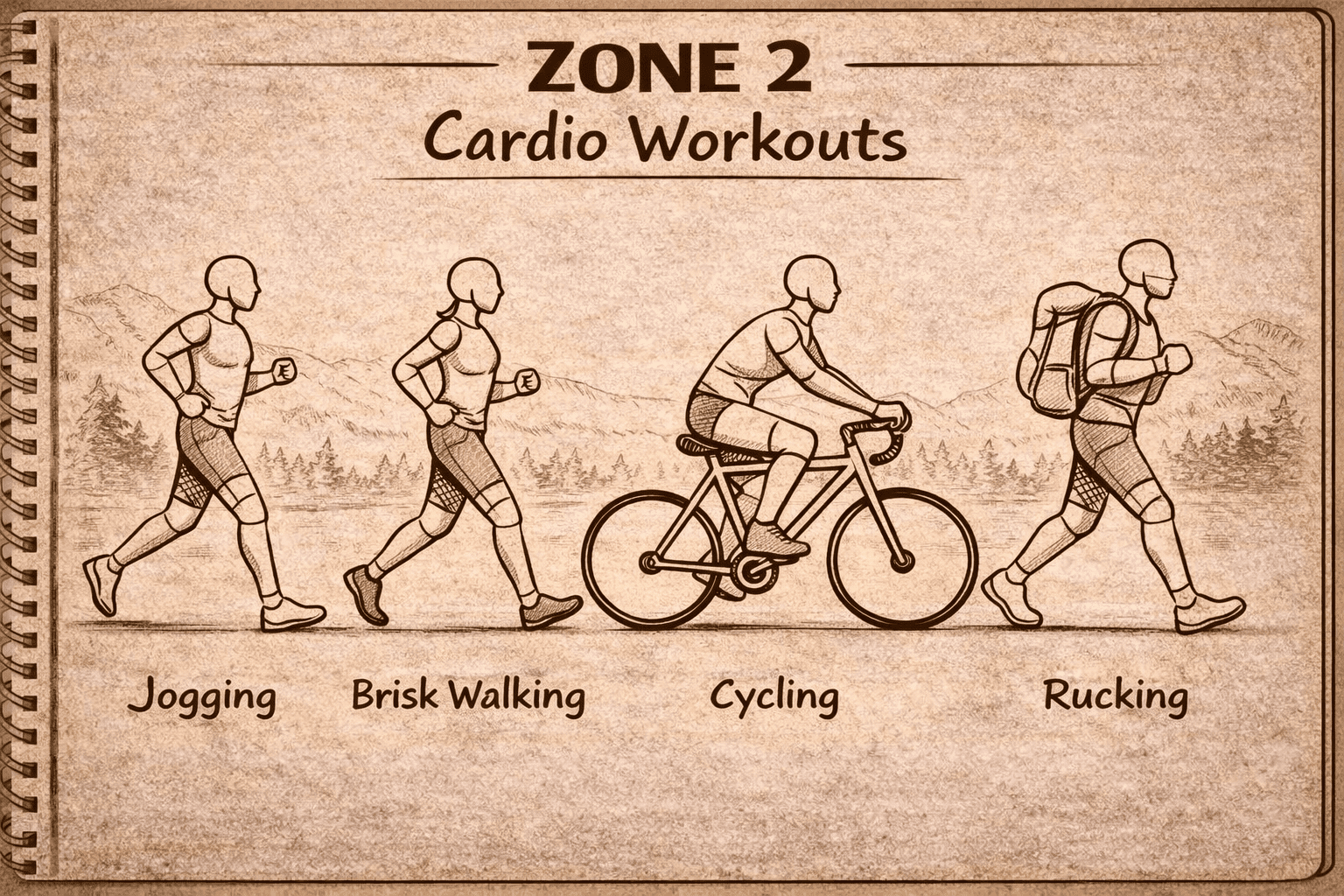
Zone 2 cardio workouts may sound boring, feels slow, and gets mocked by people who think sweating harder equals better results, but they are actually the secret to longevity, peak health, and unlocking fitness gains most gym goers miss.
Here’s what elite endurance athletes and longevity experts know that most gym-goers don’t: training at this specific intensity zone builds your aerobic engine in ways high-intensity intervals can’t replicate. You’re not just burning calories. You’re teaching your mitochondria to produce energy more efficiently, training your body to use fat as fuel, and building the metabolic foundation that supports everything from daily energy to peak athletic performance.
The problem is that most people have never actually done Zone 2 cardio correctly. They either push too hard, turn it into another HIIT session, or dismiss it as too easy to be effective.
This guide breaks down exactly what Zone 2 cardio is, why it works, how to find your personal Zone 2 heart rate, and the most effective workouts you can do anywhere.
Table of Contents
What Zone 2 Cardio Workouts actually are
Zone 2 cardio isn’t defined by the exercise you choose but by the intensity at which you perform it.
It’s the sweet spot where your body shifts from relying primarily on glucose to burning fat as its main fuel source. At this intensity, you’re working hard enough to trigger cardiovascular adaptations but staying below the threshold where lactate begins accumulating faster than your body can clear it. This is the zone where you build mitochondrial density, improve oxygen utilization, and develop true aerobic capacity.
The technical definition of a Zone 2 Cardio Workout
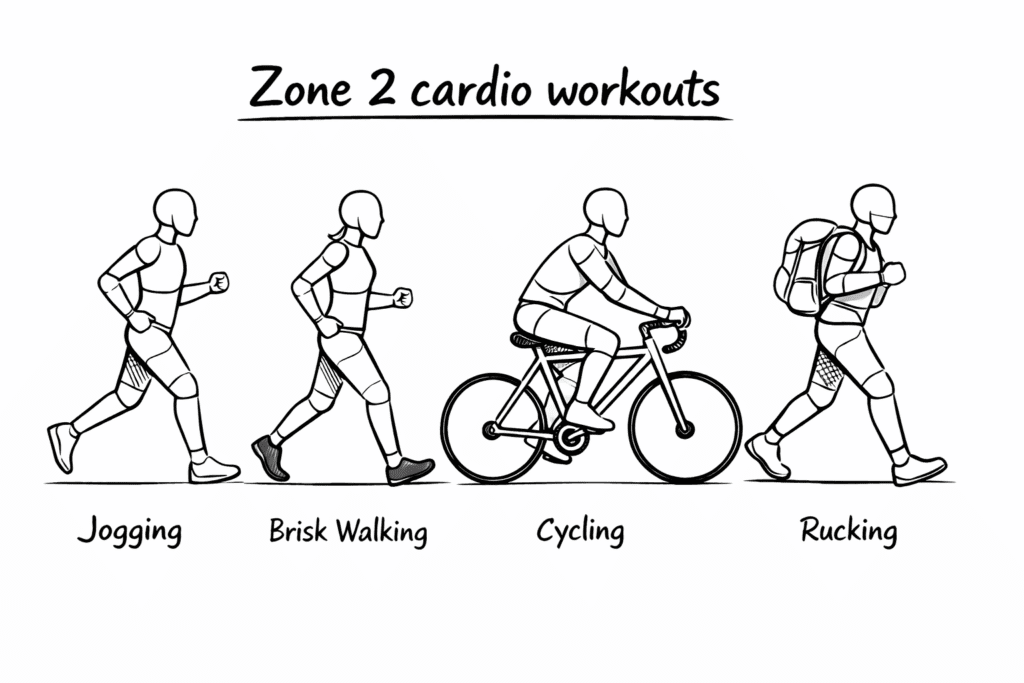
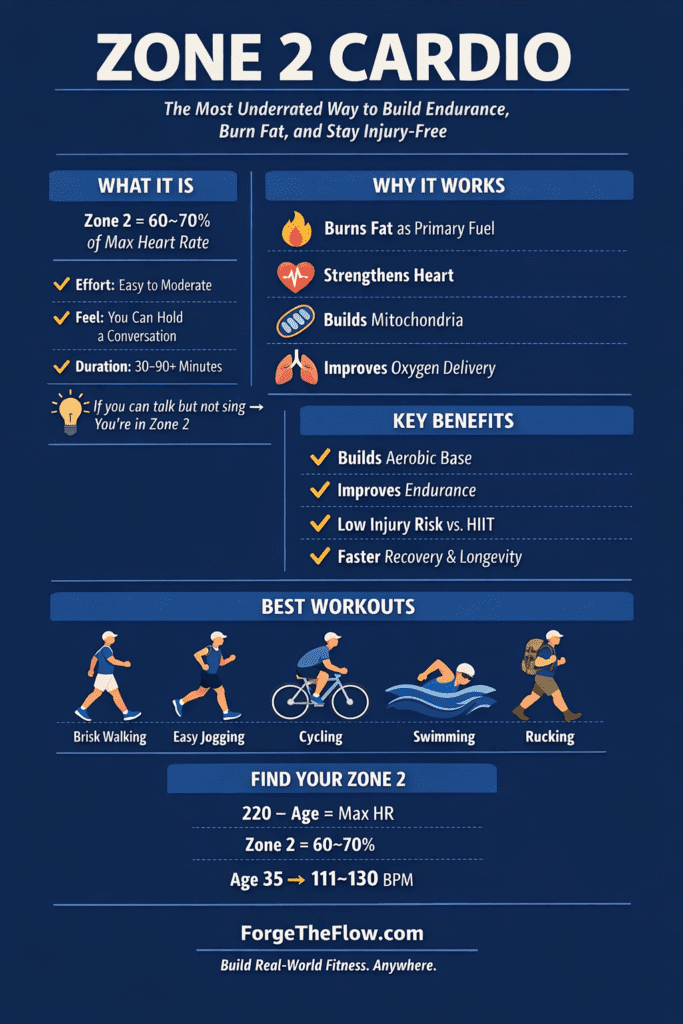
Zone 2 is typically 60-70% of your maximum heart rate, or the intensity where you can still hold a conversation but wouldn’t want to give a speech. If you’re using a talk test, you should be able to speak in full sentences but feel slightly breathless. If you can sing comfortably, you’re too low. If you can only grunt out a few words, you’ve pushed into Zone 3 or higher.
Most people completely skip this zone. They either cruise below it during “easy” workouts or blast past it chasing the burn of harder training. That’s why they miss out on the metabolic adaptations that make Zone 2 so valuable.
When done consistently, Zone 2 training rewires your metabolism at the cellular level. You’re not just getting fitter in a general sense. You’re specifically enhancing your body’s ability to generate energy efficiently, which pays dividends whether you’re running a marathon or just trying to maintain steady energy throughout your day.
Why Zone 2 Cardio Delivers Results Other Training Can’t
Training harder feels more productive, but Zone 2 work triggers specific physiological changes that intensity alone can’t deliver.
The primary benefit is mitochondrial adaptation. Your mitochondria are the power plants inside your cells, and Zone 2 training increases both their number and efficiency. More mitochondria means more capacity to produce energy aerobically, which translates to better endurance, faster recovery, and improved metabolic health. This adaptation doesn’t happen when you’re constantly redlining your heart rate.
Here’s what happens inside your body during Zone 2 training:
- Fat oxidation increases as your body learns to preferentially use fat stores for fuel instead of relying on limited glycogen reserves
- Capillary density improves around muscle fibers, enhancing oxygen delivery and waste removal during all types of exercise
- Lactate clearance gets more efficient, which means you can sustain higher intensities for longer before fatigue sets in
- Heart stroke volume expands, allowing your heart to pump more blood per beat and work more efficiently at rest and during exercise
- Metabolic flexibility develops, giving you the ability to switch between fuel sources based on availability and demand
These aren’t just athletic benefits. Research shows Zone 2 training improves insulin sensitivity, reduces inflammation, and supports longevity markers better than high-intensity training alone. It’s foundational work that makes everything else you do physically easier and more effective.
The catch is that these adaptations take time. You won’t feel dramatically different after one Zone 2 session. But after six to eight weeks of consistent training, you’ll notice you can maintain faster paces at the same heart rate, recover more quickly between hard efforts, and sustain energy levels that used to require constant fueling.
Zone 2 Cardio compared to other zones
|
Zone |
% of Heart Rate Max |
Intensity Level |
Purpose |
|---|---|---|---|
|
Zone 1 |
50% – 60% |
Very Light (Warm-up/Recovery) – Easy pace, rhythmic breathing, |
Great for burning fat |
|
Zone 2 |
60% – 70% |
Light/Aerobic (Base Building) |
Builds endurance |
|
Zone 3 |
70% – 80% |
Moderate/Tempo (Aerobic Endurance) |
Builds muscle and bone |
|
Zone 4 |
80% – 90% |
Hard (Lactate Threshold) |
Improves speed and power |
|
Zone 5 |
90% – 100% |
Maximum (Anaerobic/Peak) |
High intensity |
Zone 2 cardio is a sweet spot of cardiovascular training, as we discussed. But how does it compare to the other zones?
Zone 1 cardio is just a touch above resting, while still being active. Walking and small chores lie in zone 1. While there isn’t as much cardiovascular benefit as we need, these daily activities burn fat and are part of a healthy lifestyle.
Zone 3 cardio notches up intensity a bit. More intense swimming, rowing, cycling, hiking with a solid pace and on inclines, and gym machines (elliptical and stair stepper) push into Zone 3.
Zone 4 cardio pushes intensity to a point that can be sustained only for 30 to 60 minutes in a workout, and commonly occurs in intervals of 3 to 20 minutes with breaks. Activities such as cycling uphill, running fast or sprinting, boxing or martial arts, and intense hiking (uphill and with weight)
Zone 5 cardio is very intensity and emphasizes strength, speed, and explosive power in activities such as sprinting, powerlifting, box jumps, plyometrics in activities that are limited to minutes or seconds.
How to Find Your Personal Zone 2 Heart Rate
Generic heart rate zones based on age formulas are notoriously inaccurate because individual fitness levels and genetics vary wildly.
The most reliable method for finding your true Zone 2 is lactate testing in a lab, where technicians measure blood lactate levels at increasing intensities to identify the exact heart rate where lactate begins accumulating. But that’s not practical for most people, and there are solid alternatives that get you close enough to reap the benefits.
Method 1: The Talk Test
This is the simplest and surprisingly accurate approach. Start your cardio activity and gradually increase intensity until you reach a pace where you can speak in complete sentences but feel like you’re working. You shouldn’t be able to ramble effortlessly, but you could answer questions or have a conversation if needed. Once you find this intensity, note your heart rate. That’s your Zone 2 baseline.
Method 2: Percentage of Maximum Heart Rate
Calculate your estimated maximum heart rate using 220 minus your age, then multiply by 0.60 and 0.70 to get your Zone 2 range. For a 40-year-old, that’s 180 max HR, putting Zone 2 between 108-126 bpm. This method is less accurate than testing, but it gives you a starting point to refine through feel and the talk test.
Method 3: Heart Rate Variability and Breath Rate
Some athletes use nasal breathing as a Zone 2 indicator. If you can breathe only through your nose while maintaining a steady pace, you’re likely in Zone 2 or below. The moment you need to open your mouth to breathe, you’ve probably crossed into Zone 3. This works well for running and cycling but is harder to apply to some other activities.
Test these methods, track how you feel, and adjust based on results. Your Zone 2 heart rate will also change as your fitness improves, so retest every few months. What feels easy at 130 bpm now might require 140 bpm after eight weeks of consistent training.
9 Specialized Zone 2 Cardio Workouts for every workout and gym scenario
Beyond traditional cardio methods, these nine specialized approaches offer unique ways to hit Zone 2 intensity while adding variety to your training routine.
Each method requires specific attention to pacing and form to maintain the steady-state intensity that defines Zone 2 work. The advantage of these options is they often feel less monotonous than standard cardio while delivering identical metabolic benefits.
The 7x Circuit
The 7x circuit is a bodyweight movement sequence performed continuously for time.
Choose seven exercises that target different muscle groups:
- Squats
- push-ups
- lunges
- plank holds
- glute bridges
- mountain climbers
- standing knee raises
Perform each exercise for 45-60 seconds at a controlled tempo that keeps your heart rate in Zone 2 without spiking into Zone 3.
The key is moving deliberately through each exercise without rushing. Complete the full seven-exercise circuit, then immediately repeat without rest.
Most people will need to perform exercises at roughly 50-60% of their maximum possible speed to stay in Zone 2. Throughout the workout, monitor your heart rate after each full circuit and adjust tempo on the next round. A 45-60 minute session typically yields 5-7 complete circuits.
Box or Bench Step-Ups
Step-ups transform a simple box or bench into an effective Zone 2 cardio tool when performed with proper pacing.
To do this zone 2 workout, use a box height between 12-20 inches depending on your leg length and fitness level.
Step up with your right foot, bring your left foot up to meet it, step down with your right foot, then bring your left foot down, and that’s one rep on the right side.
Perform 10-15 reps leading with the right leg, then switch to leading with the left leg for 10-15 reps. The tempo should be steady and controlled, roughly one complete step-up every 3-4 seconds. Rushing the movement will spike your heart rate into Zone 3 or higher.
If bodyweight step-ups don’t elevate your heart rate sufficiently, add a light weighted vest (10-20 pounds).
Maintain this alternating pattern for 45-75 minutes, checking your heart rate every 5-10 minutes. The repetitive nature makes it easy to find and hold the right intensity, and the lower impact compared to running makes this sustainable for extended sessions.
Ruck Walking (with 10% of Bodyweight)
Rucking is the act of adding weighted resistance to walking, making it slightly my strenuous and easier to reach Zone 2 intensity at slower speeds.
To ruck
- Load a backpack or rucking-specific pack with weight equal to 10% of your bodyweight. For a 180-pound person, that’s 18 pounds. Distribute the weight evenly and wear the pack high on your back, snug against your shoulders.
- Walk at a pace between 3.0-3.5 mph on flat terrain or 2.5-3.0 mph on inclines. The added weight elevates heart rate compared to unweighted walking while keeping impact stress lower than jogging.
- Maintain upright posture throughout, engaging your core to support the load.
- Start with 45-minute sessions and build toward 90-120 minutes as your capacity improves.
Ruck walking works exceptionally well for people whose Zone 2 heart rate is too high for comfortable walking but whose joints don’t tolerate sustained jogging. The added resistance bridges that gap perfectly. Track your heart rate continuously and adjust pace rather than adding more weight if you drift out of zone.
Stair Stepping
Stair stepping using actual stairs rather than a machine offers natural Zone 2 training with built-in variety.
To stairstep:
- Find a staircase with at least 3-4 flights.
- Climb the stairs at a controlled pace that keeps your heart rate in Zone 2, then walk down slowly for partial recovery without letting your heart rate drop below the zone.
- Take one step every 1-2 seconds rather than bounding up quickly. If you’re breathing too hard to maintain nasal breathing or pass the talk test, you’re climbing too fast.
- Count your flights and track total elevation gain for future sessions. The constant elevation change provides excellent cardiovascular stimulus while the descent phases prevent muscular failure that would cut the session short.
The key is finding the right climbing speed—most people need to climb considerably slower than their instinct suggests. A typical Zone 2 stair stepping session involves 45-60 minutes of continuous up-and-down cycles.
This method works particularly well in office buildings, parking garages, or stadium stairs where you have consistent, accessible stairs available.
Lateral Step-Overs (Over a Line)
Lateral step-overs use side-to-side movement to create Zone 2 intensity through continuous motion.
To make lateral Step-Overs a one 2 cardio workout:
- Place a line on the ground using tape, a rope, or simply use a crack or line in the pavement. Stand with feet together on one side of the line.
- Step laterally over the line with your right foot, then bring your left foot over to meet it.
- Immediately step back over the line with your left foot leading, then bring your right foot back.
- Continue this lateral stepping pattern at a steady rhythm.
- Keep your core engaged and maintain slight knee bend throughout. The lateral motion pattern recruits different muscles than forward movement while providing steady cardiovascular demand.
The movement should be continuous but controlled, roughly 30-40 complete back-and-forth cycles per minute.
Most people find this easier on the knees than running while still achieving Zone 2 intensity. Perform for 45-60 minutes, monitoring heart rate every 5 minutes. If heart rate climbs too high, slow your stepping rhythm. If your heart rate drops too low, slightly increase tempo or add a small knee drive at the top of each step-over.
This approach to getting in a zone 2 workout is great because it requires minimal space and zero equipment, making it ideal for home workouts.
Shadow Boxing
Shadow boxing is a great way to get in a Zone 2 cardio workout through continuous, flowing striking movements without the impact of heavy bag work.
To Shadow Box your way through a zone 2 workout:
- Stand in a fighting stance and throw controlled punches—jabs, crosses, hooks, and uppercuts—in continuous combinations.
- Move around your training space with light footwork, circling and stepping as you punch.
- Throw 3-6 punch combinations in flowing sequences, maintaining constant arm movement for 2-3 minute rounds.
- Rest for 30-45 seconds between rounds, just long enough to grab water but not long enough for heart rate to drop significantly.
The key to keeping this in Zone 2 is resisting the urge to throw explosive, powerful strikes. Instead, focus on volume and continuous movement at 60-70% intensity.
A typical Zone 2 shadow boxing session includes 15-20 three-minute rounds over 60-75 minutes total time. Add light (1-2 pound) hand weights if bodyweight punching doesn’t elevate heart rate sufficiently, but most people find sustained shadow boxing at proper tempo keeps them solidly in Zone 2.
Focus on technique and breathing rhythm rather than power. This approach to a cardio workout works exceptionally well for people who find traditional steady-state cardio mentally boring, as the varied movement patterns and combinations keep your mind engaged.
Jump Roping (Single, Not Double-Unders)
Single-rope jumping at controlled tempo creates sustainable Zone 2 cardio when you resist the temptation to jump fast.
To use a jump rope to get in a zone 2 cardio workout:
- Use a basic jump rope and establish a steady rhythm of 100-120 single jumps per minute. Keep in mind, this is considerably slower than the 140-160 rpm most people naturally gravitate toward.
- Count your jumps or use a metronome app set to 100-120 bpm to maintain proper tempo. Jump just high enough to clear the rope with minimal ground clearance. Keep shoulders relaxed and generate rotation from your wrists rather than your arms.
- Perform continuous 5-10 minute blocks of jumping, taking 20-30 second breaks only when needed to prevent muscular fatigue in your calves. The breaks should be just long enough to shake out your legs, not long enough for heart rate to drop out of zone.
A full Zone 2 jump rope session runs 45-60 minutes including short breaks. Monitor your heart rate closely because it’s easy to unconsciously increase jump speed and drift into Zone 3.
If you notice heart rate climbing, immediately slow your tempo rather than stopping completely. The constant, rhythmic nature of single-rope jumping at controlled tempo makes it easier to maintain consistent Zone 2 intensity compared to more variable exercises.
Slideboard Hack (With Socks)
The slideboard hack uses a smooth floor surface and socks to create lateral sliding movements that generate Zone 2 intensity.
To “slideboard” into a zone 2 workout, on a wood, tile, or smooth concrete floor, wear socks with slippery bottoms:
- Stand in a slightly wider than shoulder-width stance.
- Slide your right foot out to the side, then pull it back to center while simultaneously sliding your left foot out to the opposite side, creating a continuous side-to-side sliding rhythm, similar to speed skating movements.
- Be sure to keep your weight low with bent knees to create tension (and work) in the legs while also engaging your core for stability. The sliding motion should be controlled and continuous, performing 40-60 complete side-to-side slides per minute.
- Use your arms in opposition to your legs for balance and added movement.
- Perform for 45-60 minutes continuously, checking heart rate every 5-10 minutes. If intensity is too low, increase sliding speed slightly or add light ankle weights (1-2 pounds)
This low-impact lateral movement elevates heart rate into Zone 2 while being extremely easy on joints. If too high, slow your tempo and reduce range of motion. The novelty of this movement pattern makes time pass quickly, and the lateral motion pattern provides a training stimulus different from forward-focused cardio.
Monostructural Circuit
A monostructural circuit rotates between different single-pattern cardio movements to maintain Zone 2 intensity while preventing mental fatigue and overuse of specific muscle groups.
To use a monostructural circuit to get in a zone 2 cardio workout:
- Select 3-5 different monostructural exercises. Good examples top choose from are using the rowing machine, assault bike, ski erg, jumping jacks, and burpees performed at controlled tempo.
- Perform each exercise for 5-8 minutes at an intensity that keeps your heart rate in Zone 2, then immediately transition to the next exercise with no rest between.
- Complete 1-2 full circuits for a 40-80 minute session. The key is maintaining consistent heart rate across all movements rather than treating each exercise as a separate effort. When you transition to a new exercise, adjust intensity immediately if heart rate drifts out of zone.
The exercise variety allows certain muscle groups to recover while others work, enabling you to maintain Zone 2 intensity for extended periods without localized muscle fatigue forcing you to stop. A sample circuit: 8 minutes rowing at 20 strokes per minute, immediately into 8 minutes on assault bike at moderate resistance, immediately into 8 minutes of controlled jumping jacks, immediately into 8 minutes ski erg, immediately into 8 minutes of slow-tempo burpees (one every 6-8 seconds).
This method works best when you have access to multiple cardio machines or are comfortable mixing machine and bodyweight work.
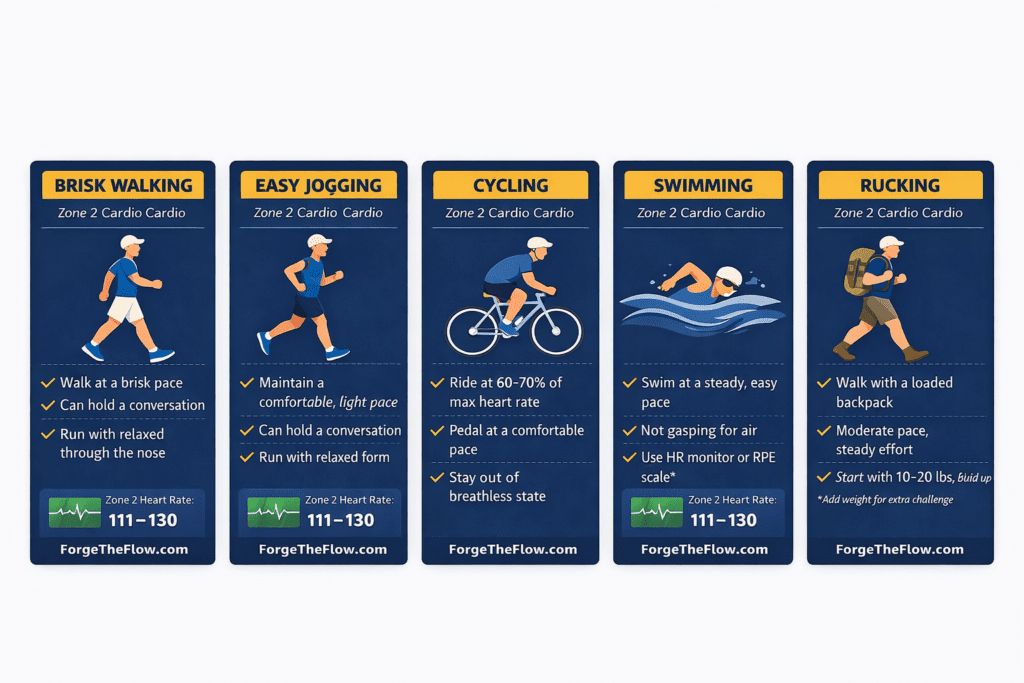
Equipment-Free Zone 2 Workouts You Can Do Anywhere
You don’t need a gym membership or fancy equipment to train in Zone 2, just the discipline to keep intensity in check.
The biggest challenge with bodyweight Zone 2 work is maintaining steady-state intensity without spiking your heart rate too high. Most bodyweight exercises either put you below Zone 2 or push you into Zone 3 or higher. The solution is choosing movements that allow continuous, rhythmic effort.
Walking (Flat or Incline)
Brisk walking is one of the most underrated Zone 2 activities. For most people, walking at 3.5-4.0 mph on flat ground or 2.5-3.5 mph on a 5-10% incline will land solidly in Zone 2. If you live in a hilly area, find a sustained uphill route that keeps your heart rate elevated without forcing you to stop. The key is maintaining consistent pace for 45-90 minutes without breaks.
Jogging at Conversational Pace
This is classic Zone 2 work for runners. The pace will feel uncomfortably slow if you’re used to pushing hard. You might be running 60-90 seconds per mile slower than your typical easy run pace. Ignore your ego, trust your heart rate monitor or talk test, and stay disciplined. Most runners sabotage Zone 2 benefits by gradually creeping into Zone 3 without realizing it.
Hiking
Extended hikes with moderate elevation gain naturally keep most people in Zone 2. The varied terrain prevents you from pushing too hard, and the duration builds aerobic capacity effectively. A 2-3 hour hike with 500-1000 feet of elevation gain is an ideal Zone 2 session that doesn’t feel like structured training.
Swimming (Easy Continuous Laps)
If you have access to a body of water or pool, easy swimming laps done continuously without rest intervals is excellent Zone 2 work. Focus on sustainable stroke rates and breathing patterns rather than speed. Most swimmers will need to deliberately slow down to stay in Zone 2, especially if they have a competitive background.
The common thread across all these options is duration and consistency. Zone 2 sessions should typically last 45-90 minutes to trigger the adaptations you’re after. Shorter sessions still have value, but the magic happens when you sustain the effort long enough to deplete glycogen stores and force your body to rely on fat oxidation.
Best Zone 2 Cardio Options for the Gym
Gyms offer equipment that makes hitting and holding Zone 2 intensity much easier than bodyweight work alone.
The advantage of gym equipment is precise control over resistance and pace, plus real-time feedback from heart rate monitors and power meters. This allows you to dial in exactly the right intensity and maintain it without the variables that outdoor training introduces.
- Stationary Bike or Spin Bike: Set a moderate resistance that allows you to maintain 70-90 RPM cadence while keeping your heart rate in Zone 2. The bike is joint-friendly and lets you sustain effort for long periods without the impact stress of running. Aim for 60-90 minute sessions at consistent wattage if your bike displays power output.
- Treadmill Walking or Jogging: Set the incline between 3-8% and walk at 3.0-3.8 mph, or set it flat and jog at whatever pace keeps you in Zone 2. The treadmill forces consistent pace and eliminates the temptation to speed up unconsciously. Use the heart rate monitor grips or wear a chest strap for accurate tracking.
- Rowing Machine: Row at a stroke rate of 18-22 strokes per minute with moderate resistance. Focus on long, controlled strokes rather than power. Rowing engages upper and lower body, making it efficient for Zone 2 work, but many people row too hard by default. Keep the damper setting between 3-5 and prioritize smooth technique over speed.
- Elliptical Trainer: The elliptical is underrated for Zone 2 because it provides low-impact, full-body movement that’s easy to sustain. Set moderate resistance and maintain a cadence of 130-150 strides per minute. The key is finding the resistance level that elevates your heart rate into Zone 2 without requiring constant intensity adjustments.
- StairMaster or Step Mill: Use a slower step rate (60-80 steps per minute) rather than the sprint-climb most people default to. This piece of equipment naturally keeps many people in Zone 2 because it’s challenging to push into higher zones without exhausting yourself quickly. Sessions of 30-60 minutes work well here.
Track your heart rate throughout these sessions and adjust resistance or pace immediately when you drift out of zone. The goal is time in zone, not distance covered or calories burned. A 90-minute bike ride that keeps you locked in Zone 2 delivers far more metabolic benefit than a 45-minute ride that bounces between Zone 2 and Zone 4.
Zone 2 Training with Minimal Equipment
A jump rope, resistance bands, or a single kettlebell can create effective Zone 2 sessions when used strategically.
The challenge with minimal equipment is that most exercises create intervals rather than steady-state cardio. The solution is designing circuits that keep you moving continuously without rest periods that drop your heart rate out of zone.
Jump Rope (Low-Intensity Continuous Skipping)
Most people jump rope too fast for Zone 2. Instead, use a slow, sustainable rhythm of 100-120 skips per minute. This feels almost meditative compared to the high-intensity rope work you might be used to. Set a timer for 30-60 minutes and maintain this pace with brief 15-20 second breaks every 5-10 minutes only if needed. The continuous nature of easy skipping keeps your heart rate elevated in Zone 2 without the lactate accumulation of faster efforts.
Kettlebell Swings (Light Weight, High Reps)
Use a kettlebell that’s 30-40% lighter than what you’d use for strength work. Perform continuous swings at a pace of 30-40 per minute for sets of 10-15 minutes. Rest only 30-60 seconds between sets and repeat for 45-60 minutes total. The lighter weight prevents muscular failure while the repetitive hip hinge movement maintains cardiovascular demand in Zone 2.
Resistance Band Circuit
Create a circuit using light resistance bands: banded squats, banded rows, banded chest press, banded deadlifts, and banded overhead press. Perform each exercise for 60-90 seconds with resistance that allows continuous movement without strain. Move immediately from one exercise to the next with no rest between exercises. Complete 6-8 rounds over 45-60 minutes. The constant movement with submaximal resistance keeps heart rate elevated without spiking into higher zones.
The key with minimal equipment Zone 2 work is choosing loads and tempos that you can sustain indefinitely. If you have to stop due to muscle fatigue rather than cardiovascular limits, the resistance is too high or the pace too fast. Zone 2 should feel like you could continue for another hour if you had to.
How Often Should You Do Zone 2 Cardio
The quick answer is, according to the American Heart Association, you should get in 150 minutes of Zone 2 cardio per week. However, for maximum health, fitness, and longevity benefits, this activity should be distributed throughout the week.,
Frequency matters more than most people realize, and the ideal amount depends on your training goals and current fitness level.
For general health and metabolic benefits, three to four Zone 2 sessions per week of 45-60 minutes each provides substantial improvements. This volume is enough to trigger mitochondrial adaptations and improve fat oxidation without requiring the time commitment of serious endurance training. Spread these sessions throughout the week rather than clustering them together to maximize recovery and adaptation.
For endurance athletes preparing for events like marathons, century rides, or triathlons, Zone 2 work should comprise 70-80% of total training volume. This typically means four to six Zone 2 sessions weekly, with durations ranging from 60-180 minutes depending on how far you are from your goal event. The remaining 20-30% of training volume comes from higher-intensity work like tempo runs, intervals, and race-pace efforts.
For people focused on fat loss and body composition, Zone 2 cardio works synergistically with strength training. Aim for three Zone 2 sessions of 45-75 minutes on non-lifting days or after strength workouts. This preserves muscle while maximizing fat oxidation and metabolic flexibility. Don’t make the mistake of replacing all strength work with cardio, even Zone 2 cardio. The combination delivers better results than either alone.
Recovery needs between Zone 2 sessions are minimal because the intensity doesn’t create significant muscle damage or nervous system fatigue. You can do Zone 2 work on consecutive days without issue, unlike high-intensity training that requires more recovery time. The limiting factor is usually time availability rather than physical recovery capacity.
Common Mistakes That Sabotage Zone 2 Benefits
Most people who try Zone 2 training make predictable errors that undermine the specific adaptations they’re chasing.
The number one mistake is training too hard. Your ego pushes you to go faster because Zone 2 feels easy, almost embarrassingly slow if you’re used to crushing yourself in every workout. But crossing into Zone 3 fundamentally changes the metabolic stimulus. You shift from primarily aerobic, fat-burning metabolism to a mixed zone that doesn’t deliver the mitochondrial and metabolic benefits of true Zone 2. If you’re constantly edging into Zone 3, you’re essentially doing mediocre tempo work instead of excellent Zone 2 work.
Other critical mistakes to avoid:
- Sessions too short: Doing 20-30 minute Zone 2 workouts misses the point. The real adaptations start happening after 40-45 minutes when glycogen depletion forces greater fat utilization. Aim for minimum 45-minute sessions, with 60-90 minutes being ideal.
- Inconsistent intensity: Letting your heart rate drift up and down throughout the session reduces time in zone and diminishes results. Monitor continuously and adjust pace or resistance immediately when you drift out of range.
- Doing Zone 2 after hard training: Scheduling Zone 2 work immediately after intense strength training or HIIT limits your ability to maintain proper intensity. Do Zone 2 on separate days or at least 6-8 hours after hard training.
- Not fueling up properly: Training in a severely depleted state can prevent you from sustaining Zone 2 intensity for the full duration. While fasted Zone 2 has some benefits, chronically under-fueling these sessions leads to poor performance and inadequate stimulus.
- Ignoring progression: Your Zone 2 heart rate will increase as fitness improves. What required 130 bpm initially might need 140 bpm after two months. Retest regularly and adjust targets or you’ll end up training below Zone 2 without realizing it.
The best way to avoid these mistakes is treating Zone 2 training with the same respect you give hard workouts. Just because it feels easy doesn’t mean it’s less important. The adaptations happen at the cellular level regardless of how hard the effort feels subjectively.
What to Expect from Consistent Zone 2 Training
Results from Zone 2 work are subtle at first but compound dramatically over weeks and months.
In the first two to three weeks, you probably won’t notice much beyond perhaps sleeping better and feeling less drained after workouts. The adaptations are happening at the mitochondrial level, but they haven’t accumulated enough to produce obvious performance changes yet. This is when most people quit because they don’t see immediate results.
After 4-6 weeks of consistent Zone 2 training:
You’ll notice you can maintain faster paces at the same heart rate, or conversely, your heart rate stays lower at paces that previously pushed you into Zone 3. Recovery between workouts improves noticeably. If you’re tracking resting heart rate, it typically drops 3-8 beats per minute. Energy levels throughout the day become more stable without the afternoon crashes that come from poor metabolic flexibility.
After 8-12 weeks:
The changes become undeniable. Your aerobic capacity measurably increases if you do fitness testing. Body composition often improves even without dietary changes as fat oxidation efficiency increases. Perhaps most noticeably, activities that used to require focused effort now feel almost automatic. Running, cycling, or hiking at Zone 2 intensity requires less mental energy to maintain.
After 6 months or more:
You’ve fundamentally changed your metabolic machinery. Mitochondrial density has increased substantially. Your body preferentially burns fat across a wider range of intensities. If you do any kind of endurance events, your performance ceiling has risen because you’ve expanded your aerobic base. Even if you never race, you’ve invested in longevity and metabolic health in ways that high-intensity training alone can’t replicate.
The key is patience and consistency. Zone 2 training rewards the long game. It’s not about what happens in a single week but what accumulates over months and years of steady work.
Zone 2 cardio won’t give you the endorphin rush of crushing a HIIT workout or the visible pump from a hard strength session, but it builds the unsexy foundation that makes everything else possible. The metabolic adaptations you develop through consistent Zone 2 work create a more efficient, resilient, fat-burning machine that serves you whether you’re chasing athletic performance or just trying to feel energized throughout your day.
Start with three sessions per week, commit to staying honest about intensity even when it feels too easy, and track your progress over months rather than weeks. The results won’t announce themselves loudly, but you’ll notice them in every aspect of your physical capacity.


ABOUT THE AUTHOR
Carlos Grider is a former U.S. Marine, CrossFit Level 1 trainer, certified personal trainer, and the creator of Forge the Flow. After nearly a decade supporting combat operations and special operations in austere environments — and another decade traveling across 65+ countries as a nomad and adventure athlete — Carlos distilled everything he learned about staying strong, capable, and resilient without a gym into the Forge the Flow training system. He has trekked solo to Everest Base Camp, surfed Bali through the pandemic, trained Muay Thai in Thailand, and run self-guided marathons across four continents — all maintained on minimalist training built for real life. He writes about the fitness methods that actually travel.
Click here to learn more about Carlos's story.