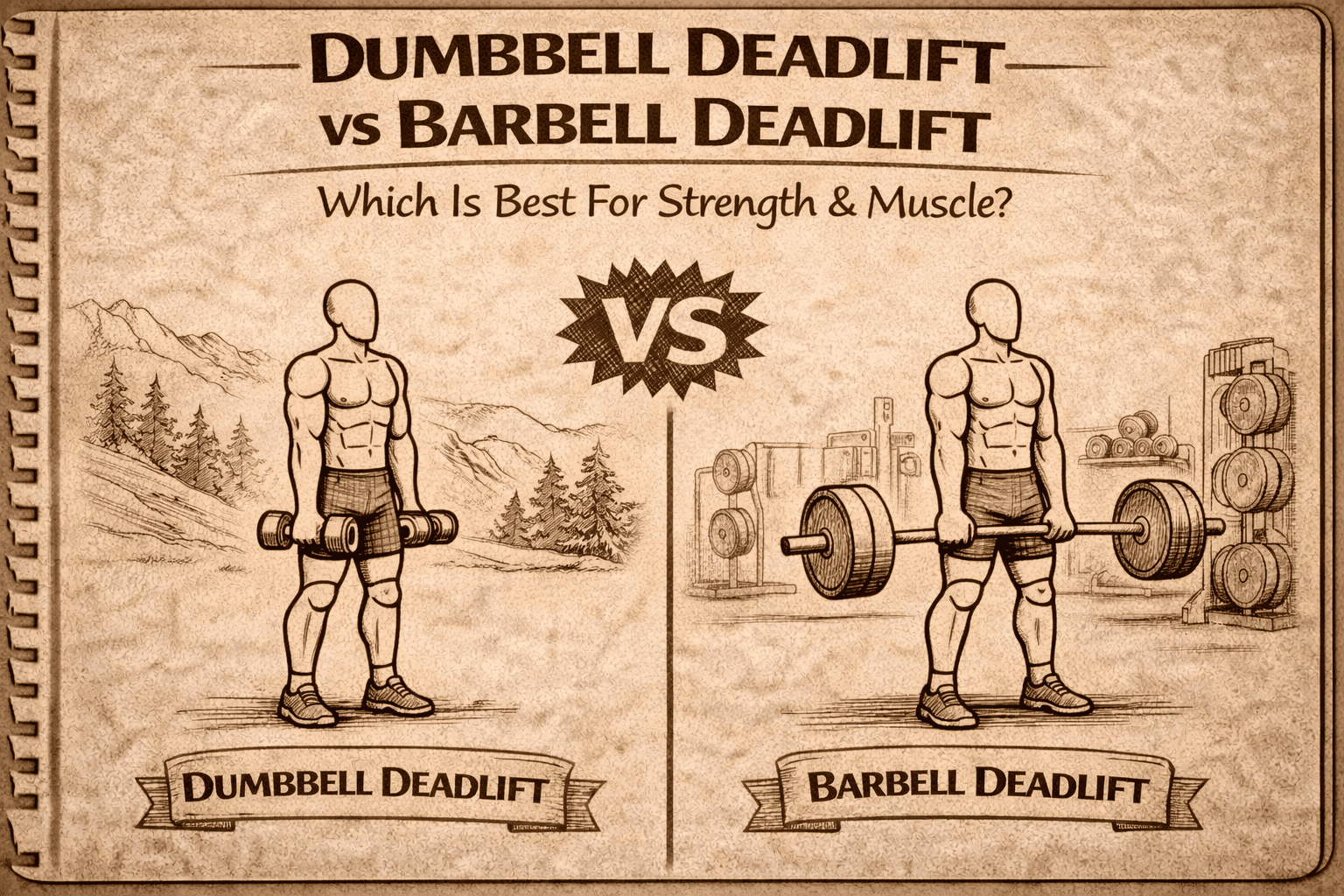
One loads your spine to build maximum strength, the other targets imbalances and builds mobility. Here’s what actually matters for longevity, all around performance, and best approaches to training the dealift with minimal gear and maximum gains.
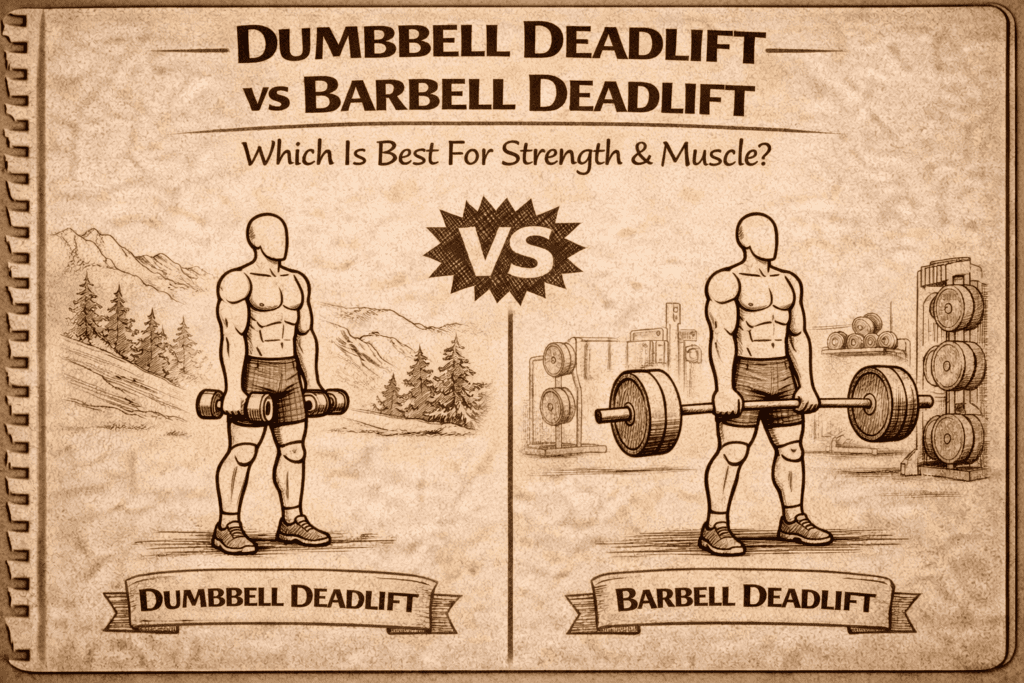
You don’t need a fully stocked gym to build real, durable strength. What you do need is to be clear about your goals, to understand how best to use the tools available to you, and to understand where to compromise and where not to. With that said, when training for strength and including the essential deadlift movement, how should you use or compromise on the dumbbell deadlift vs. barbell deadlift? And, if your tools are limited, will doing only one leave gains and performance on the table?
If your easiest, and most available, places to train are a garage, a park, or a small apartment, how you should include the deadlift debate comes down to practicality your choice (barbell or dumbbell) contributes to performance, strength, and all around physical capabilty.
The bottom line (up front) is this:
Barbells deliver raw load capacity. Dumbbells offer freedom, symmetry, and deadlifting with less gear and a smaller footprint. Both options build posterior chain strength, but they do it in ways that affect your longevity, movement quality, and gear requirements differently.
The choice isn’t about which is “better” in some universal sense. It’s about matching the tool, and the tools available to your training philosophy, your space, and your long term goals for your body. If you value minimalism, functional movement, and staying strong into your 50s and beyond, you need to understand what each variation actually does and what it costs you in setup, mobility demands, and injury risk.
This guide breaks down the mechanics, the trade-offs, and the real-world applications so you can pick the deadlift that fits your life.
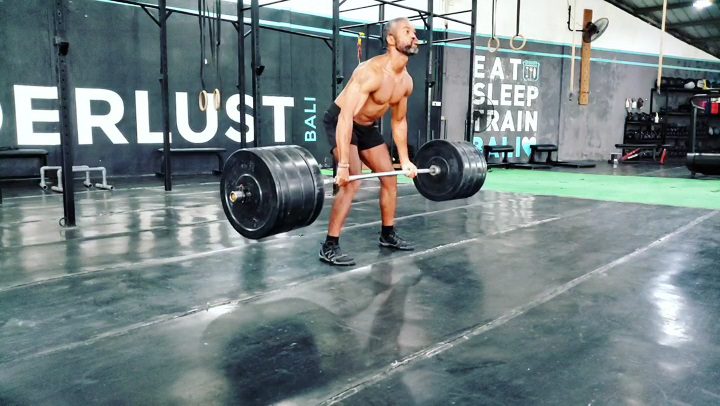
Table of Contents
What Makes Each Deadlift Different: Barbell emphasizes strength, dumbbell emphasizes muscular balance, control, and healthy range of motion
The barbell and dumbbell deadlift look similar, but the load position changes everything.
With the barbell deadlift, the weight sits in front of your body along a fixed vertical path. This positioning at the start and throughout the movement creates a longer moment arm at the hips and demands serious posterior chain recruitment to keep the bar close and your spine neutral. Because of this, the barbell rewards technical precision and punishes poor form with immediate feedback, with punishing workload and in cases of bad form or overreaching potentially injury, usually in your lower back.
Dumbbells shift the load to your sides, shortening the moment arm and reducing the shear force on your lumbar spine. This makes the movement more forgiving and puts less stress on your lower back, but it also limits how much absolute weight you can lift. The side-loaded position of the dumbbell deadlift recruits your core differently, forcing you to empohasize anti-rotation and lateral stability instead of just pure bracing strength.
Key mechanical differences:
- Load path: Barbell moves in a fixed vertical line in front of your body; dumbbells track alongside your hips and thighs
- Grip demand: Barbell allows mixed or hook grip for heavier loads; dumbbells require symmetrical grip strength and expose imbalances faster
- Range of motion: Dumbbells often allow a slightly deeper start position depending on plate diameter, encouraging lower leg, hip, and posterior chain mobility; barbells standardize ROM with 45-pound plates, a higher start position, and less required range of motion in the lower legs, knees, and hips
- Spinal loading: Barbell creates more compressive and shear forces; dumbbells distribute load with less axial stress
Neither the dumbbell nor the barbell deadlift is inherently safer or more effective. The barbell builds raw pulling strength and teaches you to manage heavy loads under tension. The dumbbell builds coordination, balance, and unilateral control. Your choice depends on whether you prioritize peak strength or long-term durability.
Equipment and Space Requirements: Dumbbells allow you to do more with less space
If you live minimally, space and versatility matter. A barbell demands a dedicated setup: the bar itself, weight plates, collars, and ideally a platform or at least a garage floor you don’t mind scuffing. You’re looking at around 7 feet of horizontal clearance just to load and lift safely. That’s before you add a rack, bench, or any other equipment.
Dumbbells collapse that footprint. A pair of adjustable dumbbells or even fixed-weight hex dumbbells can live in a corner, under a desk, or in a closet. You can deadlift in a 4×4 space with zero setup time. Additionally, the dummbell can be replaced with a kettlebell**, sandbag**, or rucksack**, which can then be easily used for other types of intense and effective training For someone who trains in a small apartment, travels frequently, or just refuses to clutter their living space with iron, dumbbells win on logistics alone.
But versatility cuts both ways. A barbell is purpose-built for loading. You can deadlift 405 pounds with a barbell and standard plates. With dumbbells, you’re capped by what you can actually hold and control, usually maxing out around 100-150 pounds per hand for most recreational lifters. That’s enough to build serious strength, but it won’t satisfy someone chasing a 500-pound pull.
(**image of me deadlifting)
Here’s what you actually need:
Barbell setup:
- Olympic barbell (45 pounds, 7 feet long)
- Weight plates (bumper or iron)
- Collars to secure plates
- Lifting platform or rubber mats (optional but smart)
- At least 7-8 feet of floor space
Dumbbell setup:
- Pair of dumbbells (fixed or adjustable)
- 4×4 feet of clear floor space
- Optional: yoga mat or thin lifting mat for traction
If you already own a barbell for other lifts, the deadlift is a no-brainer addition. If you’re starting from scratch and want maximum utility per square foot, dumbbells integrate into a broader minimalist training toolkit that includes kettlebells, pull-up bars, and bodyweight work.
Strength and Performance Outcomes: Strength vs. balance
Absolute strength development tilts heavily toward the barbell.
In the barbell deadlift, the fixed bar path, bilateral loading, and ability to pile on weight make it the superior tool for building peak posterior chain strength. Because you have less to focus on and less coordination is required, every rep can be focused purely on generating maximum power in a specific direction with minimal deviation – no additional range, no swaying to fight. You can progressively overload in small increments, track PRs with precision, and push into ranges that dumbbells simply can’t access. For powerlifters, strongman athletes, or anyone who measures progress purely in pounds moved, the barbell is non-negotiable.
The dumbbell deadlift builds strength differently. The dumbbells force each side of your body to carry its own load, exposing and correcting imbalances that a barbell can mask. If your right side compensates for a weaker left, the barbell lets you get away with it. Dumbbells don’t. This makes them a better diagnostic tool and a smarter choice for long-term symmetry and injury prevention.
The unilateral demand also cranks up core activation. Without a fixed bar to stabilize, your torso has to resist rotation and lateral shift on every rep. This builds anti-rotation strength that carries over to real-world movement, rucking, and any activity that requires you to stay stable under asymmetrical loads.
Performance trade-offs:
- Peak load capacity: Barbell wins, often by 100-200+ pounds depending on training age
- Symmetry and balance: Dumbbells expose and fix left-right imbalances that barbells hide
- Core engagement: Dumbbells demand more anti-rotation; barbells demand more bracing
- Grip strength carryover: Dumbbells challenge grip symmetrically; barbells allow mixed grip compensation
- Progressive overload: Barbells allow micro-loading with small plates; dumbbells jump in 5-10 pound increments per hand
If your goal is a 400-pound deadlift, train with a barbell.
If your goal is to stay strong, mobile, and injury-free at 50, dumbbells offer a safer, more balanced path.
Neither is wrong, but they serve different visions of strength.
Injury Risk and Longevity Considerations
Lower back pain pauses or ends more training careers than any other injury. The barbell deadlift, done well, is one of the best movements for building a resilient posterior chain and triggering muscle growth. Done poorly, it’s a fast track to chronic lumbar issues, disc problems, and compensatory movement patterns that ripple through your entire body.
The risk comes from the anterior load. The barbell pulls your torso forward, and if your hips shoot up early or your lumbar spine rounds under fatigue, the shear forces on your L4-L5 and L5-S1 discs spike dangerously. Add in ego, fatigue, or poor mobility, and you’re one bad rep away from a tweak that lingers for months.
Dumbbells reduce that risk by shifting the load to your sides and, inherently, forcing you to lift a lighter load distributed over more areas than just your lower back. This decreases the moment arm at your hips and lowers the compressive and shear stress on your lumbar spine. You still need to hinge properly, but the margin for error is wider. If you lose position, the weight drops to the floor instead of pulling you into flexion. For lifters over 40, managing chronic injuries, or prioritizing longevity over PRs, dumbbells are the smarter default.
Common failure and injury patterns and how each variation affects them:
Lower back strain: Barbell increases risk if form breaks down under heavy load; dumbbells reduce moment arm and allow safer bailouts.
Grip failure: Barbell allows mixed grip, which can create asymmetry and bicep tendon risk; dumbbells force symmetrical grip development.
Hip mobility limits: Barbell demands consistent depth and can punish limited ankle or hip mobility; dumbbells allow more freedom to adjust stance and depth.
Shoulder and trap tension: Barbell can create uneven shrugging if grip width varies; dumbbells hang neutrally and reduce upper trap overactivation.
Neither variation is bulletproof, but dumbbells give you more room to adapt, adjust, and train around limitations without sacrificing the movement pattern entirely. If you’re training for the long game, that adaptability matters more than any single heavy set.
Programming and Training Integration
Barbells belong in strength-focused blocks where you’re chasing maximum load, building peak power, or preparing for a competition. They pair well with linear progression schemes, percentage-based programs, and traditional powerlifting or strength templates. If you’re running 5/3/1, Starting Strength, or any program built around the big three lifts, the barbell deadlift is a cornerstone.
Dumbbells fit better into minimalist, hybrid, mobility enhancing, or conditioning-focused programs. They integrate seamlessly with kettlebell work, bodyweight circuits, and rucking preparation. You can superset dumbbell deadlifts with loaded carries, pair them with pull-ups, or drop them into an EMOM without worrying about setup time or equipment transitions. For someone who trains in a park, a garage gym, or rotates between different locations, dumbbells simplify logistics without sacrificing quality.
Sample programming applications:
Barbell-focused strength block:
- Barbell deadlift: 5×5 at 75-80% 1RM, 3-minute rest
- Romanian deadlift: 3×8-10
- Barbell rows: 4×6-8
- Core: Planks, dead bugs, bird dogs
Dumbbell-focused hybrid session:
- Dumbbell deadlift: 4×8-10, 90 seconds rest
- Single-arm dumbbell row: 3×10 each side
- Goblet squat: 3×12
- Loaded carry: 3×50 meters
- Pull-ups: 3x max reps
You can also rotate between both. Use barbells during strength phases, switch to dumbbells during deload weeks or when traveling, and program both in the same week if your schedule and recovery allow it. The key is matching the tool to the training goal, not forcing a single variation year-round because it’s what you’ve always done.
Technique and Learning Curve
The barbell deadlift has a steeper learning curve but rewards mastery with efficiency. You need to nail hip hinge mechanics, bar path, breathing, bracing, and timing. Small errors compound quickly under load. Your shins need to stay vertical until the bar passes your knees. Your lats need to lock the bar into your body. Your hips and shoulders need to rise together. Miss any of those cues, and the bar drifts forward, your back rounds, or your lockout stalls.
This precision makes the barbell a better teaching tool if you have access to coaching, video feedback, or a training partner who knows what to look for. Once you dial in the pattern, it becomes automatic, and you can chase progress with confidence.
Dumbbells are more forgiving on day one but still demand solid hinge mechanics. The lighter load and side position let you feel the movement without the same penalty for imperfect form. You can experiment with stance width, foot angle, and depth without worrying about a loaded bar pulling you forward. This makes dumbbells ideal for beginners, self-taught lifters, or anyone returning from injury who needs to rebuild the pattern before loading it heavy.
Key technique differences to drill:
Barbell setup: Feet under hips, bar over midfoot, shins vertical, shoulders slightly ahead of bar, lats engaged to pull slack out before the lift.
Dumbbell setup: Feet hip to shoulder-width, dumbbells outside feet or alongside shins, chest up, weight shifts into heels as you hinge, arms hang straight without rounding shoulders.
Lockout: Barbell requires aggressive hip drive and glute squeeze to finish; dumbbells allow a more natural standing pattern without hyperextension.
Breathing and bracing: Barbell demands a hard belly breath and 360-degree brace before every rep; dumbbells allow slightly more breathing freedom due to lower spinal load.
If you train alone and want to minimize risk while you learn, start with dumbbells. Once the hinge pattern is automatic, transition to a barbell if your goals and equipment support it. If you’re already competent with barbells, adding dumbbells as a variation or accessory will sharpen your movement quality and balance out any asymmetries you’ve been ignoring.
Cost and Accessibility
A quality barbell setup costs more upfront but holds value forever. Expect to spend 300 to 600 dollars for a decent barbell, a starter set of plates, and collars. Bumper plates add another 200 to 400 dollars if you want to drop weights safely. Platforms, mats, and racks push the total higher. Once you own it, you’re done. Barbells don’t wear out, plates last decades, and resale value stays strong if you ever move on. Or, at the least, you will need to get a gym membership.
Dumbbells range from cheap to expensive depending on type. A pair of adjustable dumbbells like PowerBlocks or Bowflex SelectTech runs 300 to 500 dollars and replaces an entire rack of fixed weights. Hex dumbbells cost less per pair but add up fast if you want a full range. A single pair of 50-pound dumbbells might cost 80 to 120 dollars. If you need 25s, 35s, 50s, and 75s, you’re looking at 400 to 600 dollars for four pairs.
Budget breakdown for each setup:
| Item | Barbell Setup Cost | Dumbbell Setup Cost |
| Barbell or Dumbbells | 150 to 300 dollars | 300 to 500 dollars (adjustable) |
| Weight Plates or Fixed Weights | 200 to 400 dollars | Included with adjustable or 400+ for multiple pairs |
| Collars | 20 to 40 dollars | N/A |
| Platform or Mats | 100 to 300 dollars (optional) | 20 to 50 dollars (optional) |
| Total | 470 to 1,040 dollars | 320 to 550 dollars |
Used equipment slashes costs across the board. Barbells, plates, and dumbbells flood the secondhand market from people who quit training, downsize, or upgrade. Check Facebook Marketplace, Craigslist, or local gym liquidation sales. You can often build a full barbell setup for 200 to 300 dollars or grab a pair of quality adjustable dumbbells for half retail.
Accessibility also depends on where you train. If you have a gym membership, barbells are already there. If you train at home, dumbbells give you more flexibility to start small and scale up. If you travel or train outdoors, dumbbells pack easier and adapt to uneven surfaces better than a barbell and plates.
When to Choose Each Variation
Pick the barbell if you want to build maximum pulling strength, compete in powerlifting, or already own a barbell for squats and presses. It’s the most efficient tool for loading heavy, tracking strength progress, and developing pure posterior chain power. The barbell also teaches discipline, precision, and the mental toughness that comes from managing big weights under tension.
Pick dumbbells if you value longevity, train in limited space, want to expose and fix imbalances, or integrate deadlifts into hybrid training that includes kettlebells, rucking, and bodyweight work. Dumbbells reduce injury risk, simplify logistics, and build functional strength that transfers to real-world movement better than grinding out heavy singles.
Choose barbells when:
- Your primary goal is building peak deadlift strength or competing
- You have dedicated training space and already own barbell equipment
- You’re running a traditional strength program that relies on percentage-based loading
- You want to lift 300+ pounds and track linear progress
- You have solid technique and access to coaching or video feedback
Choose dumbbells when:
- You train in a small space, travel frequently, or prefer minimal equipment
- You’re over 40 or managing chronic back issues
- You want to expose and correct left-right imbalances
- You’re integrating deadlifts into circuits, conditioning, or hybrid programs
- You value longevity and joint health over peak strength numbers
You can also run both. Use barbells for your main strength work and dumbbells as an accessory, variation, or deload option. Program barbell deadlifts on your heavy day and dumbbell deadlifts on volume or conditioning days. Rotate between them every training block to keep your body adapting without overloading any single pattern.
Common Mistakes and How to Avoid Them
Most lifters screw up the deadlift by rushing the setup, ignoring their hips, or chasing weight before they own the pattern. The barbell punishes these mistakes faster, but dumbbells let you get away with sloppy form until the load catches up and something hurts.
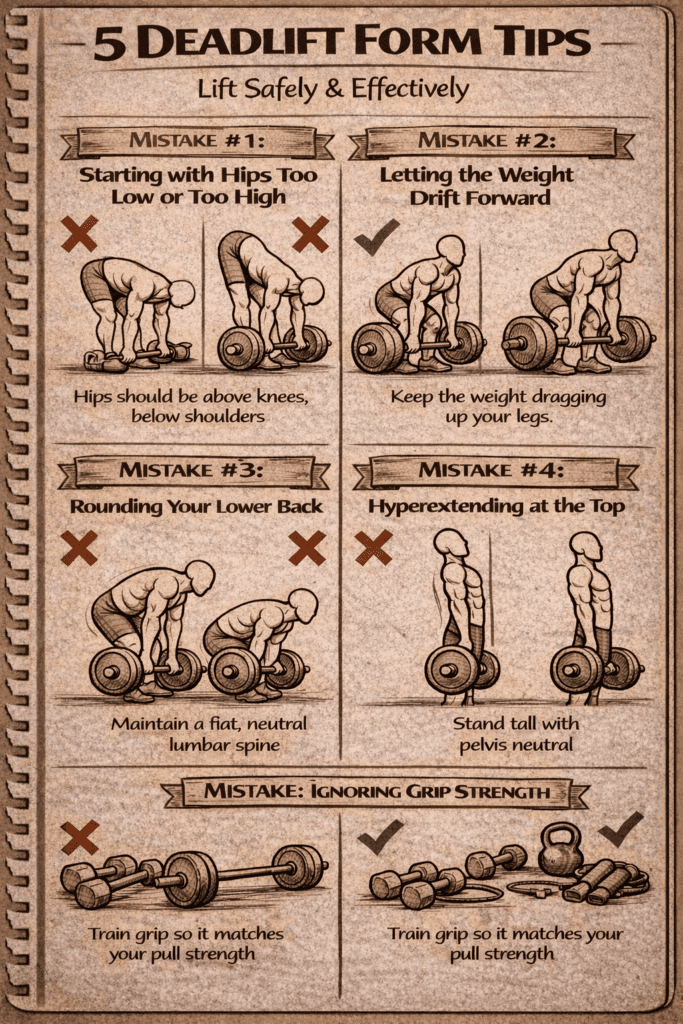
Mistake 1: Starting with hips too low or too high. Your hips should be above your knees but below your shoulders. Too low turns the deadlift into a squat. Too high shifts all the load to your lower back and hamstrings without engaging your quads or glutes properly. Film yourself from the side, freeze the frame right before the bar leaves the ground, and check your hip height. Adjust until your shins are nearly vertical and your torso angle matches your limb lengths.
Mistake 2: Letting the weight drift forward. With a barbell, the bar should drag up your shins and thighs. If it swings forward, you lose mechanical advantage and load your lower back. With dumbbells, the weights should track straight up alongside your legs. If they drift forward, you’re not hinging properly or your weight is too far onto your toes. Fix it by shifting your weight into your heels and pulling the weights back toward your body as you stand.
Mistake 3: Rounding your lower back under load. A rounded lumbar spine under tension is how you get hurt. It’s fine to start with a slightly rounded upper back if your shoulders are big or your mobility is limited, but your lower back needs to stay neutral. If you can’t hold neutral with the weight you’re using, drop the load and rebuild your bracing and hinge pattern from the ground up.
Mistake 4: Hyperextending at the top. Leaning back and thrusting your hips forward at lockout doesn’t make the lift stronger. It compresses your lumbar spine and shifts tension away from your glutes. Finish the rep by standing tall with your hips fully extended and your glutes squeezed, but keep your ribs down and your pelvis neutral. Think “stand up straight,” not “lean back.”
Mistake 5: Ignoring grip strength until it fails. Your deadlift is only as strong as your grip. If your hands open before your posterior chain fatigues, you’re leaving gains on the table. Barbell lifters often fix this with straps or a mixed grip, which works but can create asymmetry. Dumbbell lifters need to build grip strength symmetrically or accept that grip will limit load. Add farmer carries, dead hangs, and thick-grip work to keep your hands strong enough to match your hips and back.
Fixing these mistakes doesn’t require a coach or expensive tools. It requires honest self-assessment, video feedback, and the willingness to drop your ego and perfect the pattern before you chase numbers.
The barbell and dumbbell deadlift both belong in a well-rounded training program, but they don’t serve the same purpose. The barbell builds raw strength, teaches you to handle heavy loads, and rewards technical precision with measurable progress. The dumbbell builds balance, exposes weaknesses, and keeps you moving well with less risk and less equipment.
Your choice depends on your goals, your space, and your body’s long-term needs. If you want to pull heavy and have the setup to support it, use a barbell. If you want to stay strong, mobile, and injury-free with minimal gear, use dumbbells. Or use both and let each variation sharpen the other. Either way, the deadlift stays one of the most effective movements you can do, no matter what you’re holding in your hands.


ABOUT THE AUTHOR
Carlos Grider is a former U.S. Marine, CrossFit Level 1 trainer, certified personal trainer, and the creator of Forge the Flow. After nearly a decade supporting combat operations and special operations in austere environments — and another decade traveling across 65+ countries as a nomad and adventure athlete — Carlos distilled everything he learned about staying strong, capable, and resilient without a gym into the Forge the Flow training system. He has trekked solo to Everest Base Camp, surfed Bali through the pandemic, trained Muay Thai in Thailand, and run self-guided marathons across four continents — all maintained on minimalist training built for real life. He writes about the fitness methods that actually travel.
Click here to learn more about Carlos's story.