Most leg workouts are built backwards.
They chase muscle fatigue instead of movement quality. They isolate quads and hamstrings like they exist in separate universes. They leave you sore for days but no more capable of handling a long ruck, a steep trail, or playing with your kids without your knees screaming at you.
The legs you actually need aren’t built in a squat rack. They’re forged through movement patterns that mirror real life: loaded carries that test your stability, unilateral work that exposes imbalances, and mobility drills that keep your hips and ankles from turning into rusty hinges. This is strength training that respects the decades ahead of you, not just the mirror in front of you.
This leg workout routine strips away the nonsense and gives you a framework designed for longevity, power, and the kind of durability that lets you stay active well into your later years.
Table of Contents
What You’ll Need to Get Started
You don’t need a gym membership or a garage full of equipment to build strong legs that perform.
Most commercial leg routines assume you have access to leg presses, hack squat machines, and cable towers. That’s not your reality, and frankly, it’s not what builds functional strength anyway. The tools below give you everything you need to develop power, stability, and mobility without the overhead.
Essential Equipment:
- One or two kettlebells (16kg to 32kg depending on your current strength level)
- A weighted ruck or backpack (20 to 50 pounds to start)
- Resistance band (medium to heavy tension for mobility work)
- Parallettes or sturdy chairs (for pistol squat progressions and support)
- Open space (enough room to lunge, step, and move freely)
If you’re just starting out, a single 24kg kettlebell and a loaded backpack will cover 80% of what you need. As you progress, adding a second kettlebell opens up front rack work and double kettlebell movements that seriously challenge your core and coordination. The resistance band is non-negotiable for hip and ankle mobility, two areas that silently sabotage leg strength if you ignore them.
This isn’t about accumulating gear. It’s about having the right tools to train movement patterns that matter. Every item listed has multiple uses across strength, endurance, and mobility work, which makes your setup efficient and versatile.
The Framework Behind Durable Leg Training
Leg training for longevity looks different than leg training for size.
Traditional bodybuilding splits isolate muscle groups and push them to failure. That approach works if your goal is hypertrophy and you’re in your twenties with recovery to spare. But if you want legs that stay strong, mobile, and pain-free for the next 20 to 30 years, you need a smarter structure.
This routine is built on three pillars:
Movement over isolation. Your legs don’t function in isolation, so training them that way creates strength that doesn’t transfer. The best leg exercises require coordination between your hips, knees, ankles, and core. Squats, lunges, step-ups, and loaded carries all demand this full-body integration. That’s the kind of strength that translates to real-world scenarios like hiking uneven terrain, carrying heavy loads, or getting up off the ground without using your hands. While isolation exercises have their place for targeting specific weaknesses, compound exercise movements that engage the largest muscle group in your body deliver the best results.
Balance between bilateral and unilateral work. Bilateral movements like squats build raw strength and power. Unilateral movements like split squats and pistols expose weaknesses, correct imbalances, and improve stability. Most people can squat decent weight but fall apart on a single-leg movement. That imbalance is a recipe for injury as you age.
Mobility as a non-negotiable. Tight hips and stiff ankles don’t just limit your full range of motion. They force compensations that lead to knee joint pain, lower back issues, and degraded movement quality. Mobility work isn’t a cool-down afterthought. It’s a foundational piece that keeps your joints healthy and your movement patterns clean.
This framework doesn’t chase soreness or pump. It chases capacity, the ability to move well under load, recover quickly, and keep training consistently without breaking down. That’s what durable fitness actually looks like.
The Core Movements That Build Functional Leg Strength
Every effective leg workout comes down to a handful of movement patterns done well.
You don’t need 15 different exercises. You need to master the ones that deliver the highest return on investment. These movements challenge your legs through multiple planes of motion, build strength that transfers outside the gym, and scale with you as you get stronger.
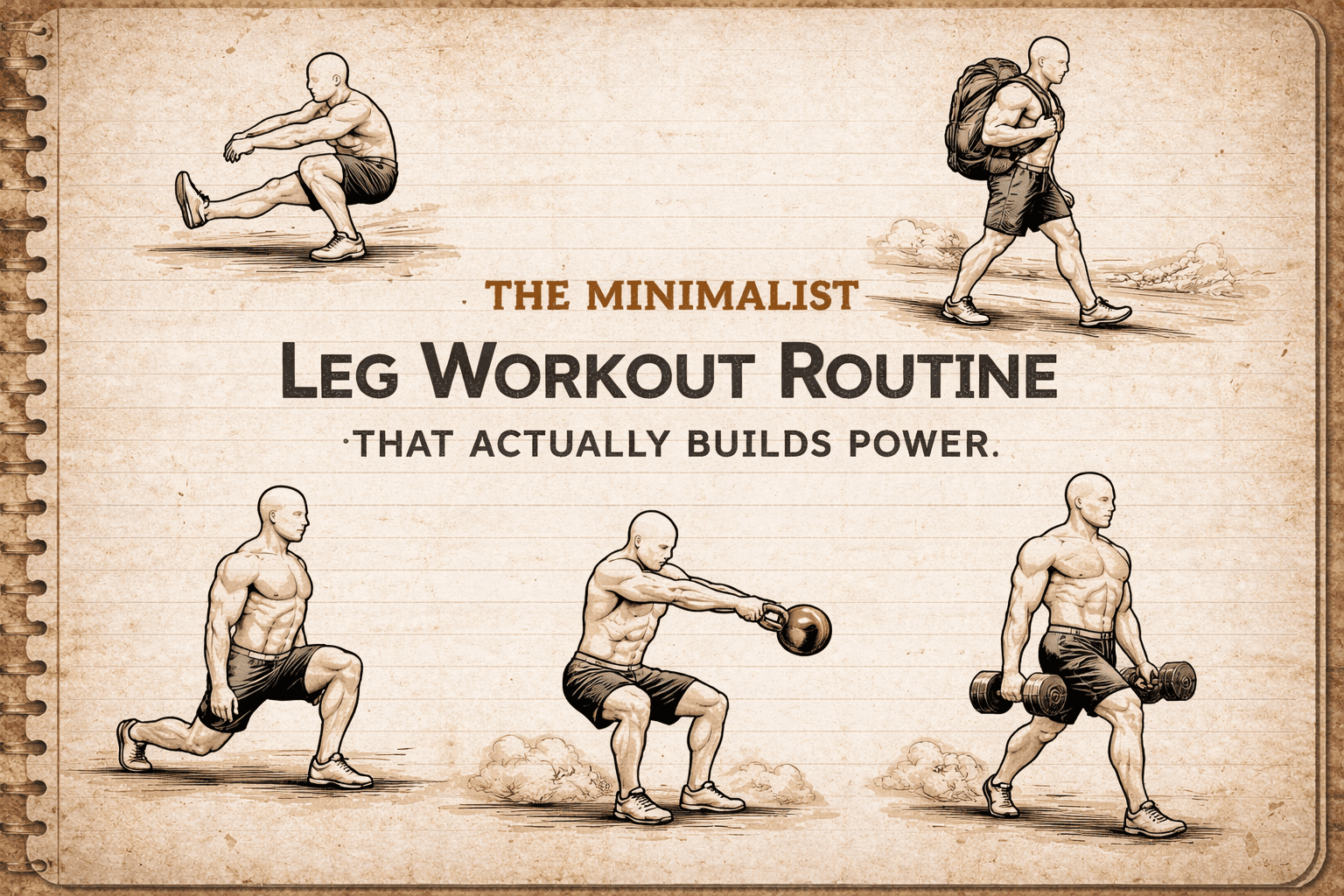
- Goblet Squat – Hold a kettlebell at chest height and squat deep, keeping your torso upright. This teaches proper squat mechanics, builds quad and glute strength, and improves hip mobility. The front-loaded position forces your core to stay engaged and prevents you from leaning forward. Start with 3 sets of 8 to 12 reps, focusing on depth and control. Maintaining good form from the starting position through the entire movement is the important thing here. Your gluteus maximus and major muscles throughout your legs will develop serious strength when you prioritize proper form over heavy weights.
- Bulgarian Split Squat – Elevate your rear foot on a bench or step, hold a kettlebell in the goblet position or at your sides, and lower into a lunge. This movement destroys imbalances and builds serious single-leg strength. Your stabilizers work overtime to keep you balanced, which translates directly to better movement on uneven ground. Start from a standing position with your right foot forward, then switch to your left foot for balanced development. Go for 3 sets of 6 to 10 reps per leg.
- Kettlebell Swing – This isn’t just a cardio move. Done correctly, the swing builds explosive hip extension, hammers your posterior chain, and teaches you to generate power from your glutes and hamstrings. Keep your back flat, hinge at the hips, and snap them forward to drive the kettlebell up. Aim for 4 to 6 sets of 15 to 20 reps with a focus on power, not fatigue. This compound exercise engages your entire lower body while building muscle mass and conditioning.
- Pistol Squat Progression – The pistol squat is the ultimate test of single-leg strength, balance, and mobility. Most people can’t do a full pistol right away, and that’s fine. Start with assisted variations using a TRX strap, pole, or counterweight. Progress slowly, working through box pistols and negative reps until you can control the full movement. Even partial range pistols build impressive strength.
- Loaded Carry (Farmer or Suitcase Carry) – Pick up a heavy kettlebell in one or both hands and walk. This simple act builds grip strength, core stability, and teaches your legs to stabilize under load while moving. Suitcase carries, where you hold the weight on one side, add an anti-lateral flexion challenge that lights up your obliques and stabilizers. Walk for 30 to 60 seconds per set, 3 to 4 sets total.
- Step-Ups – Find a box or bench at knee height, hold a kettlebell, and step up with control. This movement mimics hiking and stair climbing while building unilateral strength and stability. Focus on driving through the heel of your elevated foot rather than pushing off your back leg. Do 3 sets of 8 to 12 reps per leg.
These six movements cover every major function your legs need: squatting, hinging, lunging, single-leg stability, and loaded movement. Master these and you’ll build a foundation that supports every other physical activity you care about. While your upper body matters too, developing a strong lower-body workout foundation is critical for long-term functional fitness.
Building Your Weekly Leg Training Split
Frequency and structure matter as much as exercise selection.
Hitting legs once a week and annihilating them for 90 minutes is a recipe for poor recovery and inconsistent progress. Instead, spread your leg work across two to three sessions per week with different emphases. This approach lets you train hard, recover well, and maintain the consistency that actually drives long-term results.
Sample Weekly Structure:
Session 1: Strength Focus
- Goblet Squat: 4 sets of 6-8 reps (heavy)
- Bulgarian Split Squat: 3 sets of 6-8 reps per leg
- Suitcase Carry: 3 sets of 40 seconds per side
- Hip Mobility Flow: 10 minutes
This session prioritizes heavy, controlled movements that build raw strength. Keep rest periods between 90 seconds and 2 minutes to allow full recovery between sets. The goal is quality reps with challenging weight, not racing through the workout. While back squats and front squats with a barbell can be effective, this kettlebell-focused approach delivers the best results without requiring a full rack setup.
Session 2: Power and Conditioning
- Kettlebell Swing: 6 sets of 15-20 reps (explosive)
- Step-Ups: 3 sets of 10 reps per leg
- Ruck March: 20-30 minutes with 30-40 pounds
- Ankle Mobility Drills: 5 minutes
This session blends power development with endurance work. The swings teach your body to generate force quickly, while the ruck builds aerobic capacity and trains your legs under sustained load. This is where you build the engine that lets you keep going when things get hard. You can also add jump squats here for explosive power development if your knees are healthy.
Session 3 (Optional): Skill and Mobility
- Pistol Squat Progressions: 4 sets of 5 reps per leg
- Cossack Squats: 3 sets of 8 reps per side
- Farmer Carry: 3 sets of 50 seconds
- Full Lower Body Mobility Routine: 15 minutes
The third session is lighter and focuses on movement quality, skill development, and keeping your joints healthy. This is where you work on areas that need attention without accumulating fatigue that interferes with recovery. You might also add isolation movements like leg curls or calf raises if you have access to equipment or want to target specific areas.
Space these sessions at least 48 hours apart. If you’re also rucking, running, or doing other demanding activities, treat those as part of your weekly leg volume and adjust accordingly. More isn’t better if it leaves you beat up and unable to train consistently.
Unilateral Work: Why One Leg at a Time Matters
Single-leg training reveals the lies your bilateral lifts tell you.
You might squat with solid form and decent weight, but put you on one leg and suddenly imbalances, mobility restrictions, and stability issues come screaming to the surface. Most people discover one leg is significantly stronger than the other, or that their ankle mobility on one side limits their depth and control.
Here’s why unilateral work is non-negotiable:
Exposes and corrects imbalances. Bilateral movements let your dominant side compensate for your weaker side. Over time, this creates strength asymmetries that increase injury risk and limit performance. Single-leg work forces each side to carry its own weight, literally. You can’t hide.
Builds real-world stability. Life doesn’t happen on two legs planted firmly on flat ground. You step on uneven surfaces, shift your weight, move laterally, and stabilize on one leg constantly. Training these patterns makes you more resilient and less prone to rolling an ankle or tweaking a knee when the ground doesn’t cooperate.
Increases time under tension without joint stress. You don’t need to load a barbell with 300 pounds to challenge your legs. A single-leg squat or split squat with moderate weight creates serious tension while keeping spinal loading and joint stress lower. This matters more as you age and longevity becomes the priority.
Pistol squats, Bulgarian split squats, single-leg deadlifts, and step-ups should occupy at least 40% of your leg training volume. Start with assisted variations if you need to, progress slowly, and respect the learning curve. The payoff is legs that move better and last longer.
Loaded Carries for Legs That Don’t Quit
Carrying heavy things might be the most underrated leg builder out there.
When you pick up a kettlebell, sandbag, or loaded ruck and start walking, your legs have to stabilize your body while propelling you forward under load. Your core fights to keep you upright. Your grip has to hang on. Your stabilizers fire constantly to keep you balanced. It’s a full-system challenge disguised as a simple walk.
Three carry variations worth your time:
Farmer Carry: Hold a heavy kettlebell in each hand and walk. This builds grip strength, traps, and teaches your legs to stay stable under symmetrical load. Walk for distance or time, aiming for 40 to 60 seconds per set. If your grip gives out before your legs do, that tells you something important about a weak link in your system.
Suitcase Carry: Hold a single heavy kettlebell on one side and walk. Your core has to resist lateral flexion to keep you upright, which lights up your obliques and deep stabilizers. This variation also exposes any side-to-side imbalances in your strength and stability. Do equal time on both sides.
Overhead Carry: Press a kettlebell overhead and walk. This adds a shoulder stability component while forcing your legs to stabilize under an offset load. Your core has to work even harder to prevent you from leaning or twisting. Start light and focus on control before adding weight.
Loaded carries also prepare you for real-world demands like rucking, hiking with a pack, or carrying gear over distance. They build the kind of strength that doesn’t show up on a one-rep max test but makes everything in life easier. Add carries to the end of your strength sessions or use them as standalone conditioning work.
Mobility Work That Actually Transfers to Strength
Tight hips and stiff ankles don’t just limit your squat depth.
They force your body to compensate in ways that degrade movement quality and set you up for pain down the road. Your knees cave inward because your hips can’t externally rotate. Your heels lift off the ground because your ankles lack dorsiflexion. Your lower back rounds because your hips won’t hinge properly. Mobility isn’t a luxury. It’s the foundation that lets you move well under load.
Key areas to address:
Hip Flexors: Spending hours sitting shortens your hip flexors and limits hip extension. This kills your ability to fully engage your glutes and creates compensatory patterns in your lower back. Use a couch stretch or half-kneeling hip flexor stretch for 90 seconds per side, daily if possible.
Ankle Dorsiflexion: Limited ankle mobility forces your knees forward and prevents you from hitting depth in squats and lunges. Use a banded ankle mobilization or wall ankle stretch before lower body sessions. Spend 60 seconds per side, focusing on driving your knee forward while keeping your heel down.
Hip Internal and External Rotation: Your hips need to rotate freely in multiple directions to squat deep and move laterally without compensation. Use 90/90 stretches and controlled articular rotations (CARs) to build usable range of motion. Don’t just stretch. Move through the range with control. Your gluteus medius, which stabilizes your hip, benefits tremendously from this type of mobility work.
Adductors: Tight inner thighs limit your squat stance width and prevent your knees from tracking properly. Cossack squats and deep side lunges build strength through a stretched position, which is far more effective than passive stretching alone.
Spend 10 to 15 minutes on mobility work before or after your leg sessions. This isn’t time wasted. It’s an investment that keeps your joints healthy, your movement patterns clean, and your training sustainable for decades. Skipping mobility is borrowing from your future self, and the interest rate is brutal.
Common Mistakes That Sabotage Progress
Most leg training fails because of a handful of easily avoidable mistakes.
You can have the perfect program on paper, but if your execution is off or your priorities are misplaced, progress stalls and frustration builds. These aren’t minor details. They’re the difference between building durable strength and spinning your wheels while accumulating wear and tear.
Chasing soreness instead of performance. Soreness is not a reliable indicator of a good workout. It’s a sign of novel stimulus or excessive volume, nothing more. If you’re prioritizing how sore you get over whether you’re getting stronger, moving better, or building capacity, you’re optimizing for the wrong outcome. Track your reps, weight, and movement quality instead.
Ignoring single-leg strength. Bilateral movements feel more impressive and let you lift heavier loads, so people gravitate toward them and skip unilateral work. This creates imbalances that eventually catch up to you in the form of injuries or movement limitations. Balance your training between two-leg and one-leg work.
Skipping the warm-up. Jumping straight into heavy goblet squats or Bulgarian split squats without preparing your joints and nervous system is asking for trouble. Spend five to ten minutes on dynamic stretches, light movement, and joint prep. Your performance will improve and your injury risk drops. Even starting with bodyweight squats helps prepare your muscles and knee joint for the work ahead.
Adding volume without improving recovery. More training only works if you can recover from it. If you’re sleeping five hours a night, eating like garbage, and stacking high-intensity sessions without rest days, adding another leg workout won’t make you stronger. It’ll break you down. Respect recovery as much as you respect training.
Letting ego dictate load selection. Using a weight that’s too heavy to control properly doesn’t build strength. It builds compensatory movement patterns and increases injury risk. If your form breaks down, the weight is too heavy. Drop it, own the movement, and progress intelligently. Good form always trumps heavy weights when building muscle mass that lasts.
Fix these mistakes and you’ll see better results with less wasted effort. Training smarter always beats training harder when longevity is the goal.
Progressions and How to Scale Over Time
A good program gets harder as you get stronger.
Static routines stop working because your body adapts. Once a movement or load stops challenging you, progress stalls. The key is knowing when and how to increase difficulty without jumping too far ahead and compromising form or recovery.
Ways to progress your leg training:
- Add weight. The simplest progression. Once you can complete all your sets with solid form, increase the kettlebell weight by 4kg to 8kg or add weight to your ruck. This is straightforward and effective for bilateral movements like goblet squats and swings.
- Increase reps or sets. If you’re doing 3 sets of 8 reps, move to 3 sets of 10, then 3 sets of 12, before increasing weight. This builds work capacity and lets you own the movement pattern before adding load.
- Improve range of motion. Squatting deeper, lowering slower on split squats, or controlling the eccentric phase longer all increase difficulty without adding external weight. Quality of movement matters as much as quantity of load. Training through a full range of motion engages more muscle fibers and builds strength more effectively.
- Move to harder variations. Progress from assisted pistol squats to box pistols to full-range pistols. Move from goblet squats to front squats with double kettlebells. Swap step-ups for single-leg box squats. You might also progress from bodyweight squats to weighted variations, or add Romanian deadlifts to target your hamstrings differently. Harder variations build new strength and keep training interesting.
- Reduce rest periods. Shortening rest from 2 minutes to 90 seconds increases the conditioning demand and work density without changing the exercises. This works well for conditioning-focused sessions.
- Add tempo work. Slowing down the eccentric (lowering) phase to 3 to 5 seconds increases time under tension and builds control. A 5-second negative on a Bulgarian split squat is significantly harder than a standard tempo.
Progress one variable at a time. If you add weight and reps and reduce rest all at once, you won’t know what’s working or how to adjust when you stall. Small, consistent improvements compound into serious long-term gains. Don’t forget to also work your calf muscles with movements like calf raises and address your posterior chain with exercises like hip thrusts when appropriate.
What Results Actually Look Like
Forget the transformation photos and 12-week before-and-afters.
Real progress in leg training for longevity doesn’t show up as dramatic muscle gain or shredded quads. It shows up as capabilities you didn’t have before. You ruck longer distances without your legs turning to concrete. You hike steep trails without knee pain. You play with your kids or move furniture without feeling wrecked the next day.
Markers of success:
- Increased load or reps on core movements. You’re goblet squatting with a 32kg kettlebell when you started with 16kg. Your Bulgarian split squats feel stable and controlled instead of wobbly and uncertain.
- Improved movement quality. Your squat depth is better. Your pistol progression is cleaner. You’re moving through ranges of motion that used to feel impossible.
- Better performance in other areas. Your ruck times improve. You feel stronger on hikes. You recover faster between training sessions.
- Fewer aches and pains. Your knees don’t hurt after a long day on your feet. Your hips feel mobile instead of locked up. You’re not constantly managing nagging injuries.
- Consistency over months and years. You’re still training regularly without burnout, injuries, or constant program hopping. That’s the real win.
This type of training doesn’t deliver instant gratification. It builds slowly, compounds over time, and pays dividends for decades. If you’re looking for a quick fix or rapid aesthetic changes, this isn’t it. If you want legs that serve you well into your 60s and beyond, this is the blueprint.
The goal isn’t to peak for a single event or look impressive for a summer. It’s to stay capable, mobile, and strong for as long as you’re alive. That requires patience, consistency, and a willingness to prioritize function over flash. The results might not look dramatic in photos, but they’ll show up in how you move through the world.
Your legs are the foundation of almost everything you care about physically. Train them like it.


ABOUT THE AUTHOR
Carlos Grider is a former U.S. Marine, CrossFit Level 1 trainer, certified personal trainer, and the creator of Forge the Flow. After nearly a decade supporting combat operations and special operations in austere environments — and another decade traveling across 65+ countries as a nomad and adventure athlete — Carlos distilled everything he learned about staying strong, capable, and resilient without a gym into the Forge the Flow training system. He has trekked solo to Everest Base Camp, surfed Bali through the pandemic, trained Muay Thai in Thailand, and run self-guided marathons across four continents — all maintained on minimalist training built for real life. He writes about the fitness methods that actually travel.
Click here to learn more about Carlos's story.