
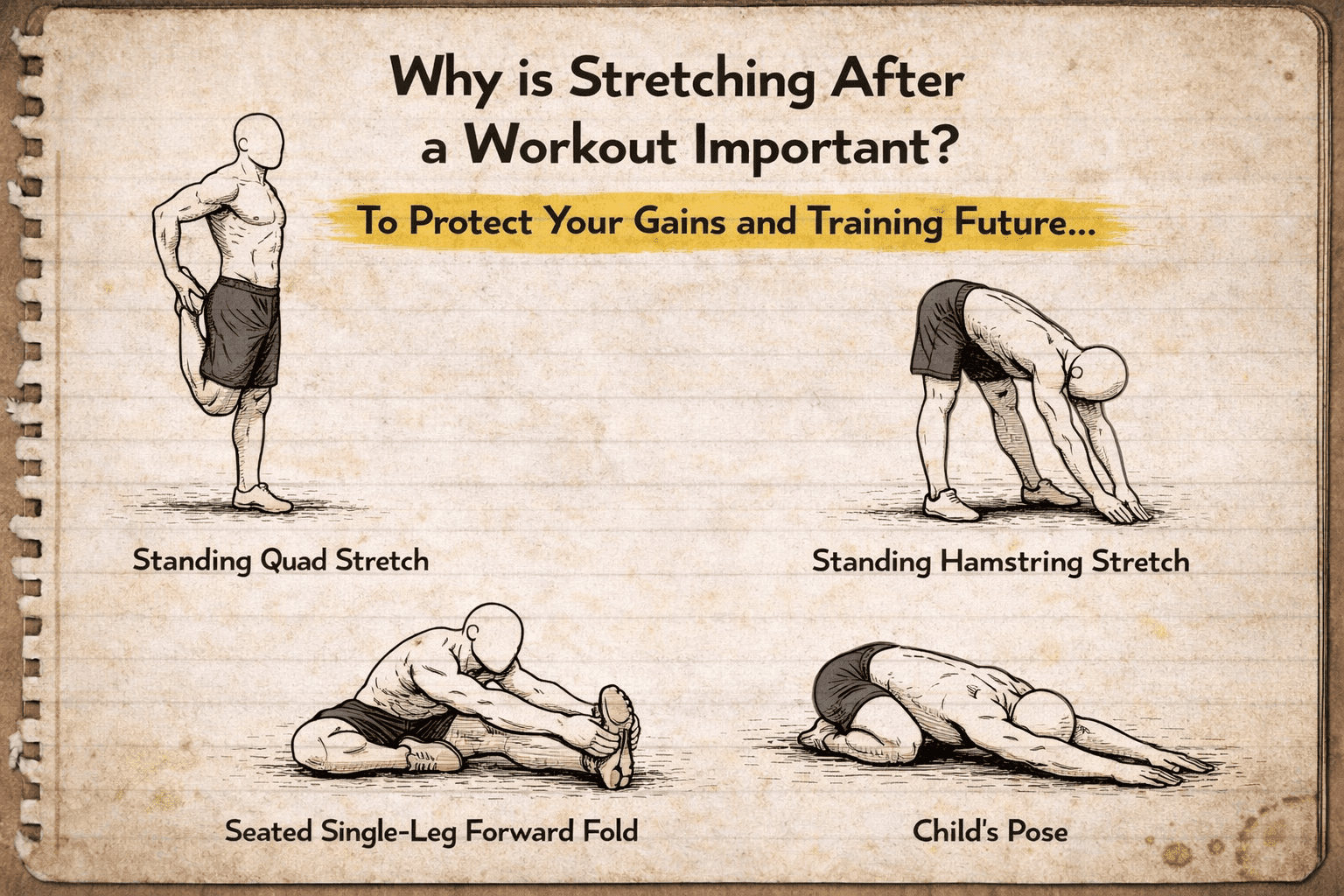
You just crushed a killer training session, and every instinct tells you to grab your water, check your phone, and move on with your day.
That’s the exact moment most guys lose the long game. Post-workout stretching isn’t some yoga studio upsell or physical therapy theater. It’s the difference between training hard at 45 and watching from the sidelines with chronic tightness, nagging injuries, and a body that feels older than it should. The guys still throwing down heavy kettlebell swings, banging out pistol squats, and rucking 10 miles in their late 40s aren’t genetically gifted. They’re just disciplined about the boring stuff that compounds over decades.
Your muscles, fascia, and connective tissue are in a specific state immediately after training. Hot, contracted, flooded with metabolic byproducts, and primed to adapt. What you do in the 10 to 15 minutes after your last rep determines whether that adaptation makes you more mobile and resilient or tighter and more injury-prone. Skipping post-workout stretching is like doing all the hard work to build a house then refusing to seal the roof. The structure might hold for a while, but you’re inviting long-term damage.
Most content on stretching treats it like an optional bonus or rehashes the same generic advice about touching your toes. This isn’t that. This is a breakdown of why post-workout stretching matters for the specific training styles you actually do, what’s happening inside your body when you stretch warm muscle, and how to build a sustainable cool-down that takes less time than scrolling Instagram but pays dividends for decades.
Here’s why those 10 minutes matter more than you think.
Table of Contents
What Happens to Your Muscles During Training
Your muscles don’t just contract and release during a workout. They undergo a complex series of structural changes that leave them temporarily shortened, inflamed, and primed for adaptation.
When you perform a kettlebell swing, a pistol squat, or a set of ring dips, your muscle fibers contract repeatedly under load. This creates micro-tears in the tissue (the good kind that leads to growth and strength), triggers an inflammatory response, and causes the muscle fibers to temporarily shorten and stiffen. Blood flow increases during the workout to deliver oxygen and nutrients, but once you stop moving, that circulation drops off rapidly. Metabolic waste products like lactic acid, hydrogen ions, and adenosine diphosphate accumulate in the tissue.
Here’s what most people miss: your muscles are in a semi-contracted state even after you finish your last rep. The nervous system keeps them slightly activated, and the fascia (the connective tissue wrapping around muscle fibers) tightens in response to the load you just placed on it. If you immediately stop moving and let everything cool down in that shortened state, the muscle fibers and fascia will adapt to that length. Over time, this leads to a progressive loss of range of motion, chronic tightness, and compensatory movement patterns that increase injury risk.
Post-workout stretching while the tissue is still warm interrupts this process. It lengthens the muscle fibers back toward their resting length, promotes circulation to clear metabolic waste, and signals to the nervous system that it’s safe to release the protective tension. This isn’t about becoming a contortionist. It’s about maintaining the range of motion you already have and preventing the slow creep of stiffness that accumulates with every training session you don’t cool down properly.
Why Warm Muscle Stretches Differently Than Cold Muscle
Stretching cold muscle is like trying to bend a frozen rubber band. Stretching warm muscle after training is like working with heated clay. The tissue responds completely differently.
Temperature changes the viscosity and elasticity of muscle tissue and fascia. When your muscles are warm from training, the collagen fibers in your connective tissue are more pliable. This allows you to safely lengthen the muscle fibers and surrounding fascia without triggering a protective stretch reflex or risking a strain. Blood flow is still elevated, which means oxygen and nutrients are circulating through the tissue as you stretch, supporting recovery and adaptation.
Cold muscle, on the other hand, is stiff and resistant to lengthening. The nervous system is more likely to interpret aggressive stretching as a threat and respond by contracting the muscle to protect it (this is called the myotatic stretch reflex). This is why static stretching before a workout can actually decrease power output and increase injury risk. You’re fighting against your body’s protective mechanisms instead of working with them.
Post-workout is the ideal window for static stretching because:
- The muscle tissue is warm and pliable, allowing for greater range of motion without triggering protective reflexes.
- Blood flow is elevated, which supports nutrient delivery and waste removal during the stretch.
- The nervous system is primed to adapt, making it easier to lock in new ranges of motion and maintain flexibility.
- You’re less likely to injure yourself because the tissue is already warmed up and prepared for lengthening.
This is why the same hamstring stretch that feels like pulling concrete before a workout can feel smooth and accessible after 20 minutes of kettlebell swings. You’re not magically more flexible. You’re just working with your biology instead of against it.
How Stretching Supports Recovery and Reduces Soreness
Delayed onset muscle soreness (DOMS) isn’t caused by lactic acid. It’s caused by micro-tears in muscle fibers, inflammation, and the buildup of metabolic byproducts. Post-workout stretching won’t eliminate soreness, but it can reduce its intensity and duration.
When you stretch after training, you’re promoting circulation through the muscle tissue. This increased blood flow helps clear out metabolic waste products and delivers fresh oxygen and nutrients to support the repair process. Think of it like flushing a system instead of letting waste sit and stagnate. The gentle lengthening also helps reorganize muscle fibers and fascia as they repair, reducing the formation of adhesions (areas where tissue sticks together instead of sliding smoothly).
There’s a common myth that stretching “flushes lactic acid” from your muscles. Lactic acid clears from your system within 30 to 60 minutes after training, regardless of whether you stretch. What stretching does help with is reducing the mechanical tension and inflammation that contribute to that deep, achy soreness you feel 24 to 48 hours after a hard session.
Here’s what the research actually shows:
- Light static stretching post-workout can reduce perceived muscle soreness by 10 to 20 percent. It won’t eliminate DOMS, but it takes the edge off.
- Stretching improves circulation and lymphatic drainage, which supports faster recovery between sessions.
- Maintaining range of motion through stretching reduces compensatory movement patterns, which decreases the risk of overuse injuries from training with tight, restricted muscle groups.
The guys who stretch consistently after training don’t just feel better the next day. They train more frequently, move with better mechanics, and stay healthier over the long haul. Recovery isn’t passive. It’s a skill you build through deliberate habits like post-workout stretching.
Stretching After Calisthenics, Kettlebells, and Gymnastics
Different training styles create different patterns of tightness. Your post-workout stretching should match the demands of the session you just completed.
Calisthenics and gymnastics training create massive tension through the shoulders, hips, and wrists. Movements like muscle-ups, handstand push-ups, and L-sits require extreme ranges of motion under load, which leaves the surrounding muscles and connective tissue tight and shortened afterward. If you’re training ring work, your shoulders are internally rotated and compressed for extended periods. If you’re working pistol squats and deep lunges, your hip flexors and adductors are working overtime.
Post-workout stretching for calisthenics and gymnastics should focus on:
- Shoulder external rotation and overhead mobility. Stretch the pecs, lats, and anterior deltoids to counteract the internal rotation and compression from pressing and pulling movements.
- Hip flexor and adductor lengthening. Deep squatting and single-leg work tighten the hip flexors and inner thighs. Stretch these areas to maintain pelvic alignment and prevent lower back compensation.
- Wrist extension and flexion. Handstands, planches, and push-ups load the wrists heavily. Gentle wrist stretches after training reduce the risk of chronic wrist pain and tendonitis.
Kettlebell training, on the other hand, hammers the posterior chain. Swings, snatches, cleans, and Turkish get-ups load the glutes, hamstrings, lower back, and upper traps. The hinge pattern creates repetitive shortening of the hamstrings and spinal erectors. Heavy carries and overhead work tighten the shoulders and upper back.
Post-workout stretching for kettlebell training should focus on:
- Hamstring and glute lengthening. Use standing or seated hamstring stretches and pigeon pose variations to restore hip extension and reduce lower back tension.
- Thoracic spine mobility. Kettlebell training compresses the upper back. Cat-cow stretches and thoracic rotations help maintain spinal mobility and prevent rounded posture.
- Lat and shoulder stretches. Overhead carries and presses tighten the lats and shoulders. Stretch these areas to maintain overhead range of motion and prevent shoulder impingement.
The key is to match your stretching to the movement patterns you just trained. If you just rucked for an hour, your hip flexors and calves are screaming for attention. If you just did a ring workout, your shoulders and wrists need care. Generic stretching routines miss the mark because they don’t address the specific tension patterns your training creates.
The Nervous System and Stretching: Why It’s Not Just About Muscles
Flexibility isn’t just about muscle length. It’s about whether your nervous system feels safe allowing you into a range of motion.
Your brain and spinal cord constantly monitor tension in your muscles through sensory receptors called muscle spindles and Golgi tendon organs. When you move into a deep stretch, these receptors send signals to your nervous system about how much tension is building. If the nervous system perceives the tension as a threat (too much, too fast, or in a vulnerable position), it triggers a protective reflex that contracts the muscle to prevent injury.
This is why you can’t force flexibility. You have to earn it by teaching your nervous system that the new range of motion is safe. Post-workout stretching, when done properly, does exactly that. By holding gentle, sustained stretches while the tissue is warm, you give the nervous system time to adapt to the new length without triggering a protective response.
Here’s how to work with your nervous system instead of against it:
- Hold stretches for 30 to 90 seconds. This gives the Golgi tendon organs time to signal the brain that the tension is safe, which allows the muscle to relax and lengthen.
- Breathe deeply and slowly during each stretch. Slow breathing activates the parasympathetic nervous system (rest and digest mode), which reduces protective muscle tension and allows for greater range of motion.
- Avoid bouncing or forcing a stretch. Rapid or aggressive stretching triggers the stretch reflex, which causes the muscle to contract and resist the lengthening.
- Use progressive overload with stretching. Just like strength training, flexibility improves gradually over time. Push slightly deeper into each stretch as your nervous system adapts, but never force it.
Post-workout stretching isn’t just about pulling tight muscles. It’s about training your nervous system to trust new ranges of motion, which is the only way to build lasting flexibility and mobility. The guys who stay mobile and pain-free into their 40s and 50s aren’t just stretching their muscles. They’re training their nervous systems to feel safe in deep positions.
Common Mistakes That Make Post-Workout Stretching Useless
Most people stretch after training, but they do it in ways that provide zero benefit or actively increase injury risk. Here’s what to avoid.
Mistake 1: Holding stretches for less than 20 seconds. Quick, superficial stretches don’t give your nervous system enough time to adapt. Research shows that holding a static stretch for at least 30 seconds is necessary to trigger the neurological changes that improve flexibility. Anything less is just going through the motions without earning the adaptation.
Mistake 2: Stretching cold muscle groups. If you finish a lower body session and immediately start stretching your shoulders, you’re working with cold tissue. Stretch the muscle groups you actually trained while they’re still warm. If you want to stretch other areas, do a brief warm-up first.
Mistake 3: Using aggressive or painful stretching. Stretching should create a strong sensation of tension but never sharp pain. If you’re grimacing and holding your breath, you’re triggering a protective response that limits progress. Back off to a level where you can breathe smoothly and relax into the stretch.
Mistake 4: Skipping stretching on “easy” days. Consistency matters more than intensity. The sessions where you feel loose and mobile are often the best times to stretch because your nervous system is relaxed and receptive. Don’t only stretch after brutal workouts. Make it a habit after every session, regardless of intensity.
Mistake 5: Rushing through a generic routine. Five minutes of half-hearted toe touches won’t move the needle. Choose three to five stretches that target the muscle groups you just trained, and hold each one for 30 to 90 seconds with full focus. Quality over quantity.
The difference between stretching that works and stretching that wastes time comes down to intention and execution. Treat your cool-down with the same discipline you bring to your warm-up and working sets. It’s not glamorous, but it’s the habit that keeps you training hard for decades.
A Simple Post-Workout Stretching Protocol You’ll Actually Use
The best stretching routine is the one you’ll actually do consistently. Here’s a framework that takes 10 minutes and adapts to any training style.
Step 1: Pick three to five muscle groups that you trained. If you just did kettlebell swings and goblet squats, focus on hamstrings, glutes, hip flexors, and lower back. If you did ring dips and pull-ups, focus on chest, shoulders, lats, and triceps. Don’t try to stretch your entire body. Target the areas that worked hardest.
Step 2: Hold each stretch for 30 to 90 seconds. Set a timer if you need to. Breathe slowly and deeply. Relax into the stretch instead of fighting it. If the tension decreases after 30 seconds, gently push a bit deeper (but never into pain).
Step 3: Use a mix of static and dynamic stretches. Static stretches (holding a position) are great for lengthening tight muscles. Dynamic stretches (controlled movement through a range of motion) help restore mobility and prep your body for the next session. A good split is two to three static stretches followed by one to two dynamic movements.
Step 4: End with deep breathing or light movement. Finish your cool-down with two minutes of slow walking, easy bodyweight squats, or simple breathwork. This helps transition your nervous system from work mode to recovery mode and prevents the stiffness that comes from sitting down immediately after training.
Example post-workout protocol after a kettlebell session:
- Standing hamstring stretch: 60 seconds per leg, focus on hinging from the hips and keeping the spine neutral.
- Pigeon pose: 60 seconds per side, breathe into the hip and relax the glute.
- Cat-cow stretch: 10 slow repetitions, focus on spinal mobility and deep breathing.
- Child’s pose with lat stretch: 60 seconds, walk hands to one side to target the lats.
- Walking lunges: 10 reps per leg, slow and controlled, to restore hip mobility.
This takes less than 10 minutes. You don’t need a foam roller, a yoga mat, or a dedicated recovery space. Just a small patch of floor and the discipline to invest those few minutes into your long-term mobility and resilience.
How Stretching Supports Longevity and Injury Prevention
The real value of post-workout stretching isn’t what it does today. It’s what it prevents five, ten, or twenty years from now.
Every training session you complete without stretching is a small deposit into the injury bank. Tight hip flexors from rucking eventually cause lower back pain. Shortened pecs and shoulders from push-ups and dips lead to impingement and rotator cuff issues. Restricted hamstrings from kettlebell swings create compensatory movement patterns that overload the knees and lower back.
These issues don’t show up overnight. They accumulate slowly, session after session, until one day you can’t get into a deep squat without pain, or your shoulder hurts every time you press overhead, or your lower back feels stiff every morning. At that point, you’re not dealing with a flexibility problem. You’re dealing with years of neglected mobility that’s now limiting your training and quality of life.
Post-workout stretching is your insurance policy. It’s the boring, unglamorous habit that keeps your joints healthy, your movement patterns clean, and your training sustainable. The guys still throwing down at 50 aren’t lucky. They’re disciplined about the small things that compound over decades.
Here’s what consistent post-workout stretching protects:
- Joint health. Maintaining full range of motion through stretching reduces abnormal joint loading and decreases the risk of arthritis and degenerative changes.
- Movement quality. Tight muscles force compensatory patterns that increase injury risk. Stretching keeps your movement clean and efficient.
- Training frequency. The more mobile and pain-free you are, the more often you can train hard without needing extended recovery periods.
- Long-term performance. Flexibility and mobility don’t just prevent injury. They unlock strength and power by allowing you to access full ranges of motion under load.
Longevity in training isn’t about finding the perfect program or the most advanced techniques. It’s about showing up consistently and taking care of the basics. Post-workout stretching is one of those basics. It’s not sexy, but it works.
When Stretching Isn’t Enough: Mobility Work and Active Recovery
Stretching is essential, but it’s not the complete picture. Durable athletes combine post-workout stretching with regular mobility work and active recovery.
Static stretching after training helps maintain the flexibility you already have, but it won’t unlock new ranges of motion or address deeper mobility restrictions. For that, you need dedicated mobility sessions that combine stretching, joint articulation, and loaded range-of-motion work. Think movements like deep squat holds, controlled articular rotations, and end-range strengthening.
Active recovery sessions (low-intensity movement on rest days) also play a critical role in maintaining mobility and reducing chronic tightness. A 30-minute walk, a light swim, or an easy bike ride promotes blood flow and keeps your joints and muscles moving through natural ranges of motion without adding training stress.
Here’s how to layer these practices into your training week:
- Post-workout stretching: 10 to 15 minutes after every training session, targeting the muscle groups you worked.
- Dedicated mobility sessions: 20 to 30 minutes twice per week, focusing on weak points and restricted joints (hips, shoulders, ankles, thoracic spine).
- Active recovery: 30 to 60 minutes of low-intensity movement on rest days to promote circulation and maintain movement quality.
None of these practices are optional if you want to train hard and stay healthy for decades. They’re different tools that serve different purposes. Post-workout stretching is your daily maintenance. Mobility sessions are your deep work. Active recovery is your reset button. Together, they create a system that keeps you moving well and training hard for the long haul.
The guys who skip all three and just hammer hard sessions week after week are the ones dealing with chronic pain, limited range of motion, and forced time off by age 40. Don’t be that guy.
Post-workout stretching isn’t a hack or a shortcut. It’s a discipline that pays dividends over decades, not days. Ten minutes after every session to restore range of motion, support recovery, and protect your joints from the slow creep of tightness and dysfunction. That’s the trade. The guys who make it look easy at 45 aren’t genetically gifted. They’re just consistent with the boring stuff that everyone else skips.
Your body will adapt to the demands you place on it, but only if you give it the tools to recover and maintain quality movement. Stretching while your muscles are still warm is one of those tools. Use it, or spend your later years wishing you had.


ABOUT THE AUTHOR
Carlos Grider is a former U.S. Marine, CrossFit Level 1 trainer, certified personal trainer, and the creator of Forge the Flow. After nearly a decade supporting combat operations and special operations in austere environments — and another decade traveling across 65+ countries as a nomad and adventure athlete — Carlos distilled everything he learned about staying strong, capable, and resilient without a gym into the Forge the Flow training system. He has trekked solo to Everest Base Camp, surfed Bali through the pandemic, trained Muay Thai in Thailand, and run self-guided marathons across four continents — all maintained on minimalist training built for real life. He writes about the fitness methods that actually travel.
Click here to learn more about Carlos's story.