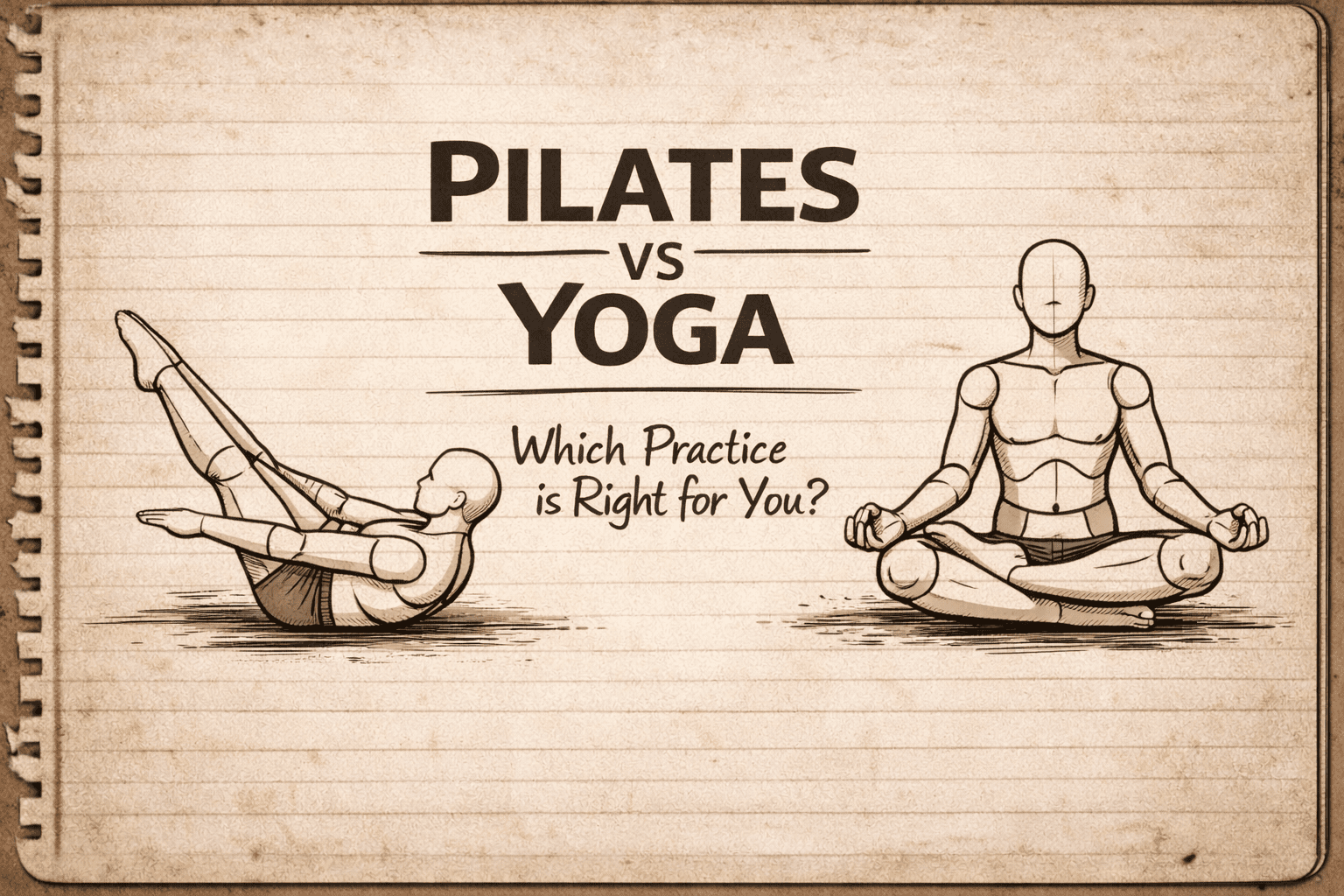
When it comes choosing between pilates vs. yoga, which is better? Spoiler alert: you have been sold a lie about flexibility training and what it means for functional fitness and longevity.
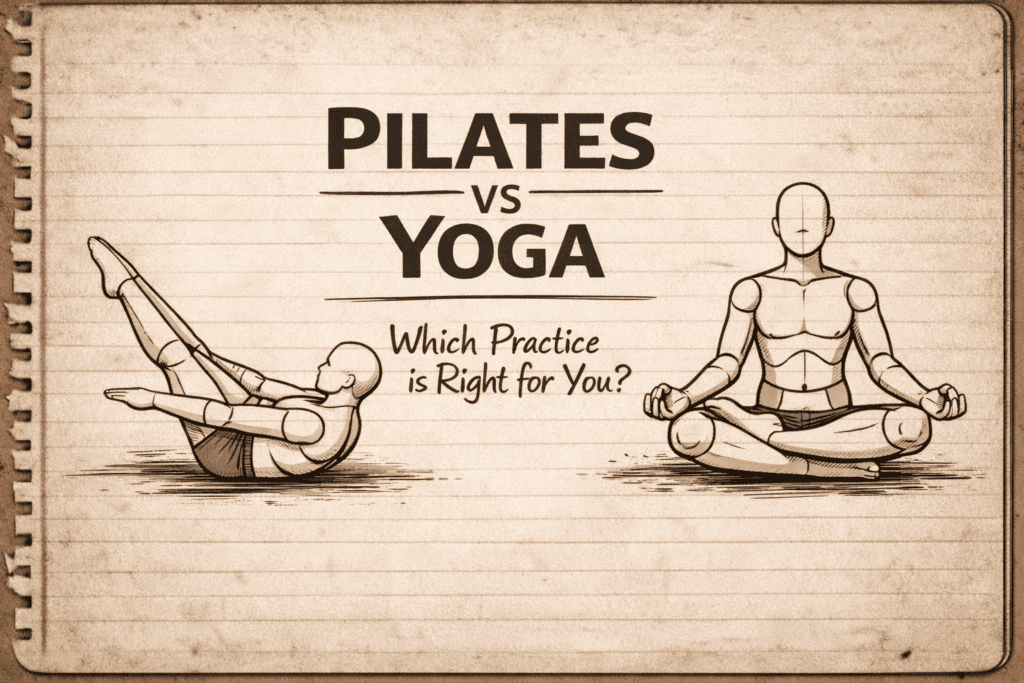
The wellness industry wants you to believe that yoga and Pilates are interchangeable, soft recovery practices best left for rest days or people who do not train hard. But if you are serious about longevity, moving well into your 50s and beyond, and building a body that stays functional under load, you need to understand the fundamental differences between these two practices. They are not the same, they do not deliver the same outcomes, and choosing the wrong one for your goals is a waste of time you will never get back.
Most comparisons treat yoga and Pilates like lifestyle accessories. This one will not. You train with kettlebells, you ruck, you do calisthenics, and you value efficiency. You want to know which practice actually complements that work, builds real strength and mobility, and integrates seamlessly into a minimalist training philosophy without eating up hours you do not have.
Here is the truth: one of these practices will make you stronger, more stable, and more resilient for the training you already do. The other will make you more flexible, calmer, and better at managing stress. Both have value, but only one is the better fit for men chasing functional strength and durable fitness.
Let’s break down what each one actually does, where they excel, where they fall short, and which one deserves a permanent spot in your training week.
Table of Contents
What Pilates Actually Is and How It Works
Pilates is not stretching with props.
It is a resistance-based movement system designed to build core stability, controlled strength, and joint integrity through precise, intentional movement patterns. Created by Joseph Pilates in the early 20th century as a rehabilitation method for injured soldiers and dancers, the practice centers on something called the powerhouse, which is your deep abdominal muscles, pelvic floor, lower back, and glutes. Every exercise in Pilates is designed to engage this region while moving your limbs through space with control and alignment.
The magic of Pilates is in the tension. Unlike yoga, which uses bodyweight and gravity to create length and flexibility, Pilates uses springs, bands, and controlled eccentric loading to build strength in lengthened positions. This is why Pilates practitioners often look lean and strong without bulk. They are training muscles to fire while stretched, which builds functional strength across a full range of motion. You are not just holding a plank. You are holding a plank while moving one leg in a controlled arc against resistance, forcing your core to stabilize against rotation and collapse.
There are two main types of Pilates. Mat Pilates uses your bodyweight and occasionally small props like resistance bands or balls. Reformer Pilates uses a sliding carriage with springs that create variable resistance, allowing you to train in ways that are impossible with bodyweight alone. Reformer work is where Pilates shines for strength athletes because it mimics loaded movement patterns, trains anti-rotation strength, and builds stability under tension.
The system is built on six core principles: concentration, control, center, flow, precision, and breathing. These are not just buzzwords. They are the operating instructions that turn simple-looking movements into brutally effective strength work. A single-leg bridge on a reformer, done with true control and precision, will light up your posterior chain in ways that surprise even experienced lifters.
What Yoga Actually Is and How It Works
Yoga is not one thing.
It is an umbrella term covering thousands of years of physical, mental, and spiritual practices that originated in ancient India. The physical practice most people know, what we call asana in Sanskrit, is just one branch of a much larger philosophical system. But for the purpose of this comparison, we are focusing on the movement side, the postures, flows, and breathing techniques that make up modern yoga classes.
At its core, yoga uses bodyweight, gravity, and time under tension to build flexibility, balance, and body awareness. You move through a series of poses that lengthen muscles, open joints, and challenge your ability to hold uncomfortable positions while staying calm and breathing deeply. The practice is built around the relationship between breath and movement. Inhale to lengthen, exhale to deepen. This rhythm creates a moving meditation that trains your nervous system as much as your muscles.
There are dozens of yoga styles, but here are the ones that matter most for active men. Hatha yoga is slow and foundational, focusing on holding individual poses for longer periods. Vinyasa or flow yoga links breath with movement, creating a continuous, cardio-like experience that builds heat and endurance. Ashtanga yoga is a rigid, athletic sequence of poses done in the same order every time, ideal for people who like structure and progression. Yin yoga holds passive stretches for 3 to 5 minutes, targeting connective tissue and deep fascia. Restorative yoga uses props to support the body in restful poses, focusing on nervous system recovery.
Yoga builds flexibility and mobility by taking joints through their full range of motion repeatedly. It strengthens muscles in isometric holds, particularly in poses like Warrior II, Chair Pose, or Chaturanga. It trains balance and proprioception through one-legged poses and inversions. And it trains breath control and mental focus, which has real carryover to any high-stress or high-output training session.
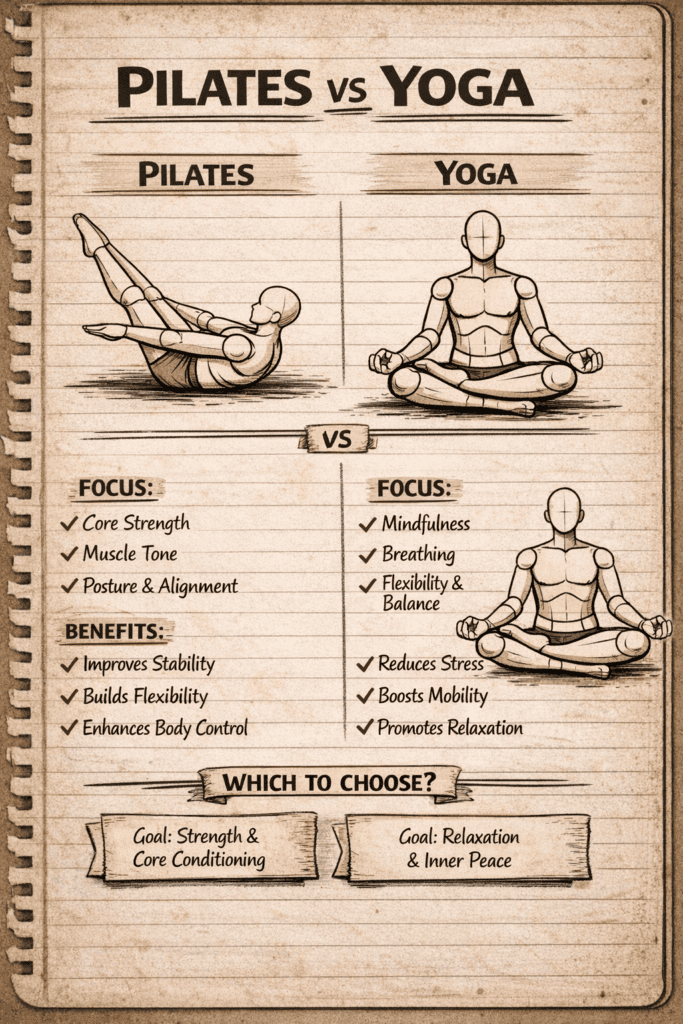
Where yoga differs from Pilates is in its primary intent. Pilates is a strength system with flexibility as a byproduct. Yoga is a flexibility and awareness system with strength as a byproduct.
Core Strength and Stability Comparison of pilates vs yoga
Pilates dominates this category.
Core strength is not about six-pack abs. It is about your ability to resist unwanted movement while your limbs are under load. When you press a kettlebell overhead, your core has to prevent your spine from overextending. When you carry a ruck for miles, your core has to stabilize against the shifting weight on your back. When you do a strict pull-up, your core has to keep your body from swinging. This is anti-extension, anti-rotation, and anti-lateral flexion strength, and it is what keeps you safe and strong under real-world demands.
Pilates trains this better than almost anything. Every exercise on the reformer or mat challenges your ability to stay stable while moving. The Hundred, Leg Circles, Teaser, and Side Plank variations all force your deep core muscles to fire continuously while your limbs create instability. You are not just bracing. You are controlling movement against resistance, which is exactly what your core does during loaded carries, swings, or gymnastic holds.
Yoga builds core strength too, but in a different way. Holding Plank, Boat Pose, or Crow Pose will absolutely strengthen your abs and obliques. But the strength you build is more isometric and less dynamic. You are holding position, not resisting movement. That is valuable, but it does not translate as directly to the kind of loaded, multi-planar demands you face in kettlebell work or calisthenics.
If your goal is to build a bulletproof midsection that stabilizes heavy lifts and protects your spine during explosive movement, Pilates is the superior choice. If you want a strong core as part of a broader flexibility and mindfulness practice, yoga still delivers.
Flexibility and Mobility Gains of pilates vs. yoga
Yoga wins this one, no contest.
Flexibility is your muscle’s ability to lengthen. Mobility is your joint’s ability to move through its full range of motion with control. Yoga directly targets both by putting your body into deep stretches and holding them long enough to create adaptation. Hip openers like Pigeon Pose or Lizard Pose, hamstring stretches like Forward Fold or Pyramid Pose, and shoulder openers like Cow Face or Thread the Needle all create length in chronically tight areas.
For men who spend hours rucking, sitting at desks, or doing repetitive strength work, this is critical. Tight hips limit your squat depth. Tight hamstrings pull on your lower back. Tight shoulders restrict your overhead position. Yoga systematically addresses all of these by taking each joint through flexion, extension, rotation, and lateral movement while you breathe and relax into the stretch.
Pilates does improve flexibility, but it is a secondary outcome. The movements are dynamic and controlled, not held for long periods. You will gain functional range of motion through exercises like Leg Circles or Spine Stretch Forward, but you will not achieve the deep, passive stretching that yoga provides. Pilates prioritizes stability in range, not maximum range itself.
Here is the key distinction. Yoga gives you the range. Pilates gives you the strength to control that range. For most active men, you need both. But if you can only choose one and your hips, hamstrings, and shoulders feel like rusted hinges, start with yoga.
Strength Development and Muscle Engagement
Pilates builds more functional strength.
Yoga builds isometric strength and muscular endurance. Holding Warrior II for 90 seconds will light up your quads and shoulders. Flowing through ten Chaturangas will fatigue your triceps and chest. But this is time-under-tension strength, not progressive resistance. You cannot add weight to a Downward Dog. You cannot increase the load on a Chair Pose. Your bodyweight is the ceiling.
Pilates, especially on the reformer, allows for progressive overload. You can increase spring tension, change angles, add instability, and manipulate tempo. A reformer footwork series can load your legs with enough resistance to challenge even strong athletes. A chest press on the reformer mimics a bench press with the added demand of stabilizing a moving carriage. You are building strength that translates directly to your kettlebell presses, your pull-ups, and your carries.
Mat Pilates still builds strength, but in a different way. Exercises like the Roll-Up, Single-Leg Stretch, and Teaser require intense core and hip flexor strength. Side-lying leg series and bridging variations target glutes and outer hips with precision. You are working smaller stabilizer muscles that often get ignored in traditional strength training.
For men focused on longevity and functional fitness, Pilates offers a better strength stimulus that complements heavy lifting without competing with it. Yoga offers mobility and recovery that allows you to lift and move better, but it will not make you stronger in the way that matters for loaded movement.
Breathing Mechanics and Nervous System Impact
Both practices prioritize breath, but in completely different ways.
Yoga uses pranayama, or breath control, to regulate your nervous system. Techniques like Ujjayi breathing, which creates an audible ocean sound in the back of your throat, slow your heart rate and activate your parasympathetic nervous system. Box breathing, alternate nostril breathing, and breath retention exercises train your ability to stay calm under physical stress. This is not woo. Controlled breathing has been shown to lower cortisol, improve heart rate variability, and enhance focus.
For men who train hard, manage high-stress jobs, or struggle with sleep and recovery, yoga breathing is a powerful tool. It teaches you how to downregulate your nervous system on demand, which directly improves recovery, decision-making, and resilience.
Pilates uses breathing differently. It emphasizes lateral thoracic breathing, which means expanding your ribcage sideways instead of letting your belly balloon forward. This keeps your core engaged while still allowing full oxygen exchange. Every Pilates exercise is paired with a specific breath pattern. Inhale to prepare, exhale during the effort. This rhythm reinforces core activation and teaches you how to stay braced under tension, which is exactly what you need during a heavy swing or a long ruck.
Both systems improve your breathing mechanics, but yoga is better for nervous system recovery and stress management, while Pilates is better for breath control during loaded movement.
Injury Prevention and Joint Health
Both practices reduce injury risk, but through different mechanisms.
Pilates prevents injury by building stability and control around your joints. If you have a history of lower back pain, knee issues, or shoulder instability, Pilates teaches your muscles to fire in the right sequence and protect vulnerable areas. The controlled, low-impact nature of the work makes it ideal for rehab and prehab. Physical therapists often use Pilates-based exercises to restore movement patterns after injury.
The emphasis on alignment and precision in Pilates also trains you to move well under fatigue. When your form breaks down during a kettlebell workout or a ruck, that is when injuries happen. Pilates ingrains good movement patterns so deeply that they become automatic.
Yoga prevents injury by improving mobility and body awareness. Tight muscles pull joints out of alignment. Limited range of motion forces compensations that lead to overuse injuries. Yoga systematically opens up tight areas and restores balance between opposing muscle groups. If your right hip is tighter than your left, yoga will expose that imbalance and help you correct it.
The mindfulness component of yoga also makes you more attuned to your body’s signals. You learn the difference between productive discomfort and harmful pain. You develop the discipline to back off when something does not feel right. For men who tend to push through pain and ignore warning signs, this is invaluable.
If you want to bulletproof your joints and build resilience against the demands of heavy training, add Pilates. If you want to restore balance, open tight areas, and prevent overuse injuries from chronic tightness, add yoga. Ideally, you use both.
Time Efficiency and Minimalist Training Fit
Pilates is more time-efficient for strength goals.
A 20-minute Pilates session can deliver a full-body strength workout if you know what you are doing. Mat exercises like the Pilates 100, Roll-Ups, Scissors, and Plank variations can be done anywhere with zero equipment. A reformer session can replace an entire accessory lifting day, hitting your core, glutes, and stabilizers without needing a gym.
Yoga requires more time to deliver results. A meaningful yoga session typically runs 45 to 90 minutes because you need time to warm up, move through sequences, and hold stretches long enough to create change. You can do a 15-minute mobility flow and feel better, but you will not build the same depth of flexibility or mental clarity that a full practice provides.
For men following a minimalist training philosophy, Pilates integrates more cleanly. You can do a short session before or after your main lifting work without feeling depleted. You can use it as active recovery on off days. You can target weak links with surgical precision without adding unnecessary volume.
Yoga fits better as a standalone session, ideally on a rest day or as an evening wind-down practice. It is harder to squeeze into the margins of a busy training week, but when you do make time for it, the return on investment is massive.
Mental Focus and Mind-Body Connection
Yoga builds mental resilience and presence.
The practice of holding uncomfortable poses while staying calm and breathing deeply is a direct training stimulus for your mind. You learn to sit with discomfort without reacting. You practice being present in your body instead of lost in your thoughts. This carries over to every hard training session, every stressful workday, and every moment where you need to stay composed under pressure.
Yoga also includes meditation and mindfulness as core components. Even in a purely physical class, the beginning and end typically include moments of stillness and breath awareness. For men who spend most of their waking hours in go mode, this forced downshift is medicinal.
Pilates builds focus through precision. Every movement requires your full attention. If you lose concentration for even a second, your form breaks down and the exercise becomes ineffective or unsafe. This trains a different kind of mental sharpness, the ability to execute with discipline and control even when fatigued.
Both practices improve your mind-body connection, but yoga does it through presence and acceptance, while Pilates does it through precision and control.
Common Mistakes Men Make with Yoga
Forcing flexibility is the biggest error.
Men tend to approach yoga the same way they approach strength training. They push into stretches aggressively, trying to gain range of motion through force instead of patience. This leads to overstretching, muscle strains, and joint irritation. Flexibility is not built in a single session. It is earned through consistent, gentle exposure over weeks and months.
Another mistake is skipping the breathing. If you are just moving through poses without syncing your breath, you are doing calisthenics, not yoga. The breath is what activates the parasympathetic nervous system and turns a physical practice into a recovery tool.
Choosing the wrong style is also common. If you walk into a hot power yoga class expecting relaxation, you will be disappointed. If you try a restorative class expecting a workout, you will be bored. Match the style to your goal. Flow and Ashtanga for movement and conditioning. Yin and restorative for deep stretching and recovery. Hatha for foundational strength and balance.
Ego is another trap. Yoga classes often include advanced practitioners doing inversions and deep backbends. Do not compare yourself. Your tight hips and limited hamstring flexibility are not a reflection of your worth or fitness. They are just the current state of your body. Respect where you are and progress gradually.
Common Mistakes Men Make with Pilates
Rushing through reps ruins the entire practice.
Pilates is not about volume. It is about control. One slow, precise rep with perfect form is worth more than ten sloppy ones. If you are banging out exercises quickly to feel like you worked hard, you are missing the point. The magic happens in the controlled eccentric, the pause at peak contraction, and the intentional breathing pattern.
Ignoring the cues is another error. Pilates instructors will tell you to engage your powerhouse, lengthen your spine, or draw your shoulders down. These are not just reminders. They are the difference between an effective exercise and wasted effort. If you tune out the cues and just mimic the shapes, you will not build the strength or stability that Pilates is designed to deliver.
Skipping the fundamentals is a mistake many men make when they first try Pilates. The basic exercises look easy, so they assume they need to jump to advanced variations. But foundational movements like the Hundred, Single-Leg Stretch, and Pelvic Curls are where you learn how to engage your core correctly. Without that foundation, advanced work is just flailing.
Not using a reformer is a missed opportunity. Mat Pilates is great, but reformer Pilates unlocks a completely different level of training. If you have access to a reformer, use it. The spring resistance allows you to load movements in ways that bodyweight cannot replicate.
How Pilates Complements Kettlebell Training
Pilates teaches you how to brace properly.
Every kettlebell movement, whether it is a swing, press, or Turkish get-up, requires core stability. Pilates drills that stability with relentless precision. Exercises like the Plank to Pike, Dead Bug, and Pallof Press variations train your core to resist movement while your limbs create instability, which is exactly what happens during a heavy swing or a bottoms-up press.
Pilates also improves your hip hinge pattern. The bridge series, single-leg glute work, and hamstring curls on the reformer strengthen your posterior chain in a way that directly supports your swing mechanics. A stronger, more stable hinge means more power and less lower back strain.
The shoulder stability work in Pilates is a game-changer for pressing. Exercises like Arm Circles, Chest Expansion, and Scapular Push-Ups train the small stabilizer muscles around your shoulder joint. These muscles keep your shoulder healthy and strong during overhead presses, windmills, and snatches.
Pilates also improves your body awareness and movement quality. You learn to feel when your ribs flare, when your lower back overextends, or when your shoulders creep toward your ears. This awareness transfers directly to your kettlebell work, helping you maintain better positions under load.
How Yoga Complements Calisthenics and Bodyweight Training
Yoga opens up the positions calisthenics demands.
If you want a deep squat, you need mobile hips and ankles. If you want a solid handstand, you need open shoulders and strong wrists. If you want to progress to advanced skills like the front lever or planche, you need full-body flexibility and control. Yoga builds all of this.
Hip-opening poses like Pigeon, Lizard, and Frog Pose prepare your body for pistol squats and deep lunges. Shoulder openers like Cow Face and Puppy Pose improve your overhead position for handstands and handstand push-ups. Wrist stretches and strengthening poses prepare your joints for the demands of planche and crow work.
Yoga also improves your balance and body control, which are foundational for calisthenics progressions. One-legged poses like Tree, Warrior III, and Half Moon train proprioception and stability, which carry over to single-leg squats and advanced balance holds.
The breathing work in yoga helps you stay calm during difficult calisthenics holds. When you are shaking in an L-sit or struggling through the last rep of a pull-up set, the ability to control your breath and stay mentally present is the difference between success and failure.
How Both Practices Support Rucking and Long-Distance Endurance
Pilates builds the stability you need to carry load for miles.
Rucking puts sustained stress on your core, hips, and shoulders. Pilates strengthens all three. Core stability prevents your lower back from collapsing under the weight of the pack. Hip strength prevents knee pain and IT band issues. Shoulder stability keeps your traps and upper back from fatiguing prematurely.
Exercises like the Side Plank series, Single-Leg Bridge, and Reformer Footwork all train the exact muscles you use during a long ruck. The emphasis on alignment and posture in Pilates also helps you maintain a neutral spine under load, which protects your back and improves your efficiency.
Yoga helps you recover from rucking by addressing the tightness and imbalances it creates. Long miles with a heavy pack tighten your hip flexors, hamstrings, calves, and shoulders. Yoga systematically opens all of these areas, restoring range of motion and reducing soreness.
A post-ruck yoga flow that includes hip openers, hamstring stretches, and shoulder releases will leave you feeling loose, mobile, and ready for your next session instead of stiff and beat up.
Integration Strategy for Minimalist Training Programs
Use Pilates twice a week as strength accessory work.
Schedule one session after your main lifting or calisthenics day, focusing on core stability and posterior chain strength. Schedule a second session on a lighter day or as standalone work, targeting areas of weakness like hip stability or shoulder control. Keep sessions between 20 and 40 minutes. You do not need more.
Use yoga once or twice a week as mobility and recovery work.
Schedule one session on a rest day or in the evening after a hard training day. Focus on hip openers, hamstring stretches, and shoulder mobility. If you have time for a second session, use it for breath work and nervous system recovery. Sessions can range from 15 minutes for a targeted mobility flow to 60 minutes for a full practice.
Rotate focus based on your training cycle.
If you are in a heavy strength phase with lots of kettlebell and barbell work, prioritize Pilates for core stability and yoga for recovery. If you are in a high-volume calisthenics or conditioning phase, prioritize yoga for mobility and use Pilates sparingly to avoid overtraining.
Do not overthink it. Both practices are tools. Use the right tool for the job in front of you.
Equipment and Setup Considerations
Pilates works best with minimal, specific gear.
For mat Pilates, all you need is a quality mat with enough cushioning to protect your spine during rolling exercises. A resistance band and a small Pilates ball can add variety and challenge, but they are optional. If you want to take your practice seriously, invest in reformer sessions at a studio. Most studios offer class packs or monthly memberships that make it affordable. A single reformer session per week will deliver more benefit than daily mat work.
Yoga requires almost nothing.
A decent yoga mat is the only non-negotiable. If you have tight hips or limited flexibility, a couple of blocks and a strap will help you access poses safely while you build range. A bolster or blanket is useful for restorative work, but you can use couch cushions or folded towels instead. The beauty of yoga is that you can practice anywhere, anytime, with almost no setup.
Both practices can be done at home with free videos or apps, but in-person instruction matters, especially at the beginning. A skilled instructor will correct your alignment, teach you how to breathe properly, and help you avoid injuries that bad form creates. Invest in a few private sessions or beginner workshops before committing to self-guided practice.
Which Practice is Better for Men Focused on Longevity and Functional Strength
Pilates is the better primary choice.
If your goal is to stay strong, mobile, and injury-free into your 50s, 60s, and beyond, Pilates delivers more direct benefit. It builds the core stability and joint control that protect your body during loaded movement. It strengthens the small stabilizer muscles that traditional lifting often misses. It teaches you how to move with precision and intention, which reduces injury risk and improves performance in every other area of your training.
Pilates also integrates seamlessly with kettlebell training, calisthenics, and rucking without adding unnecessary fatigue. You can use it as accessory work, prehab, or active recovery. It fills gaps in your training without competing with your main lifts.
But Pilates alone is not enough. You still need mobility work, and that is where yoga comes in. Yoga restores the flexibility and range of motion that heavy training and repetitive movement patterns steal. It trains your nervous system to recover. It builds mental resilience and presence. These are not luxuries. They are essential for long-term health and performance.
The ideal setup for most men is Pilates as your primary supplemental practice and yoga as your secondary recovery and mobility tool. Use Pilates to get stronger and more stable. Use yoga to stay loose, recover faster, and manage stress.
If you can only choose one and you are serious about building a body that works well for decades, choose Pilates. If you can make time for both, you will be unstoppable.
Pilates gives you the armor. Yoga gives you the freedom to move inside it. Together, they create a body that is strong, mobile, resilient, and built to last.

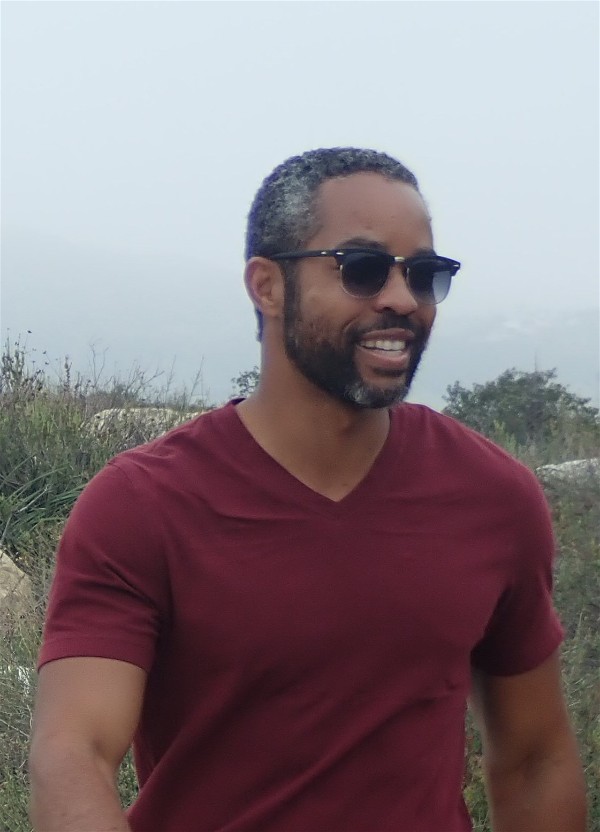
ABOUT THE AUTHOR
Carlos Grider is a former U.S. Marine, CrossFit Level 1 trainer, certified personal trainer, and the creator of Forge the Flow. After nearly a decade supporting combat operations and special operations in austere environments — and another decade traveling across 65+ countries as a nomad and adventure athlete — Carlos distilled everything he learned about staying strong, capable, and resilient without a gym into the Forge the Flow training system. He has trekked solo to Everest Base Camp, surfed Bali through the pandemic, trained Muay Thai in Thailand, and run self-guided marathons across four continents — all maintained on minimalist training built for real life. He writes about the fitness methods that actually travel.
Click here to learn more about Carlos's story.