
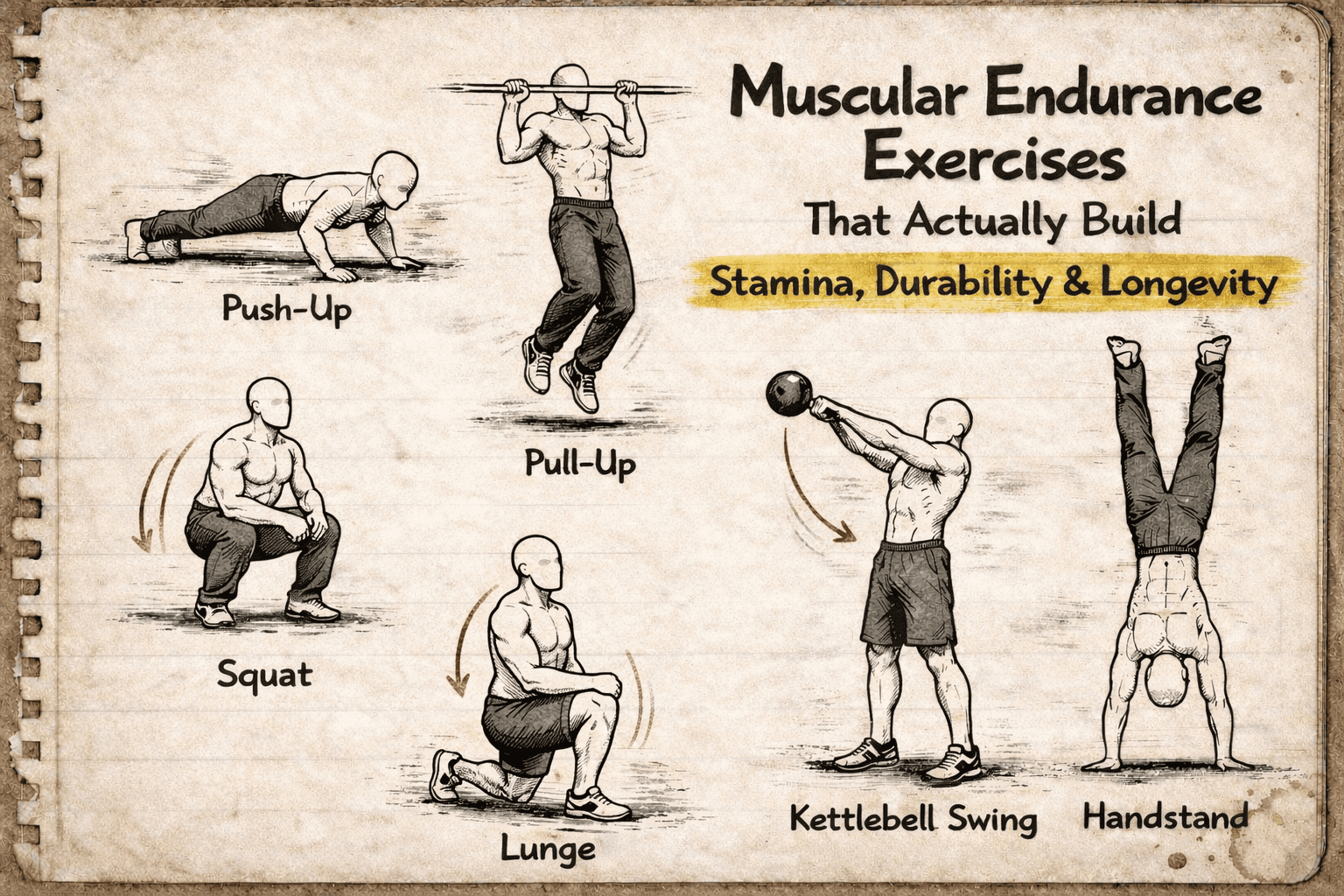
You can deadlift heavy, but can you carry gear for miles without your grip failing? Can you knock out quality reps in minute twenty of a workout, or does your form fall apart after the first set? Muscular endurance is the bridge between looking strong and being durable. It keeps your body functional under fatigue, protects joints from repetitive stress, and builds the kind of resilience that carries you through decades of movement, not just one max effort lift.
The best part is that building muscular endurance does not require complicated equipment or hour-long sessions. Bodyweight circuits, kettlebell flows, and simple gymnastics progressions deliver more bang for your buck than any machine at a commercial gym. These methods fit the minimalist lifestyle, travel well, and scale with your capability.
This guide breaks down the most effective muscular endurance exercises and how to program them for real results.
What Muscular Endurance Actually Means
Muscular endurance is your ability to sustain repeated contractions or hold a position under tension without a significant drop in performance.
It sits between raw strength and cardiovascular endurance. Strength is your one-rep max. Cardio is how long your lungs and heart can keep going. Muscular endurance is what happens when your muscles have to keep firing after the easy reps are done. It determines whether you can maintain good form during a long ruck, finish a fifty-rep kettlebell set without your shoulders giving out, or hold a plank for three minutes without shaking apart.
Why it matters for longevity: As you age, muscular endurance protects you from injury and functional decline. Joints stay healthier when muscles can absorb repetitive stress without breaking down. Tendons and ligaments benefit from controlled, sustained loading. Your body learns to distribute effort efficiently, which reduces wear on any single structure.
Why it matters for performance: Whether you are rucking, doing HIIT, or working through a calisthenics circuit, muscular endurance is what keeps you moving when fatigue sets in. It builds work capacity, the total amount of quality work you can handle in a session or over a week. More work capacity means faster recovery, better adaptation, and the ability to train harder without falling apart.
Training for muscular endurance also improves mitochondrial density in muscle tissue, enhances capillary networks for better oxygen delivery, and trains your nervous system to recruit muscle fibers more efficiently under fatigue. These adaptations are the foundation of durable fitness.
The Core Principles of Endurance Training
Building muscular endurance is not about grinding through random high-rep sets until you are too tired to continue.
Effective endurance training follows a structure. You need to control intensity, manage volume, and program progressive overload just like you would for strength. The difference is that instead of adding weight every week, you manipulate time under tension, rep schemes, rest periods, and movement complexity.
Time under tension is one of the most reliable drivers of endurance adaptation. Keeping muscles under load for extended periods forces them to develop fatigue resistance. A set that lasts sixty to ninety seconds hits a sweet spot for hypertrophy and endurance. Anything beyond two minutes shifts more toward pure endurance with less muscle-building stimulus.
Rest periods should be short enough to maintain a training effect but long enough to allow quality reps. For muscular endurance work, thirty to sixty seconds between sets is ideal. This keeps your heart rate elevated and prevents full recovery, which mimics the demands of real-world activity where you rarely get complete rest between efforts.
Progressive overload applies here just like it does in strength training. You can add reps, reduce rest, increase density by doing more sets in the same time window, or layer in more difficult variations. Progression keeps your body adapting instead of plateauing after a few weeks of the same routine.
Movement quality stays non-negotiable. Endurance work breaks down when form collapses. If you cannot maintain tension, control, and proper alignment, you are just grinding through junk reps that increase injury risk without building capacity. Scale the difficulty or cut the set short before your technique falls apart.
These principles apply whether you are doing bodyweight circuits, kettlebell complexes, or gymnastics holds. Structure beats randomness every time.
Best Bodyweight Exercises for Muscular Endurance
Bodyweight training is the most accessible and scalable way to build muscular endurance.
You can do it anywhere, adjust difficulty on the fly, and develop strength, stability, and endurance simultaneously. The key is choosing movements that load multiple muscle groups and allow you to sustain effort without technical breakdown.
Push-Up Variations
Standard push-ups are a baseline, but most guys plateau fast if they only do sets of twenty. To keep building endurance, you need to manipulate tempo, hand position, and range of motion.
- Tempo push-ups: Lower for three seconds, pause at the bottom for two, explode up. This increases time under tension and builds control.
- Close-grip push-ups: Hands inside shoulder width. Hammers triceps and front delts.
- Archer push-ups: Shift weight to one side while keeping the opposite arm extended. Builds unilateral endurance and prepares you for one-arm progressions.
- Decline push-ups: Feet elevated. Increases load on shoulders and upper chest.
Program these in circuits or density blocks. A solid endurance session might be five sets of max reps with forty-five seconds rest, aiming to keep each set within two reps of your first set. If your first set is thirty reps and your third set drops to fifteen, the intensity is too high or your rest is too short.
Pull-Up and Hanging Work
Pull-ups build pulling endurance, grip strength, and lat stamina all at once. Hanging work develops the kind of shoulder and core endurance that protects your upper body during long efforts.
- High-rep pull-ups: Sets of eight to fifteen reps with controlled tempo. No kipping unless you are specifically training for that style.
- Dead hangs: Hang from a bar for max time. Start with thirty seconds, build to two minutes. This bulletproofs your grip and shoulders.
- Scapular pull-ups: Hang, then pull shoulder blades down and together without bending elbows. Builds endurance in the stabilizers that keep your shoulders healthy.
- Chin-up hold: Pull to the top position and hold for twenty to forty seconds. Brutal for biceps and back endurance.
If you cannot do multiple pull-ups yet, use resistance bands or slow negatives. Lower yourself from the top position over five to ten seconds. This builds eccentric strength and endurance, which carries over fast to full reps.
Squat and Lunge Variations
Leg endurance separates people who can hike all day from people who blow up after an hour. Bodyweight squats and lunges are foundational, but adding tempo, pauses, and isometric holds turns them into serious endurance builders.
- Air squats: Sets of thirty to fifty with a controlled pace. Focus on depth and tension, not speed.
- Bulgarian split squats: Rear foot elevated. Builds single-leg endurance and exposes imbalances.
- Walking lunges: Cover fifty to one hundred meters. Maintain upright torso and full range of motion.
- Wall sits: Hold a squat position against a wall for sixty to ninety seconds. Simple, effective, miserable.
For endurance, do not chase depth at the expense of reps. A controlled parallel squat for fifty reps builds more endurance than ten ass-to-grass squats where you lose tension halfway through.
Core Endurance Exercises
Your core stabilizes everything. If it fatigues, your entire movement quality collapses. Building core endurance is not about doing a thousand crunches. It is about sustaining tension under different angles and loads.
- Planks: Front and side. Start with sixty seconds, build to three minutes. Keep hips level, squeeze glutes, breathe steady.
- Hollow body hold: Lie on your back, lift shoulders and legs off the ground, press lower back into the floor. Hold for thirty to sixty seconds. This is foundational for gymnastics and protects your spine under load.
- Dead bug: Slow, controlled reps for sets of twenty per side. Builds anti-rotation endurance.
- L-sit: Sit on the ground, hands by hips, press down and lift your legs off the floor. Hold for ten to thirty seconds. Scales to bar or parallel bars as you get stronger.
Core work should feel like a battle to maintain position, not a race to finish reps. Quality holds build the kind of endurance that transfers to every other movement.
Kettlebell Exercises That Build Endurance
Kettlebells are perfect for endurance work because they force you to stabilize an offset load while moving through multiple planes of motion.
A single kettlebell and twenty minutes is enough to build serious work capacity. The key is choosing exercises that let you sustain effort without your grip or form failing too early.
Kettlebell Swings
The swing is the king of kettlebell endurance. It trains your posterior chain, cardiovascular system, and grip all at once. A solid swing session will leave your lungs and hamstrings equally smoked.
Start with sets of twenty to thirty reps with thirty seconds rest. As you build capacity, push toward continuous swings for two to five minutes. Your grip will be the limiting factor at first, but it adapts fast. Use a weight that lets you maintain hip drive and a flat back for the entire set. If your lower back rounds or you start squatting the weight up, go lighter.
Goblet Squats
Hold the kettlebell at chest height and squat. The front load forces your core to stabilize and keeps your torso upright. Sets of fifteen to twenty-five reps build leg and core endurance without the spinal loading of a barbell.
Pair goblet squats with swings in a circuit for a brutal lower-body endurance session. Five rounds of twenty swings and fifteen goblet squats with minimal rest will test your capacity.
Turkish Get-Ups
The get-up is a slow, deliberate movement that builds endurance through stability and control. It teaches your body to sustain tension while transitioning through multiple positions.
Do sets of three to five per side. Focus on smooth transitions and locked-out positions. The get-up is not about speed. It is about owning every inch of the movement under load.
Kettlebell Complexes
A complex is a series of movements done back-to-back without putting the kettlebell down. Complexes are savage for building work capacity and mental toughness.
Example complex:
- Five cleans (each side)
- Five presses (each side)
- Five squats
- Ten swings
Rest sixty seconds, repeat for four to six rounds. Choose a weight that challenges you but lets you complete all reps with solid form. Complexes teach your body to manage fatigue across different movement patterns, which is exactly what real-world endurance demands.
Rucking for Full-Body Endurance
Rucking is walking with a weighted pack. It is low-skill, scalable, and one of the best ways to build full-body muscular endurance without beating up your joints.
Your legs, core, and upper back all work to stabilize the load for extended periods. Unlike running, rucking does not spike impact forces, so you can do it multiple times per week without overuse injuries. It also builds the kind of practical endurance that translates directly to hiking, travel, and real-world movement.
How to Start
Begin with ten to twenty pounds in a backpack and walk for thirty to forty-five minutes at a steady pace. Focus on posture. Keep your chest up, shoulders back, and core engaged. If you start leaning forward or your lower back aches, the weight is too heavy or your pack is sitting too low.
As you adapt, add weight in five-pound increments and extend duration. A solid long-term target is forty to fifty pounds for sixty to ninety minutes at a conversational pace.
Programming Rucking
Ruck two to three times per week. One session should be long and steady, building aerobic base and muscular endurance. Another can be shorter and faster, pushing your pace to increase intensity. A third can be hilly or include intervals where you increase speed for five minutes, recover for three, and repeat.
Rucking pairs well with bodyweight and kettlebell work. A weekly plan might include two ruck sessions, two strength or endurance circuits, and one mobility or gymnastics session. This balance builds durability without overloading any single system.
Gymnastics Movements for Endurance and Control
Gymnastics-based training builds muscular endurance through static holds, skill progressions, and high-tension bodyweight movements.
These exercises demand more from your nervous system than traditional endurance work, which makes them incredibly effective for building control, stability, and fatigue resistance.
Handstand Holds
Holding a handstand builds shoulder endurance, core stability, and body awareness. Start with wall-assisted holds, working up to sixty seconds. Focus on keeping your body tight, ribs down, and shoulders pushed through your ears.
As you build capacity, work toward freestanding holds. Even ten to fifteen seconds of a solid freestanding handstand requires serious endurance from your shoulders and core.
Ring Support Holds
If you have access to gymnastics rings, support holds are brutal for building upper-body endurance. Press down into the rings, lock out your elbows, and hold for twenty to sixty seconds. Your shoulders, chest, and triceps will burn.
Progress to ring dips, which combine strength and endurance. Sets of eight to fifteen controlled reps build serious pushing capacity.
Skin the Cat
Hang from a bar or rings, lift your knees to your chest, roll backward through a full shoulder rotation, and return. This movement builds shoulder mobility and endurance simultaneously. Start with five slow reps and build from there.
Gymnastics work is best done fresh, early in a session. These movements require focus and control, so do not stack them at the end of a workout when you are already fatigued.
HIIT Circuits for Endurance Under Fatigue
HIIT builds muscular endurance by forcing you to sustain effort while your body is in oxygen debt.
Short bursts of high-intensity work followed by brief rest periods train your muscles to perform under metabolic stress. This improves both anaerobic capacity and muscular endurance.
Structure
A solid HIIT session for muscular endurance runs fifteen to twenty-five minutes. Work intervals should be twenty to forty seconds, rest intervals ten to thirty seconds. The goal is to maintain high output across multiple rounds, not to go all-out for two rounds and then collapse.
Example Circuit
Four rounds, minimal rest:
- 40 seconds push-ups
- 20 seconds rest
- 40 seconds air squats
- 20 seconds rest
- 40 seconds kettlebell swings
- 20 seconds rest
- 40 seconds plank
- 60 seconds rest between rounds
Track your reps each round. The goal is to stay within ten percent of your first-round output. If you do twenty push-ups in round one and only manage ten in round three, the intensity is too high or you need longer rest.
HIIT sessions should be hard but repeatable. If you are completely destroyed and cannot train the next day, dial back the intensity or extend rest periods.
Common Mistakes That Kill Progress
Most people sabotage their endurance training without realizing it.
Going Too Heavy
Endurance work is not about maxing out. If you cannot sustain quality reps for the programmed time or volume, the load is too high. Drop the weight or scale the movement until you can complete the work with solid form.
Skipping Rest Days
Muscular endurance work is still stress. Your body needs recovery to adapt. Training endurance every day without rest leads to overuse injuries, joint pain, and stalled progress. Plan at least two full rest or active recovery days per week.
Ignoring Mobility
Tight hips, shoulders, or ankles limit your ability to move through full ranges of motion, which reduces the effectiveness of endurance work. Spend ten to fifteen minutes on mobility before or after sessions. Focus on hips, thoracic spine, shoulders, and ankles.
Chasing Burnout
Endurance training should build you up, not destroy you. If every session leaves you wrecked for days, you are doing too much. Progress comes from consistent, repeatable effort, not from grinding yourself into the ground.
How to Program Muscular Endurance Training
Programming endurance work depends on your goals, schedule, and current fitness level.
Beginner Approach
Start with two to three endurance sessions per week. Each session should be thirty to forty minutes and focus on one or two movement patterns. Example week:
- Monday: Bodyweight circuit (push-ups, squats, planks)
- Wednesday: Kettlebell swings and goblet squats
- Friday: Ruck for forty-five minutes
Keep intensity moderate. The goal is to build a base without overreaching.
Intermediate Approach
Three to four sessions per week with more volume and intensity. Mix modalities to avoid overuse.
- Monday: HIIT circuit (bodyweight)
- Tuesday: Ruck (steady pace, sixty minutes)
- Thursday: Kettlebell complex
- Saturday: Gymnastics endurance (handstands, ring work, holds)
Add progressive overload by increasing reps, reducing rest, or extending duration every two to three weeks.
Advanced Approach
Four to five sessions per week with varied intensity. Include one long, slow session, one high-intensity session, and two to three moderate sessions.
- Monday: Kettlebell endurance (complexes, high-rep swings)
- Tuesday: Bodyweight HIIT
- Wednesday: Active recovery or mobility
- Thursday: Ruck intervals (fast pace for five minutes, recover for three, repeat)
- Friday: Gymnastics skill work
- Saturday: Long ruck (ninety minutes, moderate pace)
Track your sessions. Note reps, times, loads, and how you felt. Adjust based on recovery and performance trends.
Tracking Progress and Adjusting
You need objective markers to know if your endurance is improving.
Reps and Time
Track how many reps you complete in a set time or how long you can sustain a movement. If you can hold a plank for ninety seconds today and you could only do sixty seconds a month ago, you have made progress.
Density
Measure how much work you can do in a fixed time window. If you complete four rounds of a circuit in twenty minutes today and you could only finish three rounds last month, your work capacity has increased.
Perceived Exertion
Rate how hard a session feels on a scale of one to ten. If a workout that used to feel like a nine now feels like a seven, you have adapted.
Recovery Time
Notice how long it takes you to feel ready for the next session. Faster recovery is a sign that your endurance and overall fitness are improving.
Review your data every four weeks. If progress stalls, adjust volume, intensity, or exercise selection. Add variety, increase difficulty, or take a deload week to let your body catch up.
Muscular endurance is not flashy, but it is the foundation of a body that works for decades, not just a season. The exercises in this guide build durability, work capacity, and the kind of quiet confidence that comes from knowing your body will not quit when things get hard. Program smart, stay consistent, and watch your capacity grow.