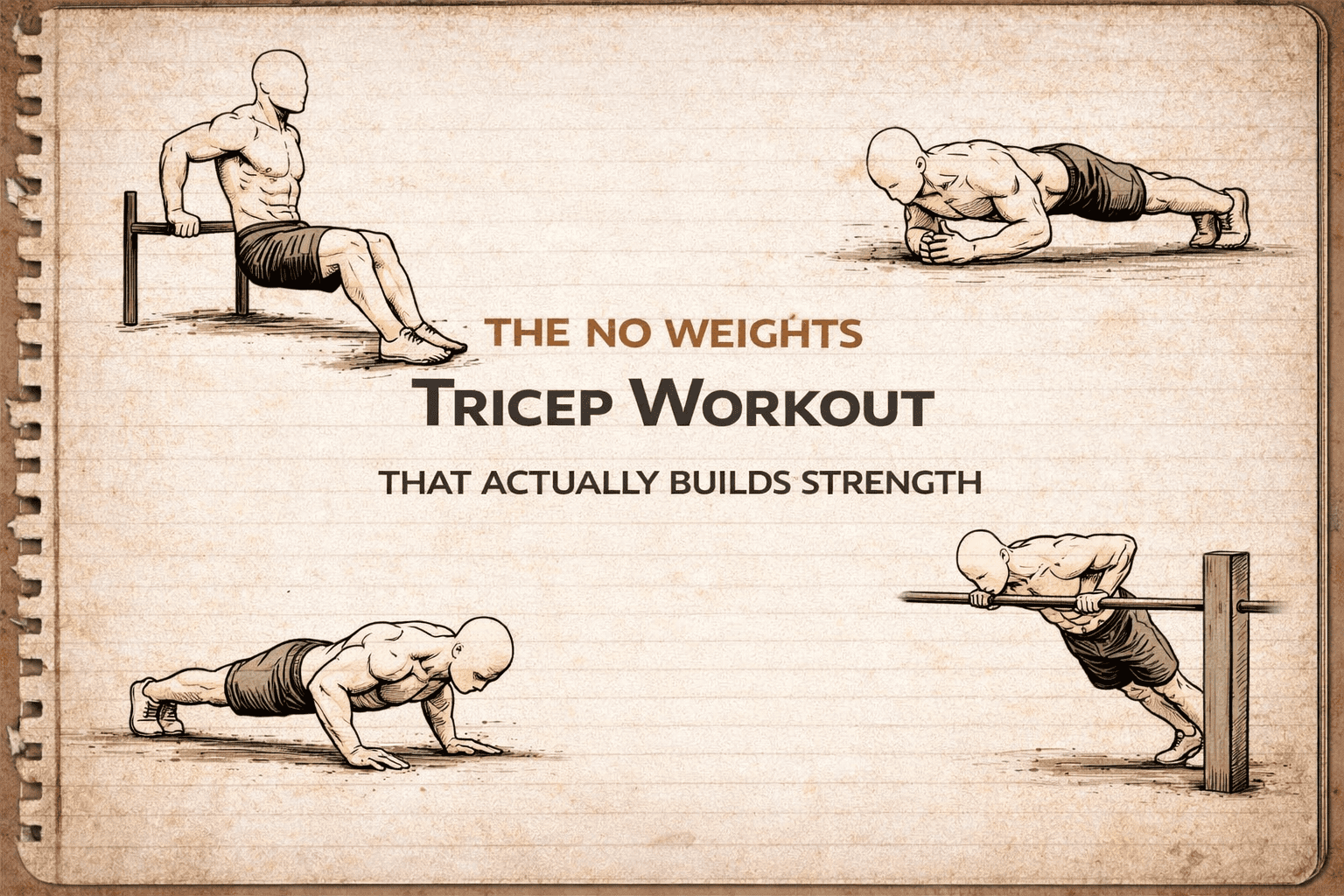
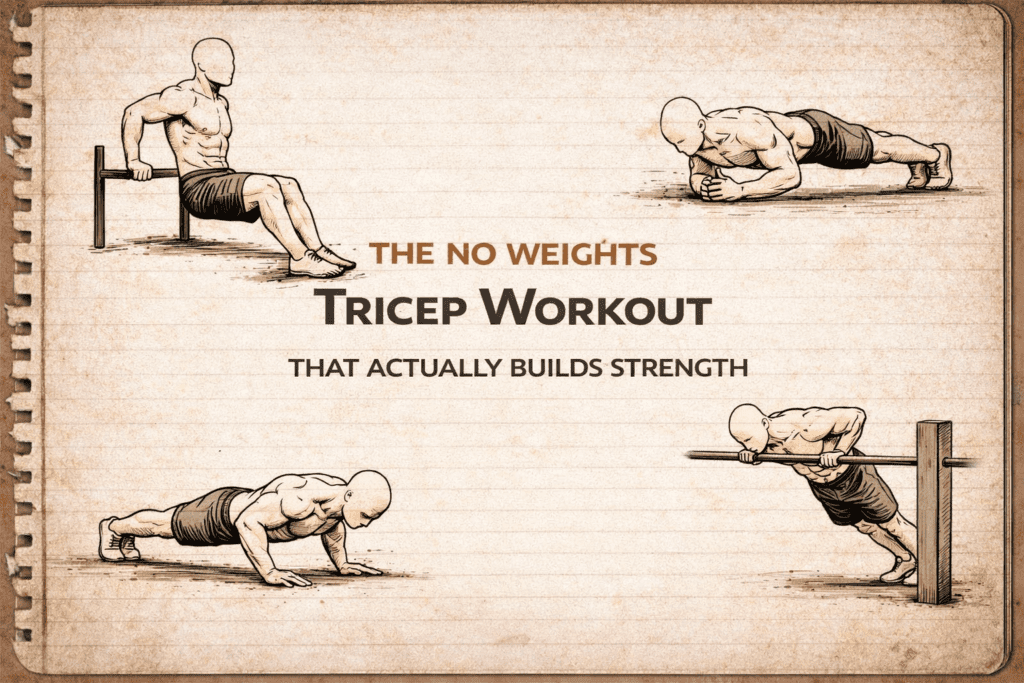
Your triceps make up two-thirds of your upper arm, yet most people train them like an afterthought.
The truth is, you don’t need a gym membership or a garage full of weights to build strong, functional triceps. Bodyweight training offers everything you need: variable resistance, natural movement patterns, and the ability to train anywhere from your living room to a park bench. The minimalist approach doesn’t mean compromising results. It means stripping away the unnecessary and focusing on movements that build durable strength you can actually use.
Most tricep exercises you see online require dumbbells, cables, or resistance bands. But your body already weighs enough to create serious tension across all three heads of the tricep. The key is understanding leverage, tempo, and progression.
This guide breaks down the exact no-weights tricep workout that builds real strength without the clutter.
Table of Contents
Why Bodyweight Tricep Training Works
Your triceps respond to tension, not equipment type.
What builds muscle is the load placed on the fibers under tension, and your bodyweight provides plenty of that when positioned correctly. Exercises like close-grip push-ups, tricep dips, and pseudo planche leans create resistance by manipulating angles and leverage. You’re not lifting an external weight, but you’re forcing your triceps to move and stabilize a significant percentage of your body mass. That creates the stimulus your muscles need to adapt and grow.
The advantage of bodyweight work is built-in scalability. Unlike dumbbells, where you’re locked into fixed increments, you can adjust difficulty instantly by changing your hand position, elevating your feet, adding pauses, or slowing down the tempo. This gives you infinite room to progress without ever adding equipment.
Bodyweight training also builds better joint health. Because you’re moving through natural ranges of motion without external loads forcing unnatural positions, your elbows and shoulders stay healthier over time. This is critical for longevity in training. You’re not just chasing size. You’re building arms that stay strong and pain-free for decades.
If your goal is durable fitness that travels with you, bodyweight tricep work checks every box. No setup. No excuses. Just intelligent movement and consistent effort.
What You’ll Need
You don’t need much, but a few simple tools make the workout more effective.
A sturdy elevated surface is the most important piece. This could be a park bench, a chair, a low wall, or parallel bars at a calisthenics park. The surface should be stable and high enough off the ground to allow your body to dip below it without your feet touching. If you’re training at home, two chairs positioned parallel can work, though a single sturdy coffee table or workout bench is safer and more stable.
A flat, open floor space is necessary for push-up variations. Indoors, a yoga mat or towel gives you cushioning for your hands and knees. Outdoors, grass or a flat section of dirt works perfectly. Avoid uneven surfaces that throw off your alignment.
If you want to increase difficulty, consider adding:
- A backpack for weighted dips or push-ups (fill it with books, water bottles, or sand)
- Parallettes or push-up bars to increase range of motion and reduce wrist strain
- Resistance bands for assisted dips if you’re not yet strong enough for full bodyweight
But none of these are required. The core workout relies only on your body and a stable surface. That’s the beauty of this approach. You can do this in a hotel room, a campsite, or your backyard without thinking twice about gear.
The Seven Best No-Weight Tricep Exercises
These movements target all three heads of the tricep and scale from beginner to advanced.
Each exercise below has been chosen because it delivers maximum tricep activation without requiring weights. Some emphasize the long head, others hit the lateral and medial heads harder. Together, they create a complete tricep workout that builds both strength and endurance.
1. Close-Grip Push-Ups
Place your hands directly under your shoulders, fingers pointing forward. Your elbows should track back along your ribs, not flare out to the sides. Lower your chest to the ground while keeping your body in a straight line from head to heels. Press back up, focusing on squeezing your triceps at the top.
This is the foundational bodyweight tricep exercise. The closer your hands, the more your triceps have to work. If standard close-grip push-ups are too difficult, start on your knees or elevate your hands on a bench. If they’re too easy, elevate your feet or add a weighted backpack.
2. Tricep Dips
Sit on the edge of a bench or chair. Place your hands beside your hips, fingers gripping the edge. Slide your hips forward off the bench, supporting your weight with your arms. Lower your body by bending your elbows until your upper arms are roughly parallel to the ground. Push back up to the starting position.
Dips are one of the most effective tricep builders in existence. Keep your elbows tight and avoid letting them flare outward. To increase difficulty, straighten your legs. To decrease difficulty, bend your knees and keep your feet closer to your body. For an advanced version, elevate your feet on a second surface to increase the load.
3. Diamond Push-Ups
Form a diamond shape with your hands by touching your thumbs and index fingers together. Position the diamond directly under your chest. Lower yourself slowly, keeping your elbows tucked. Press back up.
This variation shifts even more load onto the triceps compared to standard close-grip push-ups. The diamond hand position forces your triceps to stabilize and press through a challenging range of motion. Expect your reps to drop compared to regular push-ups. That’s normal. Focus on control and full range of motion over speed.
4. Pseudo Planche Leans
Start in a push-up position. Walk your hands back toward your hips, leaning your shoulders forward over your wrists. The farther you lean, the harder your triceps and shoulders have to work to hold you up. Hold this position, or perform small push-ups from this lean.
This is an advanced movement that builds serious tricep and shoulder strength. It’s also a gateway exercise to skills like the planche. Start with short holds of 10 to 20 seconds. As you get stronger, lean farther forward and add push-ups.
5. Pike Push-Ups
Start in a downward dog position with your hips high and your body forming an inverted V. Keep your legs as straight as possible. Bend your elbows and lower the top of your head toward the ground. Press back up.
While pike push-ups emphasize the shoulders, they also hammer the triceps, especially the long head. This movement is excellent for building overhead pressing strength, which translates directly to handstand push-ups and other advanced calisthenics skills.
6. Bench Tricep Extensions
Kneel in front of a bench or low surface. Place your hands on the edge, shoulder-width apart. Lower your elbows toward the bench, keeping your upper arms stationary. Your forearms should move, but your elbows stay in place. Press back up by extending your triceps.
This isolates the triceps in a way similar to a skull crusher, but without the barbell. It’s excellent for targeting the long head of the tricep. Keep the movement slow and controlled. If you feel shoulder discomfort, adjust your hand position or lower the range of motion.
7. Typewriter Push-Ups
Start in a wide push-up position. Lower yourself down, then shift your weight to one side, straightening the opposite arm. Your body moves laterally across the bottom of the push-up. Shift to the other side, then press back up to the starting position.
Typewriter push-ups add a dynamic, strength-endurance component to your tricep training. They’re brutal but effective. This exercise also builds unilateral strength, helping to even out imbalances between your left and right arms.
Each of these exercises can be programmed individually or combined into a single workout. Pick the ones that match your current strength level and rotate them as you progress.
Sample Workout Routine
This is a complete tricep session you can do three times per week.
The structure below balances volume, intensity, and recovery. You’ll hit your triceps from multiple angles without overtraining. Rest 60 to 90 seconds between sets. Focus on form over speed.
- Close-Grip Push-Ups: 4 sets of 8 to 12 reps
- Tricep Dips: 4 sets of 6 to 10 reps
- Diamond Push-Ups: 3 sets of 6 to 10 reps
- Bench Tricep Extensions: 3 sets of 8 to 12 reps
- Pseudo Planche Leans: 3 sets of 15 to 30 second holds
Start with the hardest exercises when you’re fresh. As fatigue sets in, the later movements will challenge your endurance and mental toughness. If you can complete all reps with good form, increase difficulty by adjusting leverage, adding pauses at the bottom, or slowing down the tempo.
This workout takes 25 to 35 minutes. Warm up with arm circles, wrist mobility drills, and a few light push-ups before you start. Cool down with static stretching, focusing on your triceps, chest, and shoulders.
You can run this routine as a standalone session or pair it with a pull-focused workout for a balanced upper body day. Just avoid training triceps on back-to-back days. Your muscles need time to recover and adapt.
Progression Strategies
Getting stronger without weights requires smart progression, not just more reps.
Most people think bodyweight training means cranking out endless reps until you hit failure. That works for beginners, but it caps out quickly. If you want continuous strength gains, you need to increase difficulty, not just volume.
Increase time under tension. Slow down your reps. Take three seconds to lower, pause for one second at the bottom, then explode up. This increases the total work your muscles perform without changing the exercise. Tempo work also builds better control and body awareness.
Change leverage to make exercises harder. Elevate your feet during push-ups. Lean farther forward during pseudo planche work. Add a deficit by placing your hands on parallettes or books. Small changes in angle can double the difficulty of a movement.
Add isometric holds. Pause at the hardest point of the rep and hold for three to five seconds. This builds strength in your weakest range of motion and increases muscular endurance. Try holding the bottom of a dip or the top of a push-up.
Use unilateral variations. Once you can perform an exercise with both arms, progress to single-arm or asymmetrical versions. Typewriter push-ups, archer push-ups, and one-arm tricep extensions force each arm to carry more load independently.
Incorporate plyometrics. Explosive push-ups, clapping push-ups, and plyo dips build power and recruit fast-twitch muscle fibers. These should be used sparingly, but they’re excellent for breaking through plateaus.
Track your workouts in a notebook or app. Write down sets, reps, and any modifications. Progress happens when you can look back and see measurable improvement over weeks and months.
Common Mistakes to Avoid
Small form errors sabotage results and increase injury risk.
Flaring your elbows during push-ups or dips is the most common mistake. When your elbows point outward, you shift load away from your triceps and onto your shoulders. This reduces tricep activation and increases the chance of shoulder impingement. Keep your elbows tight to your body. Imagine trying to tuck them into your ribs.
Rushing through reps turns strength training into cardio. Every rep should be deliberate. Control the descent, pause briefly at the bottom, and press up with intent. If you’re bouncing out of the bottom position, you’re relying on momentum instead of muscle tension.
Ignoring wrist and elbow pain is a fast track to chronic issues. Bodyweight training is joint-friendly, but only if you listen to your body. If something hurts beyond normal muscle fatigue, stop and assess. Adjust your hand position, reduce range of motion, or swap the exercise. Pain is a signal, not a challenge to push through.
Skipping the warm-up leaves your joints unprepared for load. Spend five minutes on wrist circles, arm swings, and light push-ups before diving into heavy sets. Your performance will improve, and your injury risk will drop.
Training triceps every day might seem like a shortcut to growth, but it’s actually a shortcut to overtraining. Your muscles grow during recovery, not during the workout. Three to four sessions per week is plenty. Use the off days for mobility work, rucking, or lower body training.
Variations for Different Skill Levels
Scale the workout to match your current strength.
Beginners should focus on building foundational strength and proper movement patterns. Start with incline push-ups, where your hands are elevated on a bench or wall. This reduces the load and makes the movement more manageable. For dips, keep your knees bent and feet close to your body. Aim for 3 sets of 5 to 8 reps per exercise. Master the basics before adding complexity.
Intermediate athletes can handle standard variations with solid form. Close-grip push-ups, tricep dips, and diamond push-ups should be your core exercises. Add tempo work and isometric holds to increase difficulty. Experiment with foot-elevated push-ups and pseudo planche leans. Aim for 4 sets of 8 to 12 reps. Focus on progressive overload by adding reps, slowing tempo, or adjusting leverage every week.
Advanced trainees need creative progressions to keep growing. Archer push-ups, one-arm tricep extensions, and planche leans with push-ups will challenge even the strongest athletes. Add weighted vests or backpacks to dips and push-ups. Incorporate plyometric variations like clapping push-ups and explosive dips. Aim for 4 to 5 sets with varied rep ranges from 5 to 15 depending on the movement.
No matter where you start, the key is consistent progression. Track your workouts, challenge yourself weekly, and trust the process. Strength builds slowly, but it builds reliably when you show up and do the work.
How to Program This Into Your Weekly Routine
Tricep work fits cleanly into a balanced training plan.
If you follow a push-pull-legs split, add this tricep workout to your push day after chest and shoulder work. The triceps are already warmed up from compound pressing, so you’ll be able to dive straight into isolation work.
If you train full body three times per week, rotate tricep-focused sessions with bicep and back work. Monday could be triceps and chest, Wednesday could be legs and core, Friday could be back and biceps. This spreads upper body volume across the week and prevents overuse.
If you’re running a minimalist two-day upper/lower split, include this tricep routine on your upper body day. Pair it with horizontal and vertical pulling movements to balance the pushing load.
Sample weekly structure for a calisthenics-focused athlete:
- Monday: Tricep workout + chest and shoulder accessories
- Tuesday: Ruck or zone 2 cardio
- Wednesday: Pull-ups, rows, bicep work, core
- Thursday: Mobility and stretching
- Friday: Tricep workout + handstand practice
- Saturday: Legs, loaded carries, HIIT finisher
- Sunday: Active recovery or rest
This structure gives you two quality tricep sessions per week with at least 48 hours of recovery between them. You’re also balancing pushing, pulling, and lower body work across the week. Adjust the days based on your schedule, but keep the recovery principles intact.
Mobility and Recovery for Tricep Health
Strong triceps need mobile elbows and shoulders to function long-term.
After every tricep session, spend five to ten minutes stretching. The overhead tricep stretch is simple but effective. Reach one arm overhead, bend the elbow, and use your opposite hand to gently pull the elbow deeper into flexion. Hold for 30 to 60 seconds per side. You should feel a stretch along the back of your upper arm.
Doorway chest stretches also help. Place your forearm against a doorframe and gently lean forward. This opens up your chest and takes tension off your shoulders, which indirectly benefits tricep function. Tight pecs pull your shoulders forward, which changes the mechanics of pressing movements.
Wrist mobility drills prevent overuse injuries. Sit on your knees and place your palms flat on the ground, fingers pointing toward your knees. Gently rock forward and back, stretching the wrists and forearms. Do this before and after every workout.
Use foam rolling or massage to address tightness in your triceps, lats, and shoulders. Spend 60 to 90 seconds per area, focusing on tender spots without grinding directly on joints or bones.
Sleep and nutrition also matter. You can’t recover from hard training on five hours of sleep and a poor diet. Aim for seven to nine hours of quality sleep per night. Eat enough protein to support muscle repair. Prioritize whole foods, hydration, and stress management. Recovery isn’t passive. It’s an active part of your training plan.
Your triceps will grow stronger, but only if you give them the resources and rest they need to adapt. Treat recovery with the same respect you give your workouts.
Frequently Asked Questions
Can you really build triceps without weights?
Yes. Bodyweight exercises create enough resistance to stimulate muscle growth and strength gains when performed with proper form and progression. Your triceps don’t know the difference between a dumbbell and your body mass. What matters is tension, volume, and progressive overload. Thousands of calisthenics athletes have built impressive triceps using only bodyweight movements.
How often should I train triceps?
Three to four times per week is optimal for most people. This provides enough stimulus to grow while allowing adequate recovery. Avoid training triceps on consecutive days. Space your sessions at least 48 hours apart to let the muscle fibers repair and adapt.
What if I can’t do a single tricep dip?
Start with assisted dips using a resistance band looped around the dip bar, or keep your feet on the ground and use your legs to reduce the load. You can also begin with bench dips with bent knees. Build strength gradually. Consistency beats intensity when you’re starting out.
Do I need to train triceps separately if I’m already doing push-ups?
Standard push-ups work the triceps, but they don’t isolate them. Adding dedicated tricep exercises like close-grip push-ups, dips, and extensions ensures you’re hitting all three heads with enough volume to grow. Think of push-ups as your foundation and tricep isolation as the finishing work.
How long before I see results?
You’ll feel stronger within two to three weeks. Visible muscle growth typically shows up after six to eight weeks of consistent training, assuming your nutrition and recovery are dialed in. Strength comes first. Size follows.
These exercises work for anyone willing to put in the effort, whether you’re training in a minimalist home gym, a park, or on the road. The principles stay the same: control, progression, and consistency.
The only equipment you truly need is the commitment to show up and do the work. Your triceps will respond. Build them with intention, and they’ll serve you for decades of strong, functional movement. No weights required. No excuses accepted.