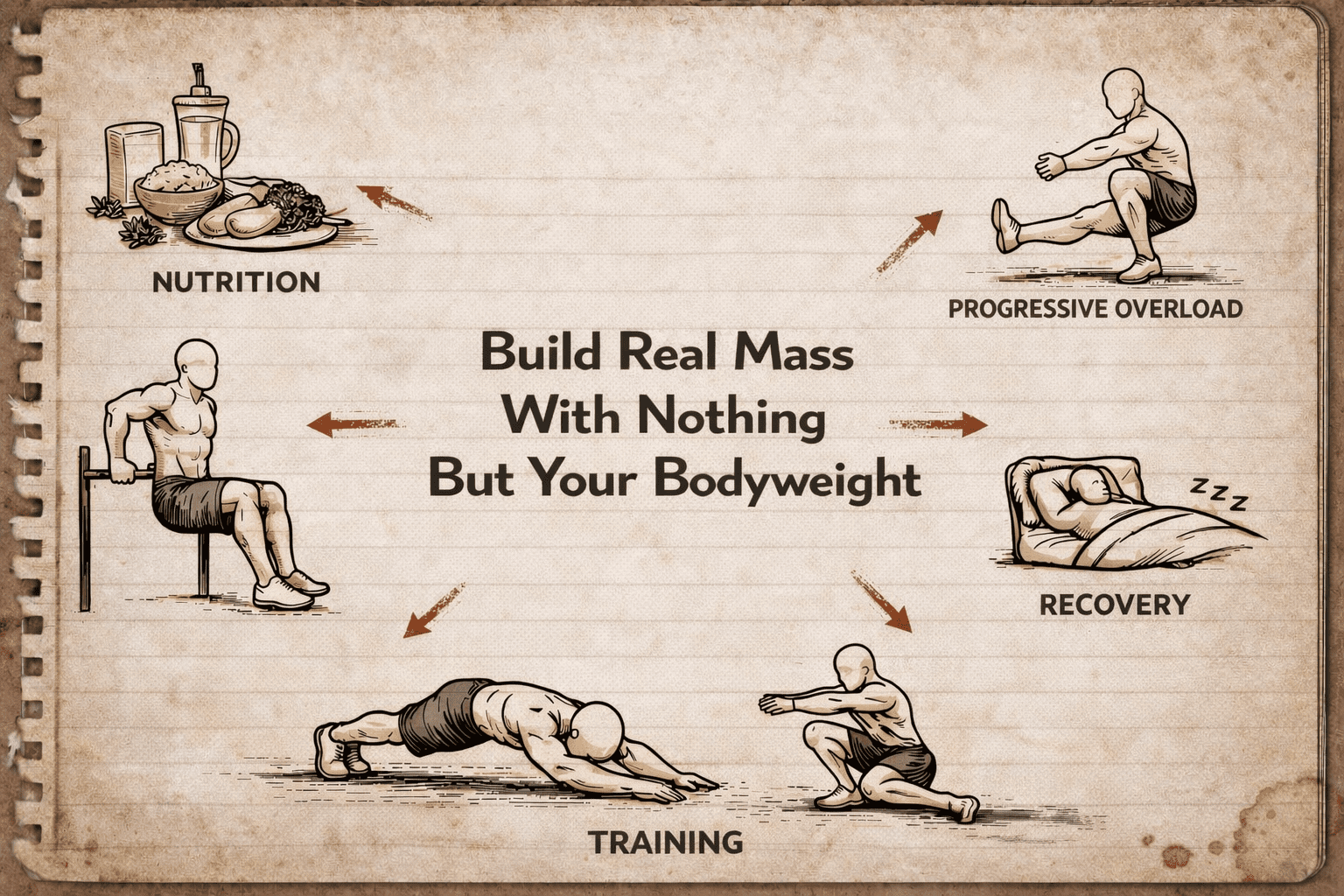
Think you need a gym to gain muscle? These progressive calisthenics protocols trigger hypertrophy using only gravity and strategic volume manipulation.
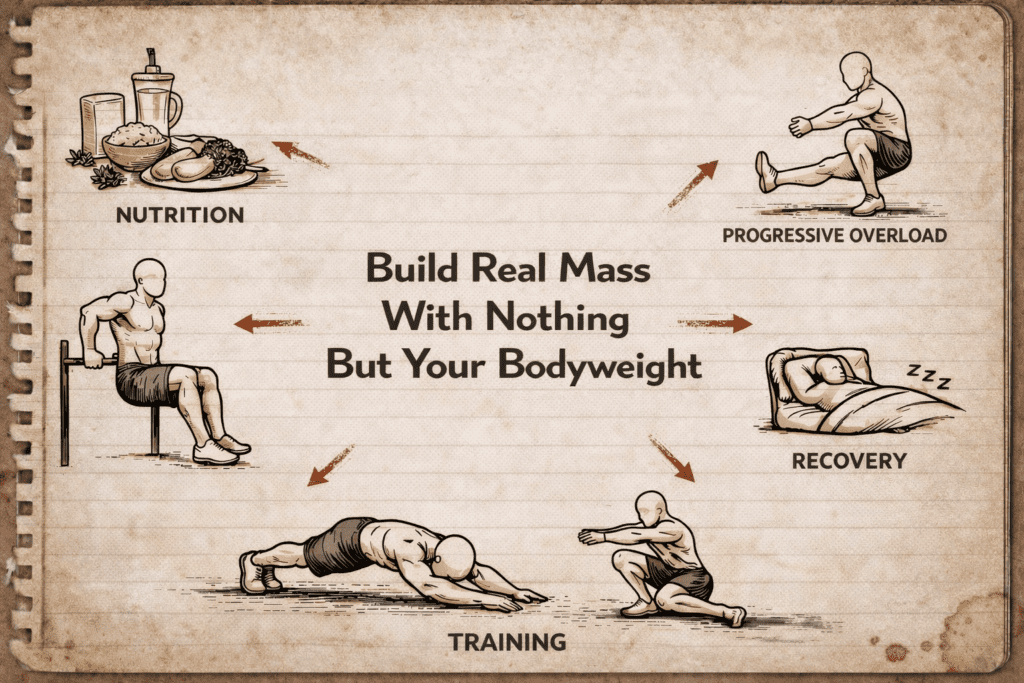
Most guys think gaining weight at home means getting soft around the middle while doing endless push-ups that lead nowhere.
That’s not what we’re doing here. The principles that build muscle in a commercial gym work just as effectively in your garage, backyard, or living room. Progressive overload, adequate volume, and strategic nutrition don’t require a squat rack or monthly membership fees. They require intention, consistency, and a willingness to push bodyweight movements beyond what most people think is possible.
The fitness industry has convinced you that muscle gain demands specialty equipment, complex machines, and supplement stacks that cost more than your grocery bill. Meanwhile, gymnasts, military operators, and old-time strongmen have been building impressive, functional physiques with minimal gear for generations. The gap between what works and what you’ve been sold is massive.
Here’s how to close that gap and build real mass without leaving home.
Table of Contents
Understanding Weight Gain Beyond the Scale
The Number That Actually Matters
Weight loss gets discussed constantly, but weight gain gets a bad reputation because most people chase the wrong number. Adding 20 pounds of mostly fat while your strength stagnates and your movement quality deteriorates isn’t progress. It’s just getting heavier. For guys focused on longevity and durable fitness, the goal isn’t simply weighing more. It’s building quality mass that enhances performance, supports metabolic health, and improves how you move through the world for decades to come.
This distinction changes everything about how you train and eat. Quality weight gain means your strength metrics climb, your body composition improves, and your work capacity expands. You should be able to do more reps, hold harder positions longer, and tackle more challenging variations as the weeks roll by. If the scale moves up but your pull-up numbers stay flat, you’re doing it wrong.
Think of it way: a gymnast who gains 15 pounds of muscle can still perform at an elite level because that mass came with corresponding strength gains. Someone who gains 15 pounds of mixed tissue while their relative strength drops now struggles with movements they used to own. One path builds durability. The other builds limitations.
The home training environment actually favors quality gains because you’re forced to rely on progressive calisthenics and simple tools like kettlebells. These modalities naturally emphasize movement quality, joint health, and functional strength patterns. You can’t hide behind fancy gym machines or ego-lift with poor form when gravity and bodyweight are your primary resistance. This built-in accountability keeps your gains clean and your joints healthy, which matters significantly more at 35 than it did at 20.
What You’ll Need to Build Mass at Home
The beauty of home-based mass building is that the equipment list stays refreshingly short.
Essential Items:
- Pull-up bar (doorway or wall-mounted): This single piece of equipment unlocks dozens of upper body mass-building movements. Invest in something sturdy that can handle weighted variations as you progress.
- Parallel bars or dip station: Dips and their progressions are among the most effective bodyweight exercises for building chest, triceps, and shoulder mass. A basic dip station runs under $100 and lasts forever.
- Gymnastic rings: Rings add instability that forces greater muscle recruitment across every movement. They’re also infinitely adjustable for different exercises and progressions.
- Kettlebells (one or two): A 24kg and 32kg kettlebell give most intermediate trainees everything they need for lower body work, carries, and supplemental movements. Quality cast iron bells outlive their owners.
- Weighted vest or dip belt: Once bodyweight movements become manageable, external loading becomes necessary for continued progression. A vest works for push-ups and pull-ups, while a dip belt handles weighted dips and chin-ups.
That’s it. Five categories of equipment that fit in a corner of your garage or spare room.
Optional But Valuable:
A few additional tools expand your options without cluttering your space. Resistance bands provide accommodating resistance for certain movements and work well for warm-ups. A suspension trainer (TRX-style) offers unique angles for rows and other pulling variations. Adjustable dumbbells save space if you want more traditional pressing options, though they’re not essential if you have kettlebells and progress your bodyweight work intelligently. When you first start, even household items like backpacks filled with books can serve as makeshift weights before you invest in proper equipment.
The minimalist approach isn’t about deprivation. It’s about focusing your resources on tools that deliver maximum training variety and progression potential. A well-chosen pull-up bar and set of rings provide more muscle-building stimulus than a garage full of random equipment you barely use. Quality over quantity applies to your home gym as much as your training approach.
The Nutritional Foundation for Clean Mass
You can’t train your way around inadequate nutrition.
This truth hits harder when building mass at home because the training stimulus, while effective, typically involves lower absolute loads than barbell-based programs. That means your nutrition has to be even more dialed in to support growth. You’re not going to accidentally bulk up doing calisthenics and kettlebell work. Every pound of muscle you add will be earned through consistent eating matched to intelligent training in your home-based weight gain workout plan.
The Caloric Surplus Reality
Building lean muscle mass requires consuming more energy than you burn. This isn’t controversial or complicated, but the size of that surplus matters enormously for the quality of weight you gain. A modest surplus of 200 to 400 extra calories above maintenance supports steady muscle growth while minimizing fat gain. Aggressive bulks that add 1,000+ calories daily just make you fat faster, especially once you’re past your early twenties and your hormone profile has matured.
Calculate your maintenance calories honestly. Track your food intake for a week while maintaining your current weight, then add 300 calories to that daily average. Monitor your weight weekly. If you’re gaining half a pound to one pound per week while your strength numbers climb, you’re in the sweet spot. If you’re gaining faster than that, pull back slightly. If nothing’s moving after three weeks, add another 100 to 200 calories and reassess.
Protein remains non-negotiable. Aim for 0.8 to 1 gram per pound of body weight daily, spread across three to four meals. This provides the amino acids your muscles need to repair and grow after training sessions. Whole food sources like eggs, fish, poultry, beef, and Greek yogurt should form the foundation, with protein powder filling gaps when whole foods aren’t practical.
Macro Balance for Sustained Energy
Beyond protein, your carbohydrate and fat intake fuel training performance and hormonal health. Carbohydrates support the high-volume bodyweight training sessions required for muscle growth. They replenish glycogen stores, improve recovery between sessions, and make hard training feel less brutal. Focus on complex carbohydrates like potatoes, rice, oats, and fruit rather than processed junk that provides calories without micronutrients.
Fats support testosterone production and overall hormonal function, both critical for building muscle as you age. Include healthy fats from sources like olive oil, avocados, nuts, fatty fish, and egg yolks. A reasonable target is 0.4 to 0.5 grams per pound of body weight. This leaves the remaining calories for carbohydrates, which you can adjust based on training volume and personal response.
Meal timing matters less than total daily intake, but strategic eating around training improves performance and recovery. Having easily digestible carbs and protein within a few hours before training provides fuel. Eating a solid meal with protein and carbs within two hours post-training supports recovery. Beyond these windows, spread your remaining meals throughout the day in whatever pattern supports adherence and energy levels.
Progressive Overload Without Barbells
The principle that drives all muscle growth is progressive overload: gradually increasing the demands placed on your muscles over time.
Most people associate this exclusively with adding weight to a barbell. When you’re limited to bodyweight and simple implements, you need to think more creatively about progression. The good news is that bodyweight training offers multiple progression variables that keep you advancing for years without hitting the equipment ceiling that stops many garage gym trainees.
Progression Strategies That Work:
- Increase reps within a set range: If you can do 3 sets of 8 pull-ups, work toward 3 sets of 12 before moving to a harder variation or adding weight. This builds work capacity and muscle endurance while adding volume.
- Add sets to increase total volume: Going from 3 sets to 4 or 5 sets of an exercise increases weekly volume, a primary driver of hypertrophy. Just ensure you can recover from the added stress.
- Slow down the tempo: A 3-1-3 tempo (three seconds down, one second pause, three seconds up) makes bodyweight exercises brutally harder without changing the movement. Time under tension increases dramatically.
- Progress to harder variations: Push-ups become archer pushup variations, then one-arm progressions. Pull-ups become weighted pull-ups, then one-arm progressions. Every basic movement has a progression ladder that extends for years.
- Add external load: Once you own a movement pattern with bodyweight, a weighted vest or dip belt allows linear progression similar to barbell training. Adding five pounds to your pull-ups every few weeks builds serious strength with heavier weights.
- Reduce leverage or stability: Elevating your feet during push-ups, using rings instead of a bar for rows, or performing pistol squats instead of regular squats all increase difficulty through mechanical disadvantage.
The mistake most people make is jumping to harder variations before mastering the basics. If your push-up form breaks down after 10 reps, you’re not ready for ring push-ups or one-arm progressions. Build a foundation of clean reps with perfect form, then layer on progression variables systematically. This patient approach prevents injury and ensures every training session actually builds toward something rather than just randomly sampling difficult exercises.
Track your workouts in a simple notebook or app. Write down exercises, sets, reps, and any added weight or tempo changes. If you can’t look back eight weeks and see clear progress in volume, intensity, or exercise difficulty, your program isn’t working. Progressive overload isn’t optional. It’s the mechanism that forces your body to adapt by building new muscle tissue.
The Core Training Framework
Building mass at home requires a structured exercise plan that balances volume, intensity, and recovery.
The framework that works best for most people centers on three to four training sessions per week, each lasting 45 to 75 minutes. This frequency allows sufficient stimulus for growth while providing adequate recovery time. More isn’t always better, especially when bodyweight movements involve high neuromuscular demand that taxes your central nervous system differently than machine-based training.
Sample Weekly Structure:
- Day 1: Upper Body Push Focus (chest, shoulders, triceps)
- Day 2: Lower Body and Carry Work (legs, posterior chain, loaded carries)
- Day 3: Rest or Active Recovery (walking, light mobility work)
- Day 4: Upper Body Pull Focus (back, biceps, rear delts)
- Day 5: Full Body or Weak Point Focus (address lagging areas or combine compound movements)
- Day 6-7: Rest and Recovery
This training plan ensures each major movement pattern gets hit with adequate volume while avoiding excessive overlap that hampers recovery. The specific days matter less than the pattern of hard training followed by sufficient rest.
Within each session, structure your work around compound exercises first. Start with the exercises that provide the most bang for your buck: pull-ups, dips, pistol squats, ring rows, and kettlebell work. These multi-joint movements recruit the most muscle mass and create the greatest stimulus for growth. Once you’ve completed your primary work, you can add isolation exercises or accessory movements that target specific areas.
A basic session structure looks like this:
- Warm-up (5-10 minutes): Joint mobility, light movement prep, and a few easy sets of the day’s main movements to groove patterns and increase blood flow.
- Primary Movement (20-30 minutes): Your main compound exercise for the day, performed with progressively heavier loads or harder variations across 3-5 working sets.
- Secondary Movements (15-20 minutes): Two to three complementary exercises that support the primary movement or address specific muscle groups. Moderate intensity and volume.
- Accessory Work (10-15 minutes): Isolation exercises, core work, or conditioning that fills gaps without creating excessive fatigue.
- Cool-down (5 minutes): Light stretching and breathing work to downregulate your nervous system.
The temptation when training at home is to either do too little because no one’s watching or do too much because the equipment is always available. Neither extreme builds muscle effectively. Stick to your planned sessions, execute them with full effort and focus, then get out and recover. The muscle growth happens during recovery, not during the workout itself.
Upper Body Mass Building Movements
Your upper body responds incredibly well to the right selection of pushing and pulling movements.
The key is choosing specific exercises that allow progressive overload while maintaining joint health over the long term. Bodyweight and ring-based movements naturally accommodate individual anatomy better than fixed bars or machines, which means less wear on your shoulders, elbows, and wrists as you age. This matters significantly when your goal is building muscle you can maintain and use for decades, not just looking bigger for beach season.
Primary Pushing Exercises:
Dips are the king of bodyweight chest and tricep builders. Start with parallel bar dips using full range of motion from the starting position. Once you can perform 3 sets of 10-12 clean reps, begin adding weight with a dip belt or vest. Progress by adding 2.5 to 5 pounds every week or two. Ring dips increase difficulty through instability and should be introduced once you’re strong on fixed bars. A deep dip with control beats a half-rep bounce every single time. Your chest should descend to hand level, your elbows should reach roughly 90 degrees, and you should press back to full lockout with authority.
Push-up variations offer nearly unlimited progression potential. Standard push-ups build a foundation, but the real mass comes from making them harder. Elevate your feet to shift more load to your upper chest and shoulders. Use rings to add instability that forces greater muscle recruitment. Progress to archer pushup variations where one arm takes most of the load while the other provides minimal assistance from the starting position. Eventually, work toward one-arm push-up progressions that build unilateral strength and iron out imbalances. For an advanced variation, the archer pushup requires you to shift your weight to one side while keeping your body in a plank position, with your opposite arm extended and supporting with your left elbow or right elbow nearly straight.
Pike push-ups and handstand progressions target your shoulders with vertical pressing that mimics overhead press movements. Start with feet-elevated pike push-ups, gradually increasing the angle of your body. Progress to wall-assisted handstand push-ups, then freestanding variations if your skill and shoulder health allow. These movements build impressive shoulder mass and develop the stability required for advanced gymnastics skills.
Primary Pulling Exercises:
Pull-ups and chin-ups form the foundation of back and bicep development. If you can’t yet perform a full pull-up, use band assistance or negative-only training (jump to the top position and lower yourself slowly over 5-8 seconds). Once you can do multiple clean reps, begin adding weight. The magic really happens when you can perform weighted pull-ups with 25-50+ pounds attached. Your lats, mid-back, and arms have no choice but to grow in response to this stimulus.
Vary your grip width and hand position across training sessions. Wide grip emphasizes lat width, close grip targets lat thickness and mid-back, and chin-ups (palms facing you) recruit biceps more aggressively. All variations build mass. Rotating between them prevents pattern overload and ensures balanced development.
Ring rows complement vertical pulling with horizontal work that hits your mid-back, rear delts, and biceps from a different angle. The further you position your feet forward and lower your body angle, the harder the movement becomes. Add a weighted vest once you can perform 3 sets of 15-20 reps at a challenging angle. Maintain a rigid body position from heels to head, pull your chest to the rings with elbows tight to your sides, and control the descent.
Key Execution Points:
Every rep should demonstrate control through the full range of motion. Partial reps and momentum-driven kipping might inflate your numbers, but they don’t build muscle as effectively as strict, controlled repetitions. Save your ego for social media. In your training, prioritize the quality of each rep over the quantity you can claim.
Breathe intentionally. Exhale during the hardest part of each rep (typically the concentric or lifting phase), inhale during the easier portion. Proper breathing maintains core stability and supports consistent performance across sets.
Rest adequately between sets with appropriate rest periods. For strength-focused work with harder progressions or added weight, take 2-3 minutes between sets. For moderate-intensity volume work, 60-90 seconds usually suffices. Cutting rest too short compromises performance on subsequent sets and reduces total volume, which limits growth stimulus.
Lower Body Development With Minimal Equipment
Here’s where most bodyweight programs fall short.
Upper body work progresses naturally with pull-ups, dips, and their variations. Lower body work requires more creativity because your legs are much stronger than your arms and adapt to bodyweight squats embarrassingly quickly. This is where strategic use of kettlebells, single-leg progressions, and high-volume protocols separates programs that build impressive legs from those that leave you looking like a tank top with toothpicks.
Pistol Squat Progressions
The pistol squat (single-leg squat to full depth) is one of the most effective lower body builders you can do at home. The strength, balance, and mobility required to perform clean pistols ensures your legs keep adapting long after regular bodyweight squats stop providing stimulus.
Start with assisted variations: hold a doorframe or suspension trainer for balance while you learn the pattern. Progress to box pistols where you squat down to a box or bench, tap it lightly, and stand back up. Lower the box height over time until you’re reaching full depth. Eventually, perform free-standing pistols with your non-working leg extended in front of you.
Once you own bodyweight pistols, add load progressively. Hold a kettlebell at chest height (goblet style) or in the racked position on one shoulder. Even 10-15 pounds makes pistols significantly harder. Work up to using a 24kg or 32kg kettlebell and your leg development will be undeniable.
Kettlebell Work for Mass and Power
Kettlebells punch above their weight class for building functional leg mass. Double kettlebell front squats allow you to load the squat pattern with significant weight in a compact form that’s easier on your spine than barbell back squats. Two 24kg bells (53 pounds each, 106 total) provide a serious training stimulus for most intermediate lifters.
Kettlebell swings build your posterior chain (glutes, hamstrings, lower back) while improving conditioning and power output. Heavy swings performed for sets of 10-20 reps with a 32kg or heavier bell create incredible metabolic stress and muscular fatigue. Your glutes and hamstrings will grow in response, and your overall work capacity will skyrocket.
Goblet squats work perfectly for higher-rep sets that accumulate volume and create the metabolic stress associated with hypertrophy. Hold a kettlebell at chest height and squat to full depth for sets of 12-20 reps. The position naturally encourages good mechanics and prevents the forward lean that plagues many squatters.
Volume-Based Leg Blasters
When you lack heavy external load, volume becomes your friend. High-rep bodyweight squat protocols build impressive leg mass through accumulated time under tension and metabolic stress. Try sets of 50-100 bodyweight squats performed with continuous tension (don’t lock out at the top or rest at the bottom). Your legs will be screaming, and the pump will feel like your quads might split your skin.
Walking lunges provide unilateral loading and create serious muscular damage, especially when performed for high reps or with a weighted vest. Complete 100 total steps (50 per leg) with bodyweight, focusing on depth and control. Add a 20-40 pound vest as you adapt.
Bulgarian split squats (rear foot elevated split squats) destroy your quads and glutes while improving single-leg strength and stability. These can be loaded with kettlebells held at your sides or in the goblet position. Sets of 8-12 reps per leg with challenging weight will humble you quickly.
Don’t Neglect Posterior Chain Work
Nordic curls (also called natural hamstring curls) provide direct hamstring work without equipment. Hook your feet under something stable, kneel on a pad, and lower your torso toward the ground using only your hamstrings to control the descent. These are brutally difficult. Start with eccentric-only reps (lower slowly, push back up with your hands) and progress toward full reps over time.
Single-leg Romanian deadlifts with a kettlebell build hamstring and glute strength while improving balance and hip stability. Hold a kettlebell in one hand, hinge at the hip while extending the opposite leg behind you, lower the weight toward the ground, then drive through your standing heel to return to the start position. These feel deceptively light until you’re trying to stand up from the bottom position on your 10th rep.
Your lower body training should leave you questioning your life choices by the end of each session. If your legs aren’t significantly fatigued and you’re not feeling serious muscular work, you’re not pushing hard enough or choosing the right progressions. Adapt, load, and progress systematically. Your legs will grow.
Programming Your Training Weeks
Random hard workouts don’t build muscle as effectively as structured progression over time.
Your weekly training structure should follow a logical pattern that accumulates volume, manages fatigue, and allows for strategic deloads when needed. This is where having a solid workout program makes all the difference. Most people train too randomly or too consistently hard without planned recovery, both of which limit long-term progress.
The Basic Mass-Building Template
Week 1-3: Accumulation Phase
Focus on building volume across all major movements. Add sets, reps, or training density (more work in the same time). Your intensity (load or exercise difficulty) stays moderate and manageable. The goal is accumulating quality training stress that your body will adapt to during the next phase.
Week 4: Deload Week
Reduce volume by roughly 40-50% while maintaining intensity. If you normally do 4 sets of weighted pull-ups, do 2 sets with the same weight. This allows your body to recover and supercompensate. You should feel fresher and stronger by the end of this week.
Week 5-7: Intensification Phase
Increase intensity through harder progressions, added load, or slower tempos while slightly reducing total volume. This is where you push for new personal records and test your strength gains from the accumulation phase.
Week 8: Deload Week
Another recovery week before starting the cycle again with new baseline numbers.
This wave-loading approach prevents burnout, manages cumulative fatigue, and creates consistent progress over months and years. You can’t hammer yourself with maximum effort every week indefinitely. Strategic backing off allows greater forward progress over time.
Tracking and Adjusting
Keep a training log. Write down what you did, how it felt, and what you’ll try to improve next session. After each mesocycle (the 8-week block described above), assess your progress honestly.
Questions to ask yourself:
- Did my strength numbers improve across major movements?
- Did my bodyweight increase at the target rate (0.5-1 pound per week)?
- Do I look more muscular with similar or better body composition?
- Are my joints feeling healthy or are nagging issues developing?
- Is my energy and recovery solid or am I constantly dragging?
If you’re seeing progress across these markers, keep the program structure and continue progressing your exercises. If progress has stalled, identify the limiting factor. Usually it’s either insufficient eating, inadequate recovery, or failing to actually progress the difficulty of your training. Fix the weak link and run another cycle.
Recovery Practices That Actually Matter
Training is the stimulus. Recovery is where adaptation happens.
You can have the perfect program and nutrition dialed in, but if you’re sleeping five hours a night and chronically stressed, you won’t build muscle effectively. Recovery isn’t passive rest. It’s an active process your body needs resources and time to complete.
Sleep Comes First
Nothing impacts muscle growth, hormone production, and overall recovery like sleep quality and duration. Aim for 7-9 hours nightly in a dark, cool room without screens for the hour before bed. During deep sleep, your body releases growth hormone and completes the cellular repair processes that build new muscle tissue. Shortchange your sleep and you shortchange your gains, period.
If sleep quality is poor, address it systematically. Establish a consistent bedtime. Avoid caffeine after 2 PM. Keep your bedroom cool (65-68°F works well for most people). Use blackout curtains or an eye mask. Consider magnesium glycinate supplementation 30-60 minutes before bed to support relaxation and sleep quality.
Stress Management
Chronic psychological stress elevates cortisol, which impairs muscle protein synthesis and promotes fat storage, particularly around your midsection. You can’t out-train or out-eat chronic stress. Incorporate daily practices that downregulate your nervous system: walking in nature, breathwork, meditation, or simply sitting quietly without digital stimulation.
The irony for performance-oriented individuals is that pushing harder isn’t always the answer. Sometimes the constraint limiting your progress is your inability to recover, not your unwillingness to work. Learning when to back off requires wisdom that typically comes from years of beating yourself into the ground and finally recognizing the pattern.
Active Recovery and Movement Quality
Rest days don’t mean complete inactivity. Light movement on off days promotes blood flow, clears metabolic waste, and maintains mobility without adding significant training stress. A 30-60 minute walk, easy bike ride, or mobility session supports recovery better than lying on the couch for 48 hours.
Dedicate 10-15 minutes daily to mobility work that addresses your specific limitations. If your ankles are stiff and limit your squat depth, work on ankle mobility. If your shoulders are tight from desk work, open your chest and work on thoracic rotation. Movement quality directly impacts how effectively you can train and how well you avoid injury.
Include deliberate soft tissue work when needed. Foam rolling, lacrosse ball massage, or actual massage therapy can address muscular tension and improve tissue quality. This doesn’t need to be daily or excessive, but strategic use helps maintain training quality as volume accumulates.
Nutrition for Recovery
Your post-training nutrition matters, but total daily intake matters more. Ensure you’re hitting your protein targets across the day, consuming enough carbohydrates to replenish glycogen stores, and staying hydrated. Chronic under-eating or low-grade dehydration will sabotage recovery no matter how perfect your training is.
Micronutrients from vegetables, fruits, and quality whole foods support the thousands of cellular processes involved in building new tissue. A diet built entirely on chicken, rice, and protein shakes might hit your macros but leaves gaps in micronutrition that eventually impact performance and health. Eat real food that grew or walked at some point.
Common Mistakes That Kill Progress
Most people who fail to gain muscle at home make predictable errors.
Mistake 1: Not Eating Enough
You think you’re eating in a surplus, but you’re actually at maintenance or below. Track your food honestly for at least two weeks. Most guys dramatically overestimate their caloric intake. If the scale isn’t moving up gradually and your strength isn’t improving, you’re not eating enough. Period.
Mistake 2: Chasing Variety Instead of Progression
Constantly switching exercises because you’re bored prevents you from getting strong at anything. Muscle growth requires progressive overload, which requires doing the same movements long enough to actually progress them. Stick with core exercises for at least 8-12 weeks before making major changes. Add weight, add reps, add sets, or increase difficulty systematically. Variety for its own sake is just organized randomness.
Mistake 3: Neglecting Lower Body Because It’s Hard
Your legs contain the largest muscle groups in your body. Skipping or half-assing leg training because it’s uncomfortable leaves massive growth potential on the table. Lower body training also creates systemic hormonal and metabolic responses that support upper body growth. Train your legs with the same intensity and focus you bring to your upper body work.
Mistake 4: Training to Failure on Every Set
Grinding out every set until you can’t complete another rep with good form accumulates fatigue faster than it builds muscle. Most of your sets should end with 1-2 reps left in the tank (RIR, or reps in reserve). This allows you to maintain consistent volume across sets and sessions without burning out your nervous system. Save true failure sets for occasional use, not every working set of every session.
Mistake 5: Ignoring Recovery Signals
Persistent joint pain, chronic fatigue, disrupted sleep, and declining performance are your body telling you something needs to change. Pushing through these signals doesn’t demonstrate toughness. It demonstrates poor judgment that leads to injury or overtraining. Take an unplanned rest day when truly needed. Drop volume or intensity for a week if you’re beat up. Strategic retreat allows you to keep training for years instead of forcing a shutdown from injury.
Mistake 6: Comparing Your Progress to Enhanced Athletes
Social media is flooded with impressive physiques built with pharmaceutical assistance, perfect lighting, favorable angles, and sometimes just outright filters and editing. Your progress as a natural athlete training at home will be slower and more modest. That doesn’t make it less valuable. Build muscle at a sustainable rate, maintain your health markers, and develop a physique you can keep for decades. That’s the real win.
Adjusting Your Approach Over Time
What works during your first three months of focused training won’t work as well in year two.
As a beginner, almost any reasonable program builds muscle because your body responds to novel stimulus. As an intermediate trainee, you need more specific progression schemes, higher volumes, and smarter programming. As an advanced trainee, progress slows to a crawl and requires meticulous attention to detail across training, nutrition, and recovery.
Beginner Phase (First 6-12 Months):
Focus on learning movement patterns, building work capacity, and establishing consistent training habits. Progress comes quickly. Add reps and sets frequently. Enjoy it while it lasts.
Intermediate Phase (Year 1-3):
Dial in your programming structure with planned progressions and deloads. Pay closer attention to nutrition timing and total intake. Begin tracking metrics more carefully. Progress slows but remains consistent with smart training.
Advanced Phase (Year 3+):
Progress becomes incremental. Adding five pounds to your weighted pull-up over six months is a win. At this stage, your focus shifts from chasing numbers to maintaining what you’ve built while making small improvements. Training becomes more about longevity and sustainability than proving something.
Adjust your program variables based on your current phase. Don’t run advanced protocols with built-in complexity when simple linear progression still works. Don’t stick with beginner approaches when your body has adapted and needs more sophisticated stimulus.
The best exercise program is the one that matches your current abilities, keeps you healthy, and progresses at a rate your body can actually sustain. There’s no trophy for burning out faster.
Building quality muscle mass at home isn’t just possible. For many people focused on long-term health and functional capacity, it’s actually superior to commercial gym training that emphasizes ego lifting and aesthetics over movement quality and durability. The constraints of limited equipment force you to master bodyweight progressions, develop real strength relative to your size, and build a physique that performs as well as it looks.
Whether you’re pursuing weight loss or weight gain, maintaining a healthy weight through home workouts that incorporate strength training and full-body workouts is entirely achievable. The principles are simple. Eat in a modest surplus with adequate protein. Train consistently with progressive overload across pushing, pulling, and leg movements through consistent resistance training. Select the right type of exercise for your goals, whether that’s bodyweight workouts using a smart combination of bodyweight exercises or incorporating external load for continued progression. Recover intentionally through sleep, stress management, and strategic rest. Track your progress and adjust based on results. Do this for months and years, not days and weeks. The muscle will come, along with strength, movement quality, and the physical resilience that supports an active life well into your later decades.