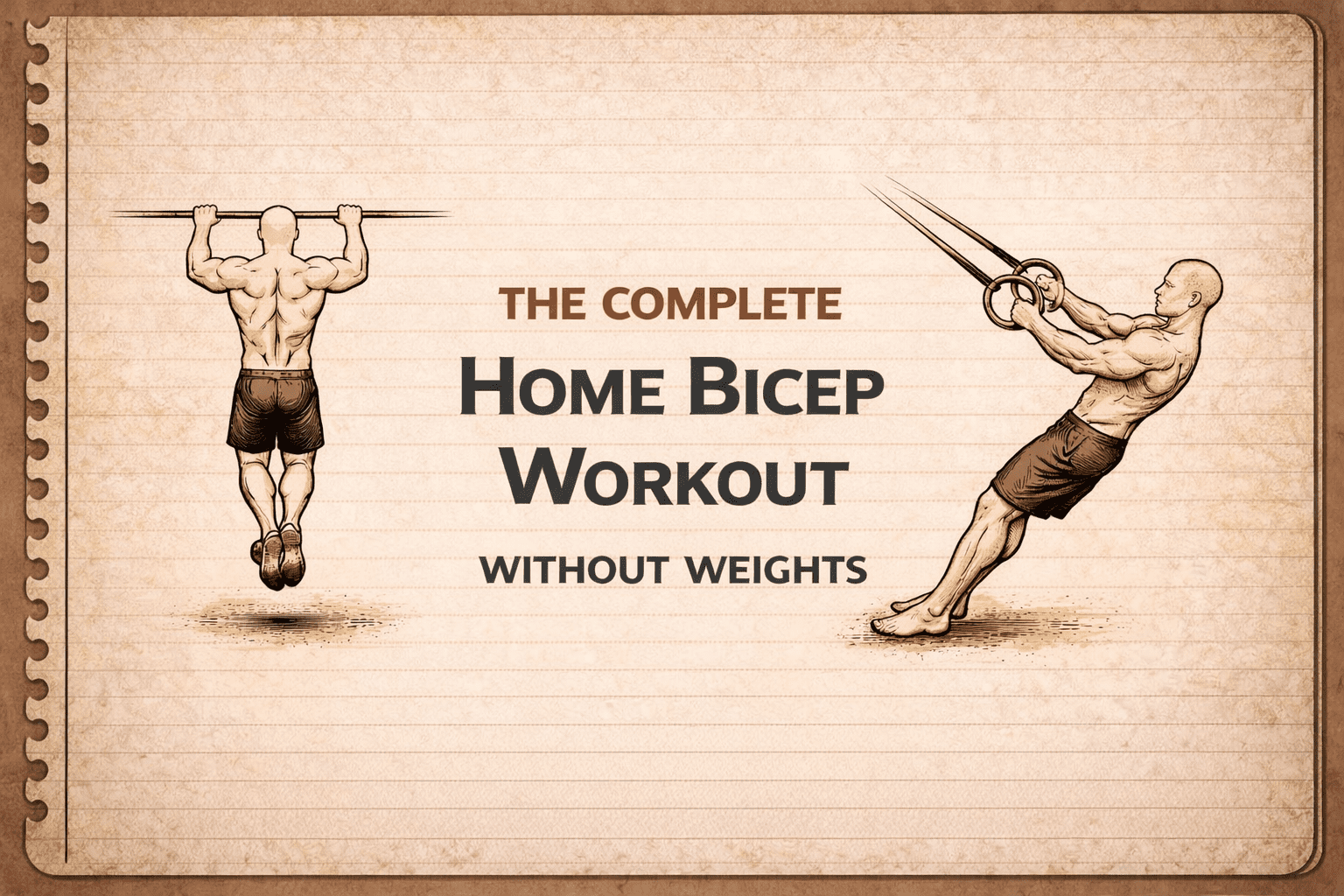
Equipment-free bicep training sounds impossible until you understand leverage angles. These movements prove your body is the only tool you need.
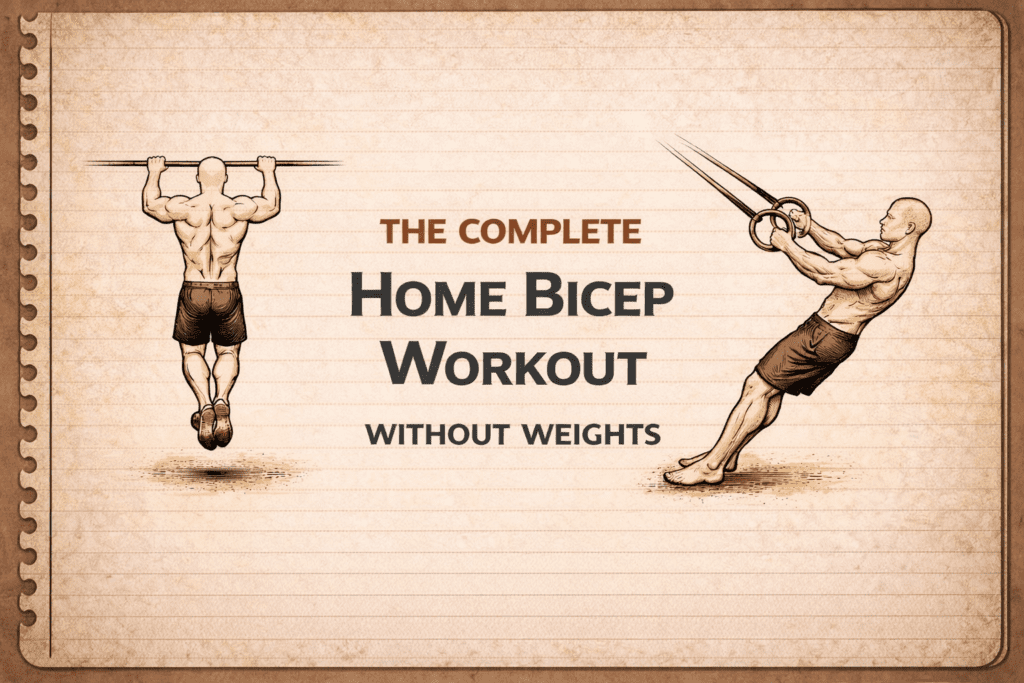
You don’t need weights to build biceps that work as well as they look.
Most guys think arm training requires a rack of dumbbells and a cable machine, but that mindset keeps you dependent on equipment instead of mastering your own body. Bodyweight bicep training isn’t just a backup plan for when you’re traveling. It’s a legitimate approach that builds functional strength, improves tendon resilience, and teaches you how to create tension through positioning and angles. The biceps respond to one thing: resistance under tension. Whether that resistance comes from iron or intelligent leverage doesn’t matter to the muscle fibers doing the work.
This guide breaks down exactly how to train biceps at home without a single weight, using nothing but strategic body positioning, tempo manipulation, and movement progressions that scale with your strength level.
Why Bodyweight Bicep Training Works Better Than You Think
Most people dismiss bodyweight bicep work because they’ve only tried half-effort chin-ups or doorframe hangs that feel more like shoulder exercises.
The biceps muscle has one primary function: elbow flexion, specifically pulling your forearm toward your upper arm. When you remove weights from the equation, you’re forced to get creative with angles, leverage, and time under tension. This actually makes you a smarter trainee because you learn how small adjustments in hand position, body angle, and movement speed completely change the stimulus. Bodyweight training also reduces joint stress while increasing proprioception, which means better muscle control and lower injury risk over time.
Here’s what makes equipment-free bicep training effective:
- Leverage manipulation creates progressive overload. Changing your body angle or hand position on a fixed surface instantly adjusts resistance without needing heavier weights.
- Isometric holds build tendon strength. Static positions under tension reinforce connective tissue and improve your ability to stabilize loads in any context.
- Eccentric control develops size and resilience. Slowing down the lowering phase of any movement creates more muscle damage and growth stimulus than most people generate with sloppy barbell curls.
- You can train anywhere, anytime. No equipment means no excuses, which leads to more consistent training over the long haul.
The real advantage is that bodyweight bicep training forces you to focus on quality over quantity. You can’t cheat reps with momentum or swing your way through sets. Every rep either happens with strict form or it doesn’t happen at all. That kind of discipline carries over into every other area of your training and builds a foundation that lasts.
What You’ll Need for This Workout
You don’t need much, but the few things you do need make all the difference.
Most bodyweight bicep exercises rely on finding stable surfaces you can pull against or hang from. The goal is to create an anchor point that lets you generate tension through your arms while controlling your body position. You’re not looking for a full home gym setup. You’re looking for everyday objects that give you leverage.
Essential items:
- A sturdy table or desk. Needs to support your full bodyweight without tipping. You’ll use this for inverted rows and underhand variations.
- A pull-up bar or sturdy overhead beam. Doorframe bars work fine if installed correctly. This opens up chin-ups, hangs, and various grip positions.
- A towel or two. Use these for towel curls, grip work, and creating instability that increases muscle activation.
- A backpack. Optional but useful for adding resistance once bodyweight becomes too easy. Load it with books, water bottles, or anything heavy.
Nice to have but not required:
- Gymnastics rings or TRX straps for variable angle pulls
- A sturdy door for towel-based isometric holds
- Resistance bands if you want hybrid movements (though this guide stays pure bodyweight)
Walk around your space right now and identify what you already have. A solid dining table, a doorframe, a tree branch, or a sturdy fence post all work. The point is to stop waiting for perfect conditions and start using what’s available. Most of the exercises in this guide can be modified based on what you find, so don’t let equipment become the excuse that keeps you from starting.
The Core Principles of Equipment-Free Bicep Training
Building biceps without weights isn’t about doing more reps until your arms fall off.
It’s about understanding the three variables that create muscle growth: mechanical tension, metabolic stress, and muscle damage. When you train with weights, you adjust these by adding plates to the bar. When you train with bodyweight, you adjust these through angles, tempo, and positioning. The muscle doesn’t know the difference between a 40-pound dumbbell and a body angle that creates 40 pounds of resistance through your arms.
Mechanical Tension
This is the primary driver of muscle growth. You need to put your biceps under significant load for enough time to trigger adaptation. With bodyweight, you create tension by adjusting leverage. Moving your feet farther from your anchor point during a row increases resistance. Shifting from a neutral grip to an underhand supinated grip changes bicep involvement. Slowing down your reps keeps muscles under tension longer, which compensates for lighter loads.
Metabolic Stress
This is the burn you feel during high-rep sets. It comes from restricting blood flow and accumulating metabolites in the muscle. Bodyweight training creates metabolic stress through longer sets, shorter rest periods, and isometric holds. When you hang from a bar with bent elbows for 30 seconds, your biceps are screaming not because of weight but because of sustained contraction without relief.
Muscle Damage
This happens during the eccentric (lowering) phase of movements. Slowing down negatives on chin-ups or inverted rows creates significant muscle damage even without heavy loads. The key is controlling the descent for 3-5 seconds instead of dropping fast. This tempo focus turns basic movements into serious growth stimuli.
The most common mistake is treating bodyweight bicep work like cardio. Going through the motions with fast, loose reps might make you tired, but it won’t build your arms. Every rep needs deliberate tension, controlled tempo, and a focus on feeling the biceps do the work. If you can’t feel your biceps contracting hard during a movement, adjust your angle or slow down until you can.
The Seven Best Bodyweight Bicep Exercises
These movements cover the full spectrum from beginner-accessible to advanced strength challenges.
Each exercise has unique benefits and targets the biceps from different angles. The goal is to pick 3-4 exercises per session based on your current strength level and available equipment, then progressively make them harder over time. Don’t try to master all seven in one workout. Focus on quality execution and controlled progression.
1. Chin-Ups (Underhand Grip)
The king of bodyweight bicep builders. Chin-ups with palms facing you put your biceps in their strongest position and force them to contribute heavily throughout the entire range of motion. If you can’t do a full chin-up yet, start with negatives: jump to the top position and lower yourself as slowly as possible for 5-10 seconds. Once you can control a 5-second negative for 5 reps, you’re close to doing full chin-ups.
2. Inverted Rows (Underhand Grip)
Set up under a sturdy table or bar at waist height. Grip the edge with palms facing you, walk your feet forward until your body is at an angle, and pull your chest to the table while keeping your body straight. The more horizontal your body, the harder it gets. This exercise lets you adjust difficulty instantly by changing foot position, making it perfect for progressive overload.
3. Towel Curls (Isometric Hold)
Loop a towel over a closed door or through a sturdy anchor point at chest height. Grab both ends, step back to create tension, and curl your hands toward your shoulders while resisting against the towel. Hold the peak contraction for 20-40 seconds. This isometric hold creates serious metabolic stress and teaches you to generate tension without movement.
4. Behind-the-Back Wrist Curls
Stand with your back to a table or elevated surface. Place your palms flat on the surface behind you with fingers pointing away from your body. Keep your arms straight and slowly bend your elbows to lower your body, then push back up using primarily your biceps and forearms. This hits the biceps from an unusual angle and builds serious forearm and wrist strength as a bonus.
5. Self-Resisted Bicep Curls
Use your opposite hand to provide resistance against the working arm. Grip your right wrist with your left hand and curl your right arm up while pushing down with your left. Control both the lifting and lowering phase. This lets you customize resistance perfectly and works well as a finisher when you’re too tired for pull-ups.
6. Doorframe Finger Curls
Stand in a doorframe and grip the edge at shoulder height with fingers only (no thumb). Lean back so your bodyweight creates tension through your arms and fingers. From this position, perform small curling motions by flexing your elbows slightly and squeezing your biceps. This subtle movement with constant tension builds incredible grip strength while hitting biceps from a static angle.
7. L-Sit Pull Progressions
Hang from a bar and lift your legs straight out in front of you to create an L-shape with your body. From this position, perform chin-ups or simply hold the L-sit with bent elbows. The added core tension and changed center of gravity make this exponentially harder than regular chin-ups while building total-body integration that carries into real-world strength.
Pick exercises based on what you can do with strict form right now. If chin-ups are too hard, start with inverted rows and towel curls. If chin-ups are easy, add tempo work, L-sit variations, or a loaded backpack. The best exercise is the one you can perform with full control while feeling your biceps work hard throughout every inch of the movement.
How to Structure Your Bodyweight Bicep Workout
Random exercises don’t build muscle. Strategic programming does.
A proper bodyweight bicep session should last 20-30 minutes and include 3-4 exercises performed in a sequence that maximizes fatigue while maintaining quality. You’re not trying to destroy your arms with junk volume. You’re trying to create enough stimulus that your body has no choice but to adapt and grow stronger.
Sample Beginner Workout:
- Inverted Rows (Underhand Grip) – 4 sets of 8-12 reps with 90 seconds rest. Focus on pulling your chest all the way to the table and controlling the descent for 3 seconds.
- Towel Curl Isometric Holds – 3 sets of 30-second holds with 60 seconds rest. Keep constant tension throughout the hold without letting your arms drop.
- Self-Resisted Curls – 3 sets of 12-15 reps per arm with 45 seconds rest. Push hard enough with the resistance hand that each rep is genuinely difficult.
- Negative Chin-Ups – 3 sets of 3-5 reps with 2 minutes rest. Lower yourself as slowly as possible, aiming for at least 5 seconds per rep.
Sample Intermediate Workout:
- Chin-Ups – 4 sets of 6-10 reps with 2 minutes rest. If you can do more than 10, slow down the tempo or add a weighted backpack.
- Inverted Rows (Feet Elevated) – 3 sets of 10-15 reps with 90 seconds rest. Elevate your feet on a chair to increase difficulty.
- Doorframe Finger Curls – 3 sets of 20-30 small pulses with 60 seconds rest. Focus on peak contraction and constant tension.
- Towel Curl Holds – 2 sets of 40-second holds with 90 seconds rest. Go to absolute failure on the last set.
Sample Advanced Workout:
- Weighted Chin-Ups – 5 sets of 5-8 reps with 3 minutes rest. Load a backpack with books or water bottles to add 10-30 pounds.
- L-Sit Chin-Up Holds – 3 sets of 20-30 second holds with 2 minutes rest. Hold at the top of the chin-up position with legs extended.
- Inverted Rows (Slow Eccentric) – 3 sets of 8-10 reps with 5-second lowering phase and 90 seconds rest.
- Behind-the-Back Wrist Curls – 3 sets of 12-15 reps with 60 seconds rest. Keep tension on biceps throughout entire range.
Training frequency matters as much as exercise selection. Hit biceps with focused bodyweight work 2-3 times per week with at least one full day of rest between sessions. Your biceps are small muscles that recover faster than your legs or back, but they still need time to repair and grow. If your arms are still sore from the previous session, push your next workout back a day.
Progressive Overload Without Adding Weight
Getting stronger with bodyweight training requires intentional progression.
The biggest mistake people make with equipment-free training is doing the same routine at the same difficulty for months and wondering why nothing changes. Your body adapts to stimulus, then stops adapting once that stimulus becomes routine. Progressive overload means consistently making workouts harder in measurable ways. Without weights to add to a bar, you need different strategies.
Seven ways to progress bodyweight bicep exercises:
- Increase reps. If you did 8 chin-ups last week, aim for 9 this week. Add one rep per set until you hit the top of your target range.
- Slow down tempo. Take 4 seconds to lower instead of 2. This doubles time under tension without changing anything else about the movement.
- Decrease rest periods. Cut 15 seconds off your rest between sets. This increases metabolic stress and makes the same workout significantly harder.
- Change leverage angles. Move your feet farther forward on inverted rows. Lean back more during towel curls. Small position changes create major resistance differences.
- Add isometric pauses. Hold the hardest part of each movement for 2-3 seconds. Pause at the top of chin-ups or the peak contraction of rows.
- Use unilateral variations. Once bilateral movements get easy, switch to single-arm versions. One-arm rows are exponentially harder than two-arm rows.
- Add external load. Fill a backpack with books, water bottles, or rocks. Even 10 pounds makes a massive difference in bodyweight exercises.
Track your workouts in a simple notebook or phone app. Write down exercises, sets, reps, and any notes about how it felt. Next session, look at what you did and aim to beat it by at least one measure. This doesn’t mean setting personal records every workout, but it does mean intentionally pushing against your current limits rather than coasting through familiar routines.
The moment an exercise feels comfortable, it’s time to make it harder. Comfort means your body has adapted and no longer needs to change. Progress lives in the zone where movements feel challenging but achievable, where you’re not sure you’ll complete the last rep but you usually do.
Common Mistakes That Kill Your Results
Most people sabotage their own progress without realizing it.
Bodyweight bicep training looks simple on the surface, which leads people to skip the fundamentals and wonder why their arms aren’t growing. The difference between effective training and wasted effort often comes down to small technical details that completely change how your muscles experience each movement.
Swinging and using momentum. When you can’t complete a rep with strict form, your nervous system recruits other muscle groups and generates momentum to finish the movement. This might help you hit a rep target, but it takes tension off the biceps and spreads it across your back, shoulders, and core. If you need momentum to complete a chin-up, you’re not ready for that rep yet. Drop to an easier variation or do fewer reps with perfect form.
Rushing through reps. Fast reps reduce time under tension and limit muscle damage. A 1-second pull followed by a 1-second drop might feel like hard work, but it creates minimal growth stimulus. Aim for a 1-2 second concentric (lifting) phase and a 3-4 second eccentric (lowering) phase. This immediately makes every exercise harder and more effective.
Not training to real failure. Stopping a set because it’s uncomfortable is different from stopping because you physically cannot complete another rep with good form. Growth happens in those last 2-3 reps where you’re genuinely struggling. If you consistently stop sets when you could have done more, you’re training endurance instead of building strength and size.
Ignoring grip position. Hand placement completely changes bicep involvement. A wide grip reduces bicep activation. A narrow grip increases it. An underhand (supinated) grip maximizes it. Neutral grips shift emphasis to the brachialis and brachioradialis. If you’re doing rows or pull-ups but not feeling your biceps work, check your grip first.
Training biceps in isolation from the rest of your body. Your arms are small muscles that respond best when your overall training volume and recovery are dialed in. If you’re doing dedicated bicep work three times per week but sleeping five hours a night and eating in a calorie deficit, your arms won’t grow no matter how perfect your form is. Muscle growth requires surplus resources. Make sure you’re eating enough protein (0.7-1 gram per pound of bodyweight daily) and sleeping enough (7-9 hours nightly) to support adaptation.
Expecting fast results. Bodyweight training builds strength and size, but it’s not as visually dramatic as going from no training to lifting heavy barbells. Expect to see measurable progress in 4-6 weeks and visible size changes in 8-12 weeks if you’re consistent. This is a long game. The guys with impressive arms built them over years, not weeks.
Fix these mistakes before worrying about advanced techniques or complicated programming. Perfect execution of basic movements beats sloppy execution of advanced variations every single time.
How to Know If Your Training Is Working
Progress isn’t always visible in the mirror right away.
The best indicators of effective training show up in performance metrics before they show up in muscle size. Your biceps might not look dramatically different after four weeks, but if your chin-up numbers are climbing and your rows feel easier at harder angles, you’re building strength that will eventually translate to size.
Signs your bodyweight bicep training is working:
- You can do more reps at the same difficulty level. If you went from 5 chin-ups to 10 chin-ups over six weeks, your biceps are getting stronger.
- You can handle harder variations. Moving from feet-on-ground inverted rows to feet-elevated rows shows clear adaptation.
- Recovery time decreases. If your arms were sore for three days after your first session but now recover in 24-48 hours, your work capacity is improving.
- Mind-muscle connection improves. You can feel your biceps working throughout entire movements instead of just burning toward the end of sets.
- Measurements increase. Track arm circumference once per month. Measure relaxed and flexed at the thickest point. Even a quarter-inch increase over two months is real progress.
Take a video of yourself doing a set of chin-ups or rows at the start of your training program. Eight weeks later, film the same movement again. The difference in control, range of motion, and rep quality will be obvious even if the visual size change is subtle. This objective comparison cuts through the daily fluctuations and mental noise that make it hard to recognize progress when you see yourself every day.
If you’re not seeing any performance improvement after 6-8 weeks of consistent training, something needs to change. Either your exercise selection doesn’t match your current ability level, your progression strategy isn’t aggressive enough, or your recovery (sleep, nutrition, stress management) isn’t supporting adaptation. Training is only half the equation. Your body builds muscle during rest, not during workouts.
Integrating Bicep Work Into Your Broader Training Plan
Your arms are part of a system, not an isolated showpiece.
Most pulling movements already involve your biceps heavily. Rows, pull-ups, dead hangs, and rope climbs all hit your arms while building your back, grip, and overall pulling strength. If you’re already doing 2-3 pulling sessions per week, you might only need one dedicated bicep session to round things out. Adding too much arm-specific work on top of heavy pulling volume leads to overuse issues, elbow tendinitis, and stalled progress.
Sample weekly training split with integrated bicep work:
| Day | Focus | Bicep Involvement |
| Monday | Upper Body Pull (Chin-ups, Rows) | Heavy indirect bicep work |
| Tuesday | Lower Body / Mobility | None |
| Wednesday | Upper Body Push (Push-ups, Dips) | None |
| Thursday | Active Recovery (Ruck, Mobility) | None |
| Friday | Dedicated Bicep Session | Direct focused work |
| Saturday | Full Body HIIT or Outdoor Activity | Light indirect work |
| Sunday | Rest | None |
This structure gives you two days where biceps get heavy stimulus (Monday’s pulling work and Friday’s direct work) plus adequate recovery time between sessions. If your elbows feel beat up or your biceps aren’t recovering between sessions, drop the dedicated Friday session and rely purely on the indirect work from Monday’s pulling movements.
Listen to your joints more than your ego. Elbow and wrist pain are early warning signs that you’re doing too much volume or using poor form. Back off immediately when you feel sharp pain in tendons or joints. Dull muscle soreness is normal and expected. Sharp, localized joint pain is your body telling you something is wrong.
The goal is sustainable strength that lasts decades, not a six-week arm blast that leaves you injured and sidelined. Build progressively, recover intentionally, and integrate arm work into a balanced program that develops your entire body as a functional unit.
Your biceps don’t exist in isolation. They’re part of a pulling chain that includes your forearms, lats, rear delts, and upper back. When you strengthen the entire chain, every link gets stronger together. That’s how you build arms that look good and perform even better in real-world contexts like climbing, carrying, and controlling loads through space.
Everything you need to build strong, functional biceps is already within reach. No weights required, no excuses accepted. The exercises in this guide work if you work them. Start with movements you can control perfectly, progress deliberately by making small increases in difficulty every week, and give your body the recovery resources it needs to adapt.
The difference between guys who build impressive arms with bodyweight training and guys who spin their wheels comes down to consistency and intentionality. Show up three times per week, push your limits without destroying your joints, track your progress so you know what’s working, and trust the process long enough for adaptations to compound. Twelve weeks from now, your arms will be measurably stronger and visibly different if you commit to this approach without cutting corners or looking for shortcuts that don’t exist.