Your back is the foundation of every movement you make, yet most people train it like an afterthought.
You carry weight, you hike, you ruck, you move through life expecting your posterior chain to just handle it. But without intentional back training, you’re building a body that looks strong from the front while your spine, shoulders, and posture slowly collapse under the load. The gym bros have their lat pulldowns and cable rows. You have something better: your bodyweight, intelligent progressions, and movement patterns that build strength you can actually use.
The best part about calisthenics back training is that it strips away the nonsense. No machines that lock you into unnatural movement paths. No need to load up plates or adjust pin stacks. Just you, gravity, and the leverage you create with your own body. This is how humans were meant to build strength, and it’s exactly why bodyweight back training creates muscle that’s functional, durable, and built to last decades.
Here’s how to turn your back into the anchor point your body deserves.
Table of Contents
What Makes Calisthenics Back Training Different
Calisthenics forces your back to work the way it evolved to work.
Every pull, every row, every hold recruits stabilizer muscles that machines completely ignore. When you hang from a bar, your lats don’t just pull you up. They also stabilize your shoulder girdle, engage your core, and coordinate with your grip and forearms to create a full-body chain of tension. This is movement with context. This is strength that transfers to real life, whether you’re pulling yourself over a wall, carrying a sandbag, or holding a hollow body position for time.
Most people assume back training means pull-ups, and if you can’t do pull-ups, you’re stuck. That’s dead wrong. Calisthenics back work includes dozens of scalable movements: inverted rows, scapular pulls, dead hangs, prone floor pulls, and isometric holds that build strength even if you’ve never done a single pull-up in your life. You meet your body where it is, then progressively overload through angles, tempo, and range of motion.
The other advantage is joint health. Machines often force your shoulders into fixed planes that ignore individual anatomy. Calisthenics allows natural movement paths, which means less impingement, less wear on rotator cuffs, and more longevity in your training. You’re not just building muscle. You’re building resilient tissue that can handle load for the next 30 years.
Your back isn’t one muscle. It’s a complex system of layers: lats, traps, rhomboids, rear delts, spinal erectors, and teres muscles. Effective bodyweight training hits all of them through different pulling angles, different grips, and different body positions. That’s the blueprint you’re about to follow.
The Seven Movement Patterns That Build Your Entire Back
Think of your back training like a toolbox.
Each movement pattern is a tool that targets specific muscles and functions. Miss one, and you’re leaving gaps in your armor. Include all seven, and you build a back that’s strong from every angle, resistant to injury, and capable of handling whatever life throws at you.
- Vertical Pull (Pull-Ups, Chin-Ups, Assisted Variations): This is your primary lat builder. Vertical pulls create length under tension through the full range of your latissimus dorsi, which is the large V-shaped muscle that gives your back width. The closer your grip, the more bicep involvement. The wider your grip, the more you isolate outer lats. Both matter.
- Horizontal Pull (Inverted Rows, Australian Pull-Ups): Rows target your mid-back, specifically the rhomboids and middle traps. These are the muscles responsible for scapular retraction, which directly improves posture and counteracts the rounded shoulders most people develop from sitting and phone use. Horizontal pulls are also easier to scale than vertical pulls, making them perfect for beginners.
- Scapular Isolation (Scapular Pull-Ups, Scapular Shrugs): Most people skip this. Big mistake. Your scapulae (shoulder blades) are the foundation of all pulling strength. Training them to move independently, to protract and retract under control, builds the stability required for heavier lifts and prevents shoulder injuries down the road.
- Isometric Holds (Dead Hangs, Flexed Arm Hangs, L-Sit Holds): Isometrics build tendon strength and grip endurance, both of which are limiting factors in back development. A 60-second dead hang might not look impressive, but it builds the kind of connective tissue resilience that keeps you training into your 50s and beyond.
- Posterior Chain Engagement (Supermans, Reverse Hyperextensions, Hollow Body Holds): Your lower back and spinal erectors stabilize your entire posterior chain. Weak erectors mean vulnerable spines under load. These movements build endurance and strength in the muscles that protect your lumbar spine during rucking, kettlebell swings, and everyday bending.
- Rotational Stability (Side Planks with Reach, Archer Rows): Your back doesn’t just pull in straight lines. It resists rotation, maintains posture during asymmetric loads, and stabilizes your torso when one side works harder than the other. Training rotation and anti-rotation builds real-world durability.
- Mobility and Decompression (Hanging Stretches, Cat-Cow, Thread the Needle): Training breaks down tissue. Mobility work rebuilds it smarter. Spending time in passive hangs, spinal flexion, and extension keeps your back supple, your discs hydrated, and your movement quality high as you age.
These seven patterns form the skeleton of every effective calisthenics back program. You don’t need to hit all seven in one session, but over the course of a week, your training should touch every one of them. That’s how you build complete, balanced, long-lasting back strength.
How to Progress When You Can’t Do a Pull-Up Yet
Starting from zero pull-ups doesn’t mean starting from zero progress.
The biggest mistake beginners make is jumping straight to attempting full pull-ups before they’ve built the foundational strength required. You end up thrashing, kipping, or using momentum, which teaches terrible movement patterns and sets you up for shoulder issues. Instead, you build capacity through regressions that target the same muscles with less resistance.
Start here if you can’t do a single pull-up:
- Dead Hangs: Hang from a bar with straight arms for time. Start with 10 to 15 seconds, build to 60 seconds. This strengthens your grip, decompresses your spine, and teaches your shoulders to stabilize under load.
- Scapular Pull-Ups: Hang from the bar, then pull your shoulder blades down and together without bending your elbows. This isolates the first phase of the pull-up and builds the scapular strength most people lack.
- Inverted Rows: Set up under a low bar or rings. Keep your body straight and pull your chest to the bar. The lower the bar, the harder the movement. Start high, progress lower over time. This builds the same muscles as pull-ups but at a manageable resistance.
- Negative Pull-Ups: Jump or step up to the top position of a pull-up, then lower yourself as slowly as possible. Focus on 5 to 10 seconds of controlled descent. Negatives build eccentric strength, which is one of the fastest ways to gain pulling power.
- Band-Assisted Pull-Ups: Loop a resistance band over the bar and place your foot or knee in it. The band reduces your bodyweight, allowing you to practice the full range of motion while building strength. Use lighter bands as you progress.
The progression isn’t linear. Some days you’ll feel strong, other days your grip will fail before your back does. That’s normal. The key is consistency and gradually increasing time under tension, whether through more reps, slower tempo, or harder variations. Most people can go from zero pull-ups to their first clean rep in 8 to 12 weeks of focused work. After that, the strength builds fast.
One more thing: don’t skip the negatives. Lowering your body under control is harder than pulling yourself up, and it’s where most of your strength gains happen. If you only have energy for one pull-up exercise, make it slow negatives.
The Minimal Equipment Back Workout You Can Do Anywhere
You don’t need a home gym. You need a bar.
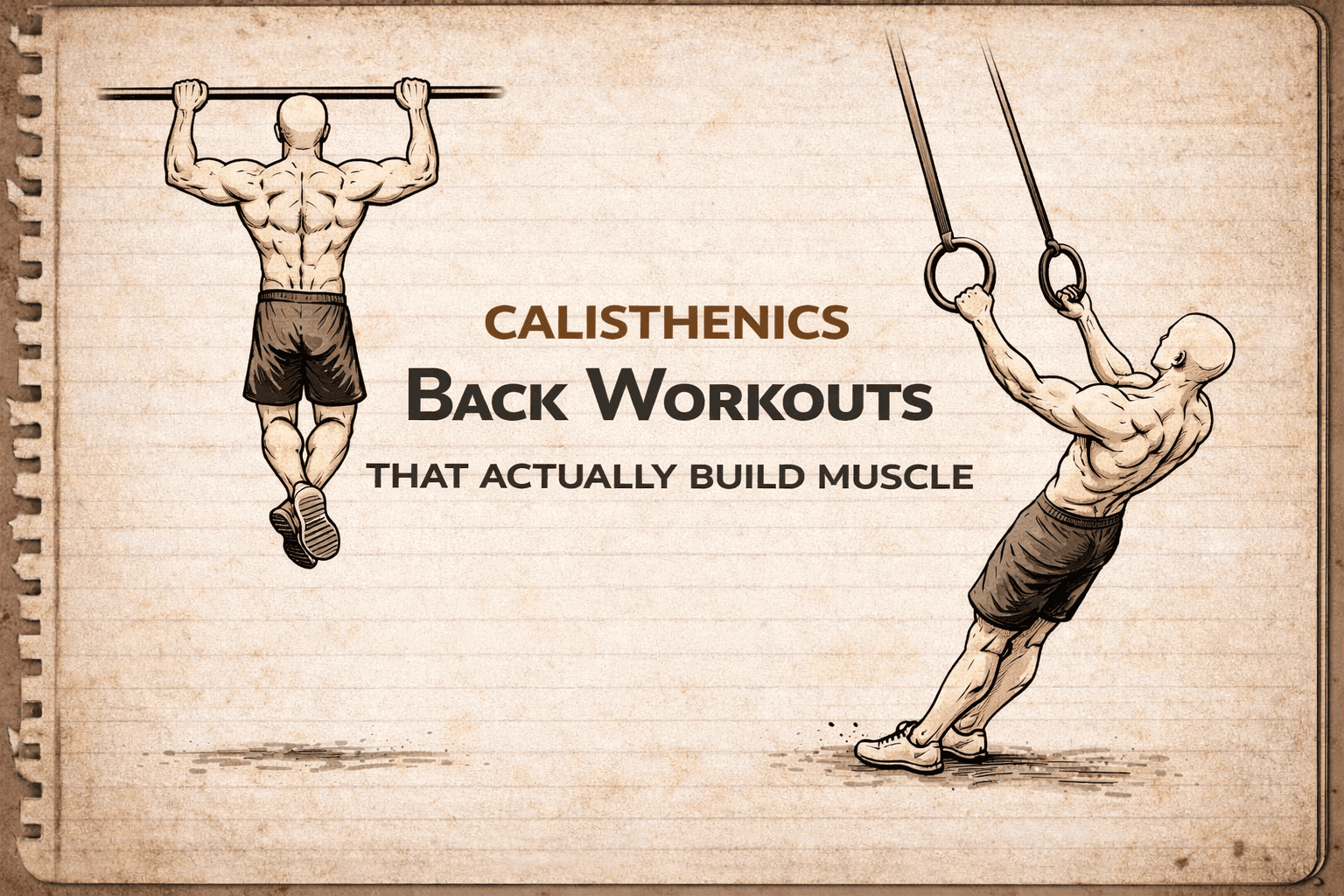
One pull-up bar, a set of rings, or even a sturdy tree branch gives you everything required to build a powerful back. If you don’t have access to any of those, you can still train effectively using just the floor and your body. Here’s a complete back session you can run three times per week with almost nothing.
Workout A: Pull-Focused
- Dead Hang: 3 sets of 30 to 60 seconds
- Pull-Ups or Negatives: 4 sets of max reps (or 5-second negatives if you can’t do full reps yet)
- Scapular Pull-Ups: 3 sets of 10 to 12 reps
- Inverted Rows: 3 sets of 12 to 15 reps
- Hollow Body Hold: 3 sets of 20 to 40 seconds
Rest 90 seconds between sets. Focus on control, not speed. If your form breaks down, stop the set. This workout takes 30 to 40 minutes and hits your entire back from lats to lower traps.
Workout B: Volume and Stability
- Inverted Rows (Feet Elevated): 4 sets of 10 to 12 reps
- Archer Rows: 3 sets of 6 to 8 reps per side
- Supermans: 3 sets of 15 to 20 reps
- Side Plank with Reach: 3 sets of 8 to 10 reps per side
- Flexed Arm Hang: 3 sets of max time (aim for 10 to 30 seconds)
This session builds endurance, reinforces scapular control, and hammers your mid-back and lower traps. It’s less intense than Workout A but just as important for long-term back health.
Rotate between these two workouts, or run them both in the same week if your recovery allows. The magic isn’t in the complexity. It’s in showing up consistently and progressively adding reps, time, or difficulty every few weeks.
Common Mistakes That Kill Your Progress
You can do everything right and still stall if you’re making one of these errors.
Calisthenics looks simple, but the details matter. Small mistakes compound over time, leading to plateaus, shoulder pain, or imbalanced development. Here are the most common traps people fall into and how to avoid them.
- Kipping or Using Momentum: If you’re swinging your legs to get your chin over the bar, you’re not doing a pull-up. You’re doing a momentum-assisted jump. Kipping has its place in specific training contexts, but for muscle and strength building, strict reps are non-negotiable. Every rep should start from a dead hang with controlled movement.
- Ignoring Scapular Control: Your shoulder blades should move first in every pull. If you’re yanking with your arms before your scapulae retract, you’re skipping the most important part of the movement. This leads to shoulder impingement and limits your long-term progress.
- Only Training Vertical Pulls: Pull-ups are sexy, but if that’s all you do, you’ll overdevelop your lats and underdevelop your rhomboids and mid-traps. This creates rounded shoulders and poor posture. Balance vertical pulls with horizontal rows.
- Skipping Lower Back Work: Your spinal erectors are part of your back too. Ignoring them leaves you vulnerable during loaded carries, deadlifts, and everyday bending. Add Supermans, back extensions, or reverse hypers into your rotation.
- Training Through Shoulder Pain: Dull aches are part of training. Sharp pain in your shoulder joint is not. If something hurts beyond normal muscle fatigue, stop. Regress the movement, work on mobility, and address the issue before it becomes chronic.
- Not Progressing Strategically: Adding one rep per week doesn’t sound like much, but over 12 weeks that’s 12 more reps per set. Progressive overload doesn’t have to be dramatic. It just has to be consistent. Track your workouts and aim to beat last week’s numbers, even if it’s just by one rep or five extra seconds of hold time.
These mistakes are fixable, but only if you’re aware of them. Film your sets occasionally. Check your form. Make sure your shoulders are doing what they’re supposed to do. Training smart beats training hard every single time.
How to Structure Your Weekly Back Training
Three times per week is the sweet spot for most people.
You want enough frequency to build skill and strength, but enough recovery to actually adapt and grow. Training your back every day sounds hardcore, but it’s a fast track to overuse injuries and fried nervous systems. Your tendons and connective tissue need more recovery time than your muscles do.
Sample Weekly Structure:
- Monday: Pull-Focused Workout (Workout A) after a short mobility warmup
- Tuesday: Lower body, core, or active recovery (rucking, walking, light kettlebell work)
- Wednesday: Volume and Stability Workout (Workout B)
- Thursday: Rest or mobility-focused session
- Friday: Pull-Focused Workout (Workout A) with slightly different rep schemes or tempo
- Saturday: Outdoor activity, rucking, or full-body conditioning
- Sunday: Complete rest or light stretching
If you’re also doing kettlebell swings, snatches, or cleans, those hit your back too. Don’t stack heavy posterior chain work on the same day as max-effort pull sessions. Spread the load across the week so your lower back, traps, and lats get adequate recovery.
Another approach is to use an upper/lower split where you hit back twice per week during upper body days, then focus on legs, core, and conditioning on the other days. The key is total weekly volume, not how you distribute it. Aim for 12 to 18 total working sets for your back each week, spread across 2 to 3 sessions.
Listen to your body. If your shoulders feel beat up, take an extra rest day. If you’re feeling strong, add an extra set or slow down your tempo. Flexibility in your program is a feature, not a bug.
Advanced Variations to Keep Progressing for Years
Once you can do 10 to 15 strict pull-ups, the game changes.
At this point, adding more reps builds endurance, not strength. To keep progressing, you need to increase difficulty through leverage, tempo, or unilateral work. Here’s where calisthenics gets really interesting.
Weighted Pull-Ups and Rows: Add a weighted vest, a dip belt with plates, or even a loaded backpack. Start with 5 to 10 pounds and build from there. Weighted pull-ups are one of the most effective ways to build thick lats and serious pulling strength.
One-Arm Progression: Begin with archer pull-ups, where one arm does most of the work while the other assists. Progress to assisted one-arm pull-ups using a towel or band. Eventually, you can work toward a full one-arm pull-up, which is a legitimate strength milestone that takes years to achieve.
Muscle-Ups: The muscle-up combines a pull-up with a dip, requiring explosive pulling power and strong transition mechanics. It’s a full upper-body movement that builds coordination, power, and serious bragging rights.
Front Lever Progressions: The front lever is an advanced isometric hold where your body is parallel to the ground while hanging from a bar. Start with tuck front levers, progress to one-leg extended, then straddle, and finally full front lever. This builds insane core and lat strength.
Tempo and Pause Reps: Slow down your reps. Try 5 seconds up, 2-second pause at the top, 5 seconds down. Or add pauses at different points in the range of motion. Time under tension is a brutally effective way to build muscle without adding weight.
Ring Work: Rings are unstable, which means every movement requires significantly more stabilizer activation. Ring rows, ring pull-ups, and ring muscle-ups are all harder than their bar equivalents and build incredible shoulder stability.
These variations ensure you never plateau. There’s always a harder progression, a slower tempo, or a new skill to chase. Calisthenics back training has no ceiling. You can train for decades and still find new ways to challenge yourself.
Mobility Work That Keeps Your Back Healthy for Life
Strength without mobility is a recipe for injury.
Your back needs to be strong, but it also needs to move well. Tight lats, stiff thoracic spines, and immobile shoulders limit your range of motion, reduce your pulling strength, and increase your risk of impingement or strain. Mobility work isn’t optional. It’s part of the program.
Daily Mobility Drills:
- Dead Hangs: Yes, these build strength, but they also decompress your spine and stretch your lats. Hang for 30 to 60 seconds at the end of every training session.
- Cat-Cow: Get on all fours and alternate between arching your back and rounding it. This mobilizes your entire spine and reinforces the movement patterns your back needs to stay healthy.
- Thread the Needle: From all fours, thread one arm under your body and rotate your torso. This opens up your thoracic spine and stretches the muscles between your shoulder blades.
- Child’s Pose with Reach: Sit back on your heels, extend your arms forward, and walk your hands to one side to stretch your lats and obliques. Hold for 30 seconds per side.
- Wall Slides: Stand with your back against a wall, arms at 90 degrees. Slide your arms up and down while keeping your back and arms in contact with the wall. This improves scapular mechanics and shoulder mobility.
Do these for 10 minutes before or after your training, or as a standalone session on rest days. Your back will feel better, move better, and recover faster. Mobility work also reduces the stiffness that comes with heavy volume and keeps your joints healthy as you age.
If you sit for work, add in some thoracic extensions over a foam roller or a rolled-up towel. Sitting locks your spine into flexion. Extending it regularly counteracts that damage and keeps your posture from collapsing.
What Success Actually Looks Like
Progress in calisthenics isn’t always linear, and it doesn’t always show up on a scale.
You might not see your lats grow in the mirror every week, but you’ll notice other things. Your posture improves. You stop getting that nagging ache between your shoulder blades after a long day. You carry your ruck longer without your traps cramping. You pull yourself over a wall without thinking about it. These are the real wins.
Strength markers to aim for over the first year:
- 10+ strict pull-ups from a dead hang
- 20+ inverted rows with feet elevated
- 60-second dead hang
- 30-second flexed arm hang
- 5+ archer rows per side
- Visible lat development and improved shoulder symmetry
These aren’t superhuman numbers. They’re achievable for anyone who trains consistently, eats enough protein, and sleeps enough to recover. The timeline depends on where you start, but most people hit these benchmarks within 12 to 18 months of focused training.
Beyond the numbers, success means you move better. Your shoulders feel stable. Your spine doesn’t ache. You can handle physical challenges without worry. That’s the real goal. Not a number on a rep counter, but a body that works the way it’s supposed to, for as long as you need it to.
Your back is the pillar that holds everything else together. Train it like it matters, because it does.
The movements are simple. The progressions are clear. The results are undeniable. You don’t need a gym membership, a fancy program, or expensive equipment. You need a bar, some rings, and the discipline to show up three times a week and do the work. Build your back with intention, and everything else in your training gets easier. Your posture improves, your lifts get stronger, your body becomes more resilient. That’s the promise of intelligent calisthenics training, and it’s yours if you’re willing to earn it.