
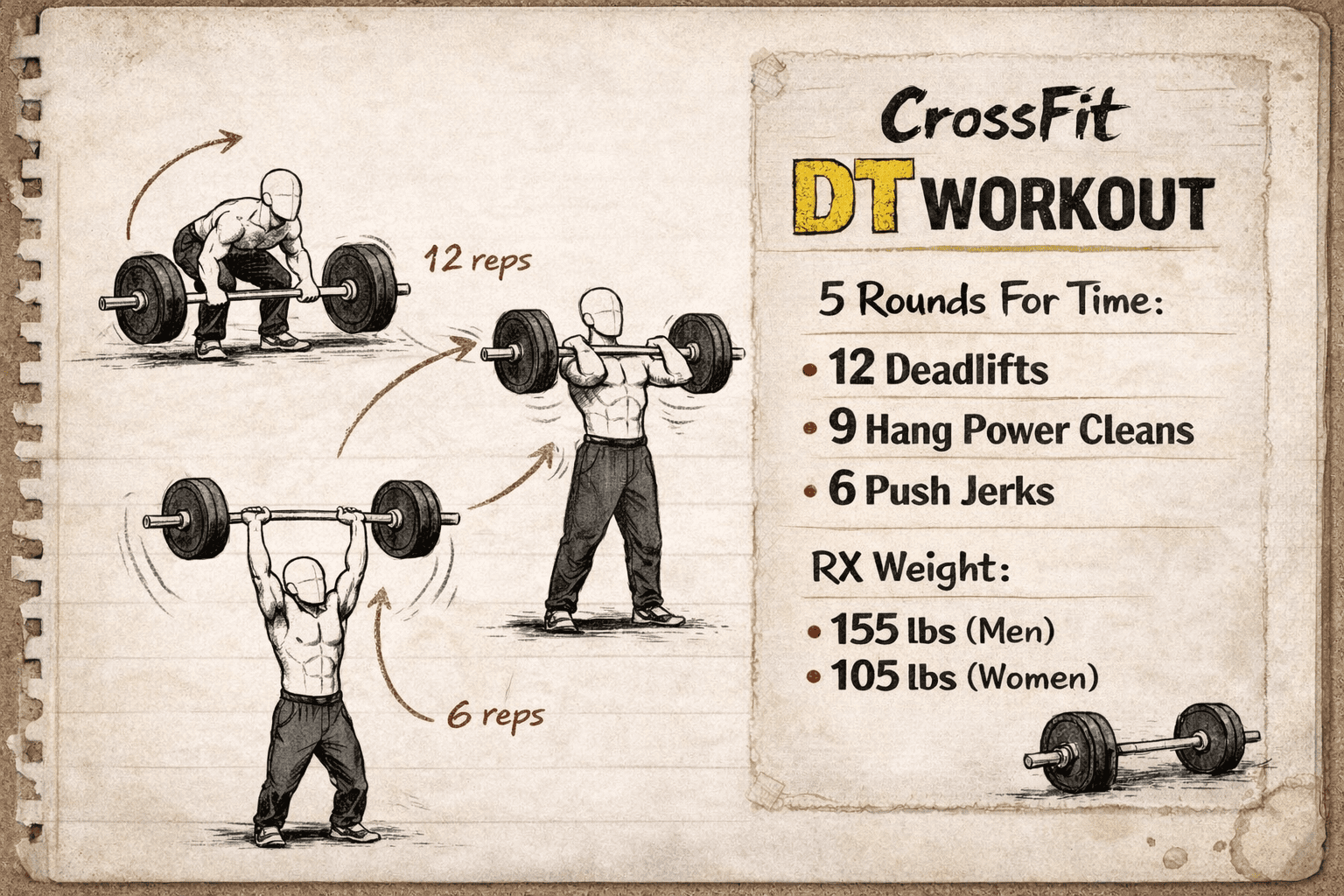
The CrossFit DT workout has ended more gym sessions than most athletes care to admit.
Named after Air Force Staff Sergeant Timothy P. Davis, this Hero WOD combines deadlifts, hang power cleans, and push jerks into five rounds that look manageable on paper but turn into a lung-burning, grip-shredding test of willpower. The weight feels light when you start, but by round three, that barbell might as well be loaded with plates made of concrete.
What makes DT especially brutal is how it targets everything at once. Your posterior chain, shoulders, and grip all get hammered while your cardiovascular system tries to keep up with the demand. Most athletes either go out too hot and crash hard, or pace so conservatively they leave performance on the table.
This guide breaks down exactly how to approach DT, from movement prep to pacing strategies to common mistakes that will wreck your time.
Table of Contents
What is the CrossFit DT Workout
DT is a Hero WOD that honors a fallen service member, and the programming reflects that tribute with intentional difficulty.
The workout consists of…
Five rounds for time of
- 12 deadlifts
- 9 hang power cleans
- 6 push jerks.
The prescribed weight is 155 pounds for men and 105 pounds for women.
Unlike some Hero WODs that involve multiple movements or long distance work, DT keeps you married to one barbell for the entire workout.
The beauty and brutality of DT come from its simplicity. Three barbell movements, one weight, five rounds. There’s nowhere to hide, no transitions to catch your breath, and no equipment changes to buy recovery time. You pick up the bar, and you work until all five rounds are complete.
The rep scheme creates a descending ladder within each round that forces you to manage fatigue across different energy systems. The deadlifts tax your posterior chain and grip. The hang power cleans demand power output while your heart rate climbs. The push jerks require shoulder stability and core strength when both are already compromised. Then you do it four more times.
Most athletes finish DT somewhere between 8 and 20 minutes depending on strength levels, barbell efficiency, and pacing decisions. Elite athletes can crack the sub-6 minute barrier, while those new to the workout or working with scaled weights might take longer. The goal is not to compare yourself to firebreathers on YouTube but to approach the workout with a strategy that matches your current capacity.
Equipment and Setup You Need
You need less equipment for DT than you might think, but what you do need matters.
The barbell and plates are non-negotiable.
Standard Olympic barbell loaded to 155/105 pounds or whatever scaled weight you’re using. If you’re working at a gym, grab your bar and plates early because this workout is popular and equipment disappears during busy hours. Bumper plates work best since you’ll be dropping the bar between rounds or during rest periods.
Chalk becomes your best friend during DT.
Your grip will fatigue faster than you expect, and sweaty hands on a barbell during hang cleans or jerks create inefficiency and injury risk. Keep chalk nearby and reapply between rounds if needed. Some athletes also use lifting straps for the deadlifts to preserve grip for the cleans and jerks, though this is a personal preference and not allowed in competition settings.
A good pair of flat-soled shoes or lifters helps with barbell work.
Running shoes compress under load and create instability during the deadlift and jerk. Metcons, lifting shoes, or even Converse work better for maintaining solid positions under the barbell. If you’re between shoe options, go with whatever keeps your foot stable and lets you drive through your whole foot during lifts.
A timer or clock visible from your workout area keeps you honest about rest periods and overall time. Mental math gets fuzzy when you’re deep in a hard workout, and knowing exactly how long you’ve been working helps with pacing decisions in later rounds.
Set up your space with enough room to safely drop the barbell if needed. DT can get ugly in the final rounds, and having clear space around you prevents accidents when form breaks down or you need to bail on a rep.
Movement Standards and Technique Breakdown
Understanding the movement standards before you start saves you from no-repped efforts and wasted energy.
Deadlift Standards **
The barbell starts on the ground. You pull until hips and knees reach full extension with shoulders behind the bar. The bar doesn’t need to pause at the top, but you must show control and full extension. At the bottom, the plates must touch the ground each rep. Touch-and-go reps are allowed and often preferred for maintaining rhythm, but full dead-stop reps are also acceptable if you need the micro-rest.
Your setup position determines how the entire round feels. Start with your feet hip-width apart, hands just outside your legs, chest up, and lats engaged. Most athletes rush their setup when fatigued and end up yanking the bar with a rounded back, which kills efficiency and increases injury risk. Even when you’re deep in the workout and your lungs are screaming, take the half-second to set your back before each pull.
Hang Power Clean Standards **
The bar starts from the hang position (standing, bar at hip level). You dip and drive the bar upward, receiving it in a partial squat with hips above parallel. The bar must reach the front rack position with elbows clearly in front of the bar. Stand to full hip and knee extension to complete the rep.
The transition from deadlift to hang clean is where most athletes waste energy. After your final deadlift, keep the bar in your hands and reset your grip for the cleans. Dropping the bar and re-gripping adds seconds and breaks your rhythm. Your hands might be screaming by round three, but staying connected to the bar between movements keeps you moving efficiently.
Push Jerk Standards **
The bar starts in the front rack position. You dip by bending the knees while keeping your torso vertical, then drive upward explosively while pressing the bar overhead. You receive the bar with knees bent in a partial squat, then stand to full extension with the bar locked out overhead. Arms must be fully extended with the bar over the middle of your body. Bring the bar back to your shoulders and repeat.
Hip drive makes or breaks your jerks, especially in later rounds when your shoulders are fried. The power comes from your legs, not your arms. If you’re pressing the bar overhead with arm strength alone, you’ll gas out fast. Use an aggressive dip and violent hip extension to launch the bar, then punch under it to lock out.
Scaling Options for Different Skill Levels
Not everyone needs to attack DT at the prescribed weight, and smart scaling lets you get the intended stimulus without compromising safety.
The standard scale drops the weight to 115 pounds for men and 75 pounds for women. This reduction maintains the barbell cycling challenge while making the workout accessible to athletes still building strength. If 115 or 75 still feels too heavy for maintaining good positions across all three movements, go lighter. The goal is to use a weight that challenges you but doesn’t force you into dangerous positions when fatigue sets in.
Another scaling option reduces the number of rounds. Instead of five rounds, complete three rounds for time. This cut maintains the rep scheme and weight while reducing overall volume, making it appropriate for athletes newer to high-volume barbell work or those coming back from injury. Three quality rounds beat five ugly rounds every single time.
For athletes still developing the hang power clean or push jerk, substitute movements keep you working. Swap hang power cleans for kettlebell swings at a challenging weight, or replace push jerks with dumbbell push presses. These substitutions change the workout significantly, but they let you work in a similar time domain and intensity without movements you haven’t yet mastered.
You can also scale by changing the loading scheme but keeping the movements. Use different weights for each movement rather than one barbell throughout. Deadlift at 155, clean at 95, jerk at 75. This approach lets you challenge your deadlift strength while keeping the technical movements at weights where you can maintain form. It’s not the original DT, but it’s a valid training option.
The worst scaling decision is keeping the prescribed weight when you’re not ready and then doing horrible reps that ingrain bad patterns. Scale appropriately, move well, and build toward the RX weight over time.
Warm-Up Protocol That Actually Prepares You
Jumping straight into DT is a recipe for injury and poor performance.
Start with 5 to 10 minutes of general warm-up that raises your heart rate and body temperature. Row, bike, jump rope, or run at an easy pace. The goal is not to pre-fatigue yourself but to get blood flowing and joints moving. Your warm-up should leave you slightly sweaty but not breathing hard.
After general movement, shift to specific mobility work that targets the positions you’ll need during DT. Focus on thoracic extension, hip flexion, ankle mobility, and shoulder flexion. Spend 2 to 3 minutes per area with movements like cat-cow stretches, deep squat holds, wrist stretches, and shoulder pass-throughs with a PVC pipe or band.
**
- Thoracic opener: Lie on a foam roller positioned along your spine, arms extended overhead. Let your upper back extend over the roller for 60 seconds.
- Hip flexor stretch: Half-kneeling position with the back knee on the ground, drive your hips forward and hold for 30 seconds each side.
- Ankle mobilization: Place your toes against a wall and drive your knee forward, holding the stretch at end range for 20 seconds each side.
- Shoulder pass-throughs: Hold a PVC pipe or band with a wide grip, raise it overhead and behind your back while keeping arms straight. Repeat 10 to 15 times, narrowing your grip as you warm up.
Next comes barbell-specific warm-up. Start with an empty bar and perform 5 reps of each movement (deadlift, hang power clean, push jerk). Focus on positions and rhythm, not speed. Add weight gradually, performing 3 to 5 reps at 50%, 70%, and 85% of your working weight. This progressive loading prepares your nervous system for the actual workout loads and lets you troubleshoot any position issues before the clock starts.
Finish your warm-up with a practice round. Complete one full round of DT at your working weight, moving at about 70% intensity. This dress rehearsal confirms that your setup, transitions, and pacing feel right. If something feels off during the practice round, address it before you start for real.
Total warm-up time should land between 15 and 25 minutes. That might seem long, but DT punishes unprepared bodies, and investing in a proper warm-up pays off in performance and injury prevention.
Pacing Strategy for the Five Rounds
The first round of DT feels easy, and that’s the trap.
Most athletes attack round one at 90% effort, feel great, then hit a wall in round two that they never recover from. The workout is short enough that you need to push, but not so short that you can redline from the start. Smart pacing means treating round one as your baseline, not your sprint.
Break your effort into three phases: controlled aggression for rounds one and two, survival mode for round three, and whatever you have left for rounds four and five. In the first two rounds, focus on smooth barbell cycling and controlled breathing. You should feel challenged but not desperate. Your deadlifts should be touch-and-go or very quick singles, your cleans should be rhythmic, and your jerks should feel powerful.
Round three is where DT gets real. Your grip starts to slip, your shoulders burn, and your lungs can’t quite keep up with the demand. This is the round that determines your final time. If you blow up here, rounds four and five become a suffer-fest of broken sets and long rest periods. Protect round three by managing your breathing and taking strategic micro-rests before you absolutely need them.
In rounds four and five, you’re playing damage control. Barbell cycling falls apart for most athletes, and sets get broken into smaller chunks. That’s fine. The goal is to keep moving and minimize time standing over the bar. If you need to break the deadlifts into sets of 6 and 6, do it. If the cleans become triples, make them quick triples with minimal rest between sets.
A conservative pacing approach for most athletes: Unbroken sets for round one, maybe one break in round two, planned breaks in round three, survival mode in rounds four and five. An aggressive approach for stronger athletes: Unbroken rounds one through three, break as needed in four and five. Find the approach that matches your capacity and stick to it.
One warning: Don’t rest with the bar in the front rack position. It seems like a good idea to hold the bar at your shoulders between jerks, but this crushes your breathing and fatigues your upper back unnecessarily. If you need a break during the jerks, complete your rep, bring the bar to your waist, and breathe there.
Rep Scheme Strategies and Breaking Up Sets
How you break up the reps within each round matters more than you think.
For the 12 deadlifts, most athletes should go touch-and-go or quick singles for as long as possible. Unbroken sets keep your heart rate from spiking too high too fast. If you must break the deadlifts, go 6-6 or 8-4 rather than smaller sets. Every time you step away from the bar and reset, you waste time and let your heart rate climb while you’re not working.
The exception is if your grip is completely cooked. In later rounds, quick singles with a breath between reps can save your hands for the cleans and jerks. You lose a few seconds on the deadlifts but gain it back by not failing cleans because your grip gave out.
The 9 hang power cleans are where strategy gets personal. Strong athletes with good barbell cycling can go unbroken for multiple rounds. Most athletes should plan to break these into sets before they’re forced to. Common splits include 5-4, 6-3, or 3-3-3. Breaking them proactively, before your grip fails or your form falls apart, keeps you moving efficiently.
If you’re breaking the cleans, do it at the hang position, not by dropping the bar. After your planned set, hold the bar at your waist, take two to three big breaths, then go again. Dropping the bar means you have to deadlift it again, which adds reps and wastes energy.
The 6 push jerks can be done unbroken in early rounds but often need breaks by round three. Sets of 4-2 or 3-3 work well for most athletes. The key is using your legs for every single rep. When you start pressing the bar overhead with your arms because you’re too tired to dip and drive, you’re done. Take a break, reset, and use your hips.
A sample breakdown for an intermediate athlete might look like this:
- Round 1: Deadlifts unbroken, cleans unbroken, jerks unbroken
- Round 2: Deadlifts unbroken, cleans 5-4, jerks unbroken
- Round 3: Deadlifts 8-4, cleans 5-4, jerks 4-2
- Round 4: Deadlifts 6-6, cleans 3-3-3, jerks 3-3
- Round 5: Deadlifts 6-6, cleans 3-3-3, jerks 2-2-2
This is just one example. Your actual breakdown depends on your strength, conditioning, and how you respond to fatigue. The important thing is having a plan before you start rather than making desperate decisions when your brain is oxygen-deprived in round three.
Breathing Techniques Under the Barbell
Breathing during DT determines whether you finish strong or fall apart.
The natural tendency is to hold your breath during lifts and then gasp for air between reps. This creates an oxygen debt that compounds over five rounds and leaves you lightheaded and inefficient. Instead, develop a breathing rhythm that matches your rep scheme.
During deadlifts, use a breath-per-rep pattern if you’re doing touch-and-go reps. Inhale at the top, brace your core, lower the bar, exhale as you stand. It feels rushed at first, but it keeps oxygen flowing and prevents the desperate gasping that ruins your next movement. If you’re doing dead-stop reps, take a full breath at the top, another breath in your setup position, then pull.
For hang power cleans, breathe at the hang position. Bar at your waist, take a full breath through your nose, brace, perform the clean, stand up, breathe out. Reset and repeat. If you’re doing unbroken sets, this breathing happens quickly. If you’re breaking sets, take two to three deliberate breaths at the hang position before starting your next set.
Push jerks require breathing discipline. Breathe at the top of each jerk while the bar is locked out overhead, not while the bar is in the front rack. Trying to breathe with the bar on your shoulders restricts your diaphragm and makes everything harder. Lock the bar out, take a breath, bring it down, perform your next rep.
Between rounds, resist the urge to collapse over the bar and pant like a dying animal. Stand up tall, put your hands on your head or behind your neck, and take deep belly breaths. This position opens your diaphragm and helps you recover faster than hunching over. Give yourself 10 to 20 seconds between rounds to reset your breathing, then get back on the bar.
If you feel lightheaded or see spots during the workout, that’s your sign that you’re not breathing enough. Drop the bar, stand up, and take several full breaths before continuing. Pushing through that feeling leads to passing out or collapsing, neither of which helps your time.
Common Mistakes That Destroy Your Time
Even experienced athletes make predictable errors during DT that cost them minutes.
Starting too fast is the number one mistake. Round one feels light, your ego takes over, and you try to set a record pace. By round three, you’re wrecked. Your first round should feel controlled and smooth, not heroic. If you finish round one and you’re already breathing hard, you went too fast.
Dropping the bar between movements wastes time and energy. After your last deadlift, keep the bar in your hands and reset your grip for the cleans. After your last clean, keep the bar in the front rack and go straight into jerks. Every time you drop the bar and pick it back up, you add seconds to your time and tax your grip unnecessarily.
Resting too long between rounds kills momentum. Yes, you need to breathe and recover between rounds, but 45 seconds of standing around staring at the bar is too much. Give yourself 10 to 20 seconds max, then get back to work. The longer you rest, the harder it is to start moving again.
Poor setup positions on the deadlift cause energy leaks. When you’re tired, you start yanking the bar off the ground with a rounded back and loose lats. This not only increases injury risk but also makes each rep harder than it needs to be. Even when you’re deep in the pain cave, take the extra second to set your back and engage your lats before each pull.
Pressing the jerks instead of using your legs is a death sentence for your shoulders. As fatigue sets in, athletes stop dipping and driving with their hips and start muscle-pressing the bar overhead. This burns out your deltoids in seconds. If you catch yourself doing this, stop, reset, and focus on an aggressive leg drive for the next rep.
Not using chalk when your hands get sweaty creates inefficiency and danger. Slippery hands mean weaker grips, which means more failed reps and wasted energy. Keep chalk nearby and use it liberally, especially before rounds three, four, and five.
Wearing the wrong shoes might seem minor, but it matters. Squishy running shoes compress under the barbell and make it harder to maintain stable positions. Flat-soled shoes or lifters give you a solid base and better power transfer.
Grip Management Throughout the Workout
Your grip will fail before your legs or lungs, guaranteed.
DT puts relentless demand on your hands and forearms. Twelve deadlifts load your grip, nine cleans require you to catch and control the bar, and six jerks demand stability in the front rack and overhead. Multiply that by five rounds, and you’re looking at 135 total reps where your grip is under tension.
The key is preserving your grip early so you have something left in later rounds. In round one, resist the temptation to death-grip the bar. Hold it firmly but not desperately. Over-gripping when you don’t need to fatigues your forearms faster and gives you nothing in return.
Chalk application strategy matters. Apply chalk before you start and again before rounds three and four. Don’t wait until your hands are so sweaty that the bar is slipping. Proactive chalking prevents grip failures that force you to break sets or drop the bar unexpectedly.
Some athletes use a hook grip for deadlifts and cleans to reduce grip fatigue. If you’re comfortable with hook grip, it can help, but if you’re not used to it, DT is not the day to experiment. Stick with the grip style you’ve trained with.
Another strategy is using lifting straps for the deadlifts to save your grip for cleans and jerks. This is a personal choice and not allowed in competition, but for training days when you want to push the pace or you’re dealing with hand injuries, straps let you focus on the other aspects of the workout. Just know that using straps changes the workout and removes some of the intended grip challenge.
Between rounds, shake out your hands and forearms. Let them hang loose at your sides and shake them vigorously for a few seconds. This flushes out metabolic waste and gives your grip a tiny recovery window before the next round.
If your grip does start to fail mid-round, don’t panic. Break your sets earlier, take quick breaks at the hang position during cleans, and focus on holding the bar with your fingers rather than trying to squeeze it in your palms. A lighter touch on the bar when you’re fatigued often works better than trying to white-knuckle your way through.
Mental Strategy for Pushing Through the Pain
DT is as much a mental fight as a physical one.
The workout is short enough that you can’t pace conservatively and long enough that you can’t just sprint through it. This creates a mental challenge where you’re constantly negotiating with yourself about how hard to push and when to rest.
One effective mental approach is to focus only on the current set, not the entire workout. Don’t think about the fact that you still have three rounds left. Think about the next six jerks. Finish those, then think about the next set of cleans. Breaking the workout into tiny chunks keeps you from drowning in the overall volume.
Another strategy is using countdowns instead of count-ups. Instead of thinking “I’ve done two rounds,” think “I have three rounds left.” For some athletes, this creates urgency and motivation. For others, it’s demoralizing. Know which mental frame works for you and use it.
When the pain gets intense and your brain starts screaming to stop, separate sensation from danger. Burning lungs, aching muscles, and a pounding heart are uncomfortable but not dangerous. Your body can handle more than your brain wants to believe in those moments. The discomfort is temporary, and it ends the moment you finish your last rep.
Use simple mantras or focus cues to override negative thoughts. “Stay on the bar,” “One more rep,” “Breathe and move,” whatever phrase keeps you focused on the task rather than the suffering. When your internal dialogue turns into complaints and excuses, interrupt it with your chosen phrase and get back to work.
Visual cues help some athletes push through tough moments. Put a piece of tape on the wall or floor that you look at during rest periods. Use it as an anchor point to reset your focus before picking up the bar again. This tiny ritual can interrupt the spiral of negative thoughts and get you moving.
Remember why you’re doing this. DT is a Hero WOD honoring someone who made the ultimate sacrifice. When you want to quit or take an extra-long rest, think about that. Your discomfort is temporary and voluntary. Finishing strong is a way to pay respect.
Post-Workout Recovery and Cool-Down
What you do after you finish DT affects how you feel for the next several days.
Immediately after your last rep, resist the urge to collapse on the floor. Walk around for 3 to 5 minutes at an easy pace. This active recovery helps clear lactate from your muscles and prevents blood from pooling in your legs, which can make you dizzy or nauseous. Keep moving even though everything in you wants to lie down.
Once your heart rate starts to come down, shift to static stretching. Focus on the muscle groups that just got hammered: hamstrings, glutes, quads, shoulders, lats, and forearms. Hold each stretch for 30 to 60 seconds, breathing deeply and letting your body relax into the stretch.
- Hamstring stretch: Sit on the ground with one leg extended, reach for your toes, hold for 60 seconds each side.
- Quad stretch: Standing or lying on your side, pull your heel toward your glutes, hold for 45 seconds each side.
- Shoulder stretch: Pull one arm across your body at chest height, hold for 45 seconds each side.
- Lat stretch: Hang from a pull-up bar or grab something overhead and let your lats lengthen for 30 to 60 seconds.
- Forearm stretch: Extend one arm in front of you, palm up, use your other hand to gently pull your fingers back, hold for 30 seconds each side.
Hydration and nutrition matter within the first 30 minutes after finishing. You just depleted glycogen stores and created muscle damage. Drink water or an electrolyte beverage to start rehydration. Eat something with protein and carbohydrates within an hour to support recovery. A protein shake with a banana works. So does a chicken sandwich or Greek yogurt with fruit.
Consider contrast therapy if you have access to it. Alternating between cold and hot water (or ice bath followed by hot shower) can reduce muscle soreness and speed recovery. Three minutes cold, three minutes hot, repeat three times, ending on cold. This isn’t mandatory, but many athletes find it helps them bounce back faster.
Foam rolling or using a massage gun on your quads, hamstrings, glutes, and upper back can reduce next-day soreness. Spend 1 to 2 minutes per muscle group, moving slowly and pausing on particularly tight or tender spots. This myofascial release helps break up adhesions and improve blood flow to recovering muscles.
Sleep is your most powerful recovery tool. DT creates significant systemic fatigue, and your body needs quality sleep to repair and adapt. Aim for 8 hours the night after completing the workout. If you’re someone who struggles with sleep after intense evening workouts, consider doing DT earlier in the day.
Benchmark Times and What They Mean
Understanding where your time falls helps you set realistic goals and track progress.
Elite CrossFit athletes complete RX DT in under 6 minutes. These are Games-level competitors with exceptional strength, conditioning, and barbell efficiency. If you’re hitting times in this range, you’re operating at a very high level.
Advanced athletes typically finish between 6 and 10 minutes. This range represents strong recreational CrossFitters who have trained the movements extensively and can maintain good barbell cycling under fatigue. Breaking into this range requires both strength and conditioning development.
Intermediate athletes usually land between 10 and 15 minutes. This is a solid showing for someone who’s been training CrossFit for a year or more. You’re moving well, managing the weight, but still breaking sets and taking strategic rests to finish.
Beginner athletes or those using scaled weights often finish between 15 and 25 minutes. There’s zero shame in this range. You’re doing the work, building capacity, and creating the foundation for future improvements. Every minute you shave off your time in future attempts represents real progress.
Your first time doing DT gives you a baseline, not a judgment. The workout exposes weaknesses in strength, conditioning, grip, and mental toughness. Whatever your time is, you now have data. The next time you attempt it (which should be at least several weeks later), you’ll know where you struggled and can adjust your strategy accordingly.
DT is a workout worth repeating every few months to track progress. Unlike some benchmark workouts that you might do monthly, DT’s volume and intensity make it better suited for quarterly testing. This spacing gives you time to build strength and conditioning between attempts while keeping it frequent enough to see meaningful improvements.
When you log your time, also note your scaling choices, rest periods, and where you struggled. “12:45 RX, broke cleans every round after round 2, grip failed in round 4” gives you much more useful information than just “12:45.” These details inform your training focus before your next attempt.
Training to Improve Your DT Performance
Getting better at DT requires targeted work outside of doing the workout itself.
Barbell cycling efficiency makes a massive difference in your time. Practice touch-and-go deadlifts at moderate weights for sets of 15 to 20 reps. Work on smooth transitions between reps without resetting completely between each pull. This builds the rhythm and grip endurance needed for DT’s deadlifts.
Develop your hang power clean under fatigue. After a conditioning piece or at the end of a training session, perform EMOM (every minute on the minute) work with hang power cleans. Example: 3 hang power cleans every minute for 10 minutes at 70% of your working weight. This teaches your body to execute the movement when you’re tired and breathing hard, which is exactly what DT demands.
Build pushing strength and stamina with jerk accessory work. Push press in sets of 8 to 10 reps, focusing on using your legs to drive the bar. Strict press to build shoulder strength. Split jerks to practice getting under the bar efficiently. All of these contribute to better jerks when you’re deep in a DT round.
Train your grip with targeted exercises. Farmer’s carries with heavy kettlebells or dumbbells, dead hangs from a pull-up bar, and barbell holds all build grip strength and endurance. Spending 5 to 10 minutes twice a week on grip work pays off significantly in workouts like DT.
Conditioning work that mimics the DT stimulus helps prepare your energy systems. Workouts that combine strength movements with minimal rest create similar metabolic demands. Examples include barbell complexes, chipper-style workouts, or interval work that alternates between heavy barbell movements and short rest periods.
Don’t neglect posterior chain strength. Romanian deadlifts, good mornings, glute-ham raises, and heavy kettlebell swings all build the hamstrings, glutes, and lower back strength needed to handle DT’s volume. A stronger posterior chain means less fatigue accumulation during the deadlifts and better power output on cleans and jerks.
Practice the full workout at reduced volume or weight every 4 to 6 weeks. Instead of five rounds RX, do three rounds at RX weight or five rounds at 85% of RX weight. This builds familiarity with the movements and pacing without the full recovery cost of a max-effort attempt.
Variations and Related Workouts to Try
Once you’ve conquered DT, several variations and similar workouts can challenge you in new ways.
Reverse DT flips the rep scheme: 6 deadlifts, 9 hang power cleans, 12 push jerks for five rounds. This variation shifts the emphasis to the jerks and changes how fatigue accumulates across the round. The lower deadlift volume preserves your grip slightly better, but the higher jerk volume destroys your shoulders.
DT 2.0 increases the loading: Same rep scheme and rounds as regular DT but at 185 pounds for men and 125 pounds for women. This variation is for advanced athletes looking for a new challenge. The heavier weight makes barbell cycling much harder and turns the workout into more of a strength test.
Mini DT reduces the volume to three rounds instead of five. This is great for newer athletes or as a finisher after a heavy lifting session. You get the DT experience without the full crushing volume.
DT with a vest adds a conditioning element. Perform regular DT while wearing a 20-pound or 14-pound weight vest. The extra load doesn’t affect the barbell movements much but makes breathing harder and increases the overall metabolic demand.
Other Hero WODs with similar demands include:
- Griff: Five rounds of 10 back squats (185/125 lbs) and 10 bar-facing burpees. Similar rep scheme structure but different movement demands.
- Nutts: 10 rounds of 10 deadlifts (185/125 lbs), 15 push-ups, and 15 box jumps. Higher volume, lighter deadlifts, different movement mix.
- White: Five rounds of 10 deadlifts (275/185 lbs), 15 push-ups, 15 box jumps, and a 400-meter run. Heavier deadlifts with more mixed modality work.
These variations and related workouts let you test similar energy systems and movement patterns while keeping your training fresh. Rotating between different Hero WODs every few months builds well-rounded capacity and prevents overuse injuries from repeating the exact same workout too frequently.
Safety Considerations and Injury Prevention
DT’s combination of volume and intensity creates injury risk if you’re not careful.
The most common injury site is the lower back. Fatigue causes form breakdown on deadlifts, and when you start yanking reps with a rounded spine, you’re asking for trouble. If you feel your back rounding excessively, break your sets smaller, take longer rests, or drop the weight. No time is worth a back injury that sidelines you for months.
Shoulder issues can develop from poor jerk mechanics or overuse. Make sure you’re using your legs to drive the bar overhead rather than pressing with your shoulders. If you feel sharp pain (not just burning fatigue) in your shoulders during jerks, stop the workout. Dull aches and burning are normal. Sharp, stabbing pain is your body telling you something is wrong.
Wrist pain during front rack positions signals poor rack mechanics or mobility limitations. Work on your wrist and thoracic mobility outside of the workout. During DT, if your wrists are screaming in the front rack, adjust your grip width or consider using a looser grip where only your fingertips are under the bar.
Dropping the bar from overhead is sometimes necessary, but do it safely. If you’re going to bail on a jerk, push the bar forward and step back rather than trying to control it down. Make sure your workout area is clear of other people and equipment. Bumper plates on rubber floors are designed for this. Dropping metal plates on concrete is not.
Listen to your body between rounds. If you feel dizzy, see spots, or feel like you might pass out, stop immediately. Stand up, breathe deeply, and give yourself time to recover. Pushing through legitimate warning signs leads to passing out and hitting your head, which is far worse than a slower workout time.
Know when to scale or modify mid-workout. If you start a workout at RX weight and realize by round two that you’re not ready, it’s smarter to drop the weight than to keep grinding through terrible reps. Your ego might take a hit, but your body will thank you.
Post-workout soreness is normal. Pain that persists for more than a few days or gets worse instead of better needs professional attention. See a physical therapist, chiropractor, or sports medicine doctor if you develop ongoing pain after attempting DT.
DT is designed to honor a hero, and the best way to honor someone is to approach the challenge with respect, intelligence, and the wisdom to know the difference between discomfort and danger.
Frequently Asked Questions
How often should I do the DT workout? No more than once every 4 to 8 weeks. DT creates significant muscular damage and central nervous system fatigue. Doing it more frequently prevents full recovery and increases injury risk while providing minimal additional benefit. Use it as a quarterly benchmark to assess progress.
What if I can’t do hang power cleans yet? Scale to kettlebell swings at a challenging weight or practice hang cleans with a PVC pipe or empty bar. You can also do power cleans from the floor instead of the hang position, though this changes the workout slightly by adding more leg and back work.
Should I use a belt for DT? That’s a personal choice. A belt can provide additional core support during deadlifts and cleans, especially in later rounds when fatigue compromises your bracing. Some athletes find it restricts breathing during the high-intensity portions. Try it both ways in training and see what works better for you.
Can I do DT if I have a previous back injury? Consult with a medical professional or physical therapist before attempting DT if you have a history of back issues. The high-volume deadlifts under fatigue create risk for people with compromised back health. There’s no shame in choosing a different workout that doesn’t put you at risk.
What’s a good beginner time for DT? If you’re completing the workout at scaled weight with good form, anything under 20 minutes is solid for your first attempt. Focus on movement quality and finishing the workout rather than chasing a specific time on your first go.
Is it better to do DT unbroken or break up the sets? For most athletes, strategic breaks lead to better overall times than trying to go unbroken and failing mid-set. Plan your breaks, keep them short, and execute consistently. Elite athletes can go unbroken for multiple rounds, but that’s not the reality for most people.
What should I eat before attempting DT? Eat a normal meal 2 to 3 hours before the workout with a balance of protein and carbohydrates. Avoid trying new foods or eating a huge meal right before. Some athletes benefit from a small snack (banana, energy bar) 30 to 45 minutes before starting. Stay hydrated throughout the day leading up to the workout.
Why is DT so much harder than it looks on paper? The combination of moderate weight, high reps, and minimal rest creates a perfect storm of muscular fatigue, cardiovascular demand, and grip failure. Each movement taxes different systems, and the cumulative fatigue across five rounds is brutal. The only way to truly understand DT is to experience it.
The first time you attempt DT, you’ll understand why it’s considered one of the toughest CrossFit benchmarks. The second time, you’ll be smarter about pacing and strategy. By your third or fourth attempt, you’ll have the experience and capacity to really push your limits.
Your time doesn’t define your effort or your worth as an athlete. Finishing DT at any weight, at any time, with good form and maximum effort is an accomplishment. You showed up, you suffered through it, and you honored the memory of a fallen hero by pushing yourself to your limit. That’s what matters.